Woman Accused of Using Software Company’s Name for Recruitment, Visas and Mumbai Office Must Face Trial: Delhi High Court

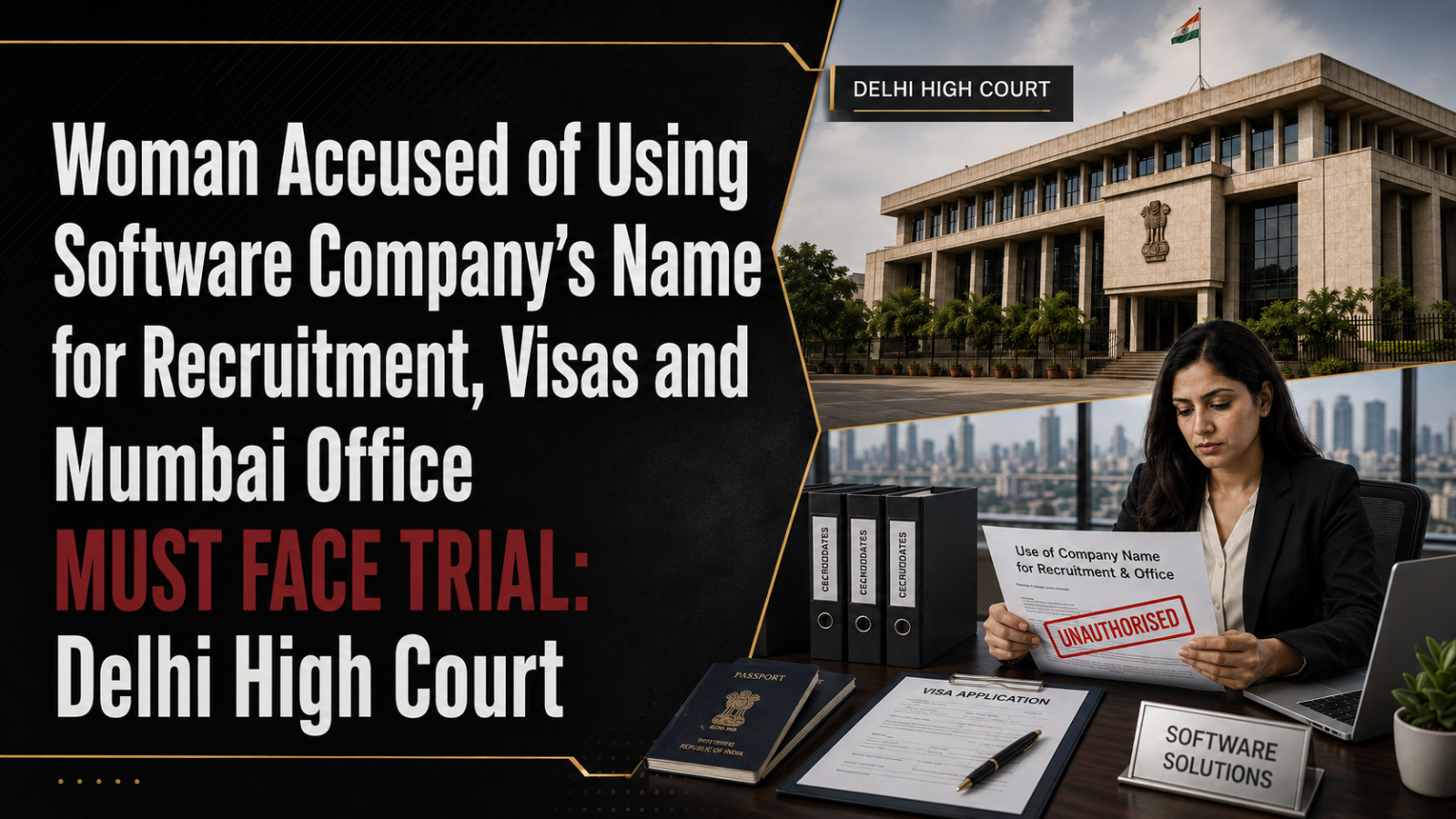
Alleged Forging of Company Letterheads and Appointment Letters Discloses Prima Facie Criminal Case: Delhi High Court
Facts
Respondent No. 2 was a company engaged in software development and bug fixing. In 2011, Venessa Beumont and a co-accused placed orders with the company for software-development and bug-fixing work. According to the company, the assigned work was completed and the agreed consideration was paid.
The company alleged that it had no continuing association, tie-up, joint venture or other arrangement authorising the petitioner and the co-accused to act on its behalf.
On June 8, 2012, the company allegedly discovered that the accused were forging and fabricating its letterheads and documents while falsely representing themselves as its executives or authorised representatives.
The complaint contained allegations that the accused:
- Issued appointment letters in the company’s name.
- Recruited employees by representing that they were acting for the company.
- Facilitated work visas and statutory formalities using the company’s documents.
- Issued authority letters in the company’s name.
- Rented premises at Oberoi Garden, Kandivali, Mumbai, in the company’s name.
- Displayed the company’s signboard at those premises.
- Operated the location as an office of the complainant company without authority.
The company sent emails on June 8, 2012, directing the petitioner to stop the alleged activities. It also submitted a police complaint at Fatehpur Beri Police Station on January 19, 2013. When no police action followed, the company instituted a private criminal complaint.
At the pre-summoning stage, the company examined its authorised representative and produced documents including:
- The board resolution authorising the complaint.
- Email correspondence.
- The disputed authority letter.
- Appointment letters.
- Work-visa documents.
- The complaint made to the police.
On August 1, 2014, the Metropolitan Magistrate found that a prima facie case existed and summoned Venessa Beumont and her co-accused under Sections 419, 420, 468 and 471 read with Section 34 of the Indian Penal Code, 1860.
The petitioner approached the Delhi High Court under Section 482 of the Code of Criminal Procedure, 1973, seeking quashing of the complaint and the summoning order.
Issues
- Whether the complaint and pre-summoning evidence disclosed a prima facie case of cheating, impersonation, forgery and use of forged documents.
- Whether the Metropolitan Magistrate applied her mind before issuing summons.
- Whether the alleged commercial relationship authorised the petitioner to use the company’s name, letterheads and documents.
- Whether the petitioner’s defence documents were sufficiently undisputed and conclusive to justify quashing.
- Whether the complaint was a retaliatory action arising from the petitioner’s dispute with another individual.
- Whether disputed questions concerning authority, business arrangements and authenticity of documents could be decided under Section 482.
- Whether continuation of the criminal proceedings amounted to an abuse of the judicial process.
Petitioner’s Arguments
The petitioner argued that the complaint was founded on the incorrect premise that no association or business relationship existed between the concerned entities.
She relied on documents which, according to her, showed a commercial relationship and understanding between the parties. She maintained that the activities mentioned in the complaint were undertaken under that arrangement.
The petitioner contended that none of the documents relied upon by the company established that she had:
- Forged any document.
- Impersonated a company representative.
- Used its letterheads without authority.
- Obtained any wrongful gain.
- Caused any wrongful loss to the company.
According to her, the allegations regarding appointment letters, employee recruitment, misuse of letterheads and work visas were unsupported by contemporaneous documents.
She further argued that the Magistrate’s observation about wrongful gain and wrongful loss was not supported by the complaint or evidence.
The petitioner claimed that the complaint arose from her separate dispute with Mahesh Chand Nagar. She had previously initiated proceedings before the Economic Offences Wing against him, and the present complaint was allegedly filed as a counterblast to pressure her.
Relying on Pepsi Foods Ltd. v. Special Judicial Magistrate and Suresh Kumar Goyal v. State of Uttar Pradesh, she argued that summoning an accused is a serious matter and that the Magistrate had failed to adequately scrutinise the allegations.
Respondent’s Arguments
The State supported the summoning order and argued that the complaint and supporting documents disclosed a prima facie case.
Respondent No. 2 maintained that its dispute with Mahesh Chand Nagar was independent of the present allegations. Even if such a dispute existed, it did not authorise the petitioner to use the company’s identity or documents.
The company argued that the petitioner and the co-accused represented themselves as being associated with it, issued documents in its name and conducted activities on its behalf without authority.
According to the company, the alleged acts exposed it to:
- Financial consequences.
- Legal claims by recruited persons.
- Possible taxation liabilities.
- Reputational damage.
The respondents submitted that the Magistrate had considered the complaint, oral testimony and documents before issuing process. At the summoning stage, the Court was required only to determine whether a prima facie case existed—not whether conviction was certain.
They contended that the petitioner’s claimed commercial authorisation was a disputed defence which could be established only through evidence at trial.
Analysis of the Law
Scope of Section 482
The High Court’s inherent jurisdiction under Section 482 is exercised to:
- Prevent abuse of the court’s process.
- Give effect to an order under the Code.
- Secure the ends of justice.
Quashing criminal proceedings at the threshold is an exceptional remedy. It may be appropriate where the complaint, even if accepted entirely, fails to disclose an offence or where unimpeachable material completely disproves the allegations.
The High Court does not ordinarily conduct a trial within quashing proceedings.
Standard at the summoning stage
Summoning an accused is a serious judicial act. The Magistrate must consider:
- The nature of the allegations.
- The complainant’s preliminary evidence.
- Supporting documents.
- Whether the alleged facts prima facie satisfy the ingredients of an offence.
The Magistrate need not write an elaborate judgment or conclusively determine every ingredient. A reasoned prima facie satisfaction based on the available material is sufficient.
Consideration of defence material
The High Court may consider defence documents before trial only in exceptional circumstances. Such material must be:
- Sound and reasonable.
- Of sterling and impeccable quality.
- Undisputed or incapable of legitimate dispute.
- Sufficient to completely displace the complaint’s factual foundation.
If the complainant contests the defence material or its effect depends upon interpretation, cross-examination or comparison with other evidence, the issue must be decided at trial.
Disputed commercial authority
The petitioner claimed that a business relationship permitted her actions, while the company denied giving any authority.
Determining whether the relationship existed and what authority it conferred would require examination of:
- Correspondence between the parties.
- Contractual arrangements.
- Authenticity and context of the documents.
- Oral testimony concerning the parties’ understanding.
- Whether the authority extended to recruitment, visas and establishing an office.
These matters could not be conclusively resolved under Section 482.
Retaliatory complaint
A complaint is not liable to be quashed merely because the accused alleges that it was filed in retaliation for another dispute.
Where the complaint independently contains specific allegations satisfying the ingredients of criminal offences, the alleged motive behind filing it is a matter for trial.
Precedent Analysis
Pepsi Foods Ltd. v. Special Judicial Magistrate, (1998) 5 SCC 749
The Supreme Court held that summoning an accused is a serious matter and criminal law cannot be set in motion mechanically.
The Magistrate must apply judicial mind to the allegations and supporting oral and documentary evidence before deciding whether an offence is prima facie disclosed.
The Delhi High Court found that this requirement was met because the Magistrate had considered the complaint, the authorised representative’s deposition and the supporting documents.
Suresh Kumar Goyal v. State of Uttar Pradesh, (2019) 14 SCC 318
This decision explains when defence material may be considered in a petition seeking quashing before trial.
Such material must be of sterling and unimpeachable quality and must completely rule out the allegations. It must also be undisputed or incapable of legitimate refutation. Continuation of proceedings must clearly amount to an abuse of process.
The petitioner’s documents did not satisfy this test because their meaning, authenticity and legal effect were contested.
Rajiv Thapar v. Madan Lal Kapoor
The Supreme Court formulated a four-step test for considering defence material at the quashing stage:
- Whether the accused’s material is sound, reasonable and unimpeachable.
- Whether it completely rules out the complaint’s assertions.
- Whether the complainant has not and cannot legitimately refute it.
- Whether continuing the trial would abuse the judicial process and defeat justice.
Only when all conditions are satisfied should proceedings ordinarily be quashed on the strength of defence material.
The Court found that these requirements were not fulfilled.
Court’s Reasoning
The complaint contained specific allegations rather than general accusations. It identified the company’s name and documents allegedly used, the recruitment activities, visa formalities and the Mumbai premises allegedly operated as its office.
The company also alleged potential financial, legal and reputational consequences resulting from those acts.
At the pre-summoning stage, the authorised representative repeated the allegations on oath and produced supporting material, including emails, authority letters, appointment letters and visa documents.
The Magistrate therefore had both oral and documentary evidence before issuing the summons.
The High Court rejected the argument that the summoning order was mechanical. The order recorded consideration of the complaint, testimony and documents and expressed a prima facie conclusion that the accused had misrepresented their association with the company and used its letterheads.
The petitioner’s claim that a commercial relationship authorised her conduct raised disputed questions. The company denied that any association or authority existed.
Accepting the petitioner’s argument would require the High Court to assess the evidentiary value of competing documents and determine the precise scope of the alleged commercial relationship. That exercise belonged to the trial court.
The defence documents did not conclusively disprove the allegations or meet the standard of sterling and unimpeachable material.
The claim that the complaint was retaliatory also did not justify quashing. Even if there was a separate dispute involving Mahesh Chand Nagar, the allegations in the present complaint independently disclosed cognisable offences.
The Court clarified that its decision did not establish the petitioner’s guilt. It only meant that the allegations and preliminary evidence were sufficient for the case to proceed to trial.
Conclusion
The Delhi High Court held that the complaint, the authorised representative’s testimony and the supporting documents disclosed sufficient material for the Magistrate to form a prima facie opinion.
Whether the petitioner had a commercial relationship authorising her to use the company’s name and documents was a disputed factual issue requiring evidence at trial.
The Magistrate had applied her mind and had not issued summons mechanically. The petitioner’s defence material did not conclusively disprove the allegations, nor did continuation of the case amount to an abuse of process.
The petition seeking quashing was dismissed, the interim orders were vacated, and the criminal complaint and summoning order were allowed to continue.
Case Details
Case: Venessa Beumont v. State and Others
Court: High Court of Delhi at New Delhi
Case Number: Criminal Miscellaneous Case 4493/2014 with Criminal Miscellaneous Application 15409/2014
Judge: Justice Madhu Jain
Date: July 17, 2026
Result: Quashing petition dismissed; summoning order for offences under Sections 419, 420, 468 and 471 read with Section 34 of the Indian Penal Code upheld; interim orders vacated.