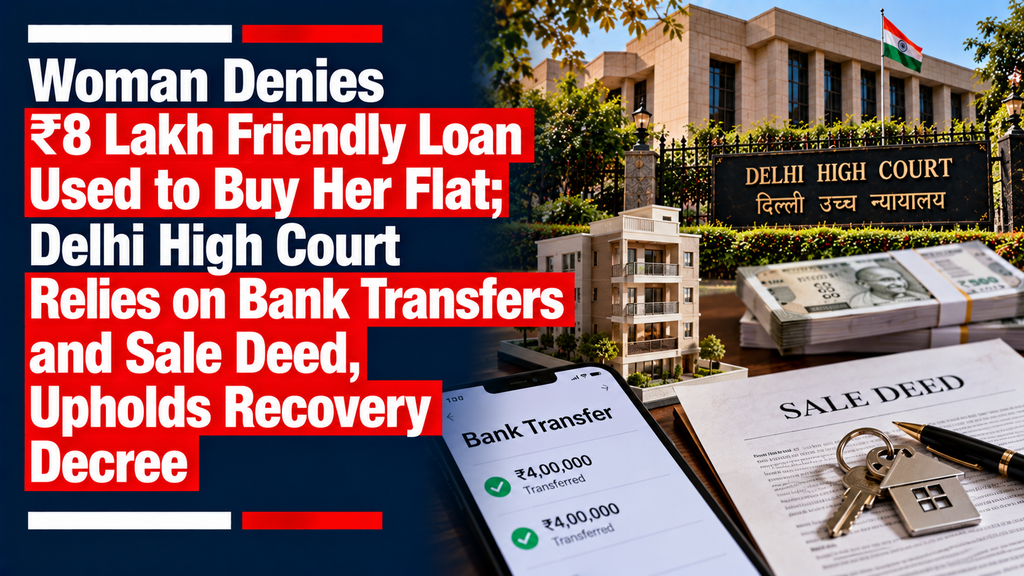
Woman Denies ₹8 Lakh Friendly Loan Used to Buy Her Flat; Delhi High Court Relies on Bank Transfers and Sale Deed, Upholds Recovery Decree

Borrower Challenges Ex Parte ₹8 Lakh Recovery Decree Citing COVID Disruption; Delhi High Court Says Documentary Evidence Proved Loan and Later ₹9.5 Lakh Settlement Cannot Be Reneged From
Facts
The Respondent/Plaintiff, Gulab Devi Prasad Singh, knew the Appellant/Defendant Pooja Singh through her husband, Sushil Kumar, with whom he had worked. According to the Plaintiff, the Defendant and her husband approached him in September 2017 after finalising the purchase of a third-floor flat for ₹18 lakh and sought a friendly loan because they were short of ₹7 lakh.
Instead of handing the amount directly to the Defendant, the Plaintiff made payments to the builder. Between 5 October 2017 and 7 February 2018, an aggregate amount of ₹7 lakh was transferred through his HDFC and ICICI Bank accounts towards the builder’s account.
The Plaintiff further asserted that after subsequent difficulties involving the Defendant’s brother and seizure of a Hyundai Verna car by Kota Police, the Defendant sought an additional ₹1 lakh so that the amount already paid towards the flat would not be forfeited. This further amount was transferred in three tranches in January 2019.
The Plaintiff claimed that the Defendant promised to repay the entire ₹8 lakh by 31 March 2019 but failed to do so. A legal notice demanding repayment was issued in June 2020, after which the Plaintiff instituted a recovery suit for ₹8 lakh with interest.
The Defendant denied the alleged friendly loan. She claimed that the suit was fabricated, that the Plaintiff had merely acted as an intermediary, and that the Plaintiff himself had borrowed ₹3 lakh from her husband. She also raised non-joinder and other objections.
The Defendant was proceeded ex parte on 11 February 2022. Her application seeking recall of the ex parte order was dismissed on 31 October 2022. She did not cross-examine the Plaintiff and did not lead evidence in support of the defence pleaded in her Written Statement.
By judgment dated 8 April 2024, the District Judge decreed the suit for ₹8 lakh with interest at 5% per annum from the date of institution of the suit, 26 August 2020, until realisation, together with costs.
The Defendant challenged the decree before the Delhi High Court under Section 96 CPC. During execution proceedings, however, the parties subsequently settled the decretal liability at ₹9.50 lakh. The Appellant paid ₹1.98 lakh and later deposited the remaining ₹7.52 lakh before the High Court.
Issues
Whether the Plaintiff had proved that the aggregate payment of ₹8 lakh constituted a friendly loan advanced to the Defendant.
Whether the bank transfers made directly to the builder were sufficiently connected with the Defendant’s purchase of the third-floor flat.
Whether the Defendant’s failure to cross-examine the Plaintiff or lead evidence justified acceptance of the Plaintiff’s unrebutted documentary and oral evidence.
Whether the ex parte proceedings and refusal to recall the ex parte order were vitiated because of COVID-19 disruption and the Supreme Court’s suo motu extension of limitation.
Whether the Defendant could continue to challenge the decree after entering into and partly acting upon a settlement of ₹9.50 lakh during execution proceedings.
Appellant’s Arguments
The Appellant argued that the Trial Court failed to account for the extraordinary disruption caused by the COVID-19 pandemic, during which court functioning was affected and litigants and lawyers faced difficulty in tracking proceedings.
She contended that her application seeking setting aside of the ex parte order had been wrongly dismissed as time-barred without properly applying the Supreme Court’s suo motu orders excluding the COVID period for limitation purposes.
On merits, she argued that there was no material proving that the payments made by the Plaintiff directly to the builder represented a loan advanced to her. According to her, the Plaintiff might merely have acted as an intermediary.
The Appellant also relied upon alleged inconsistencies concerning the Hyundai Verna car and questioned the Plaintiff’s knowledge of the property transaction and the stated sale consideration.
She contended that greater scrutiny was required before an ex parte recovery decree could be passed merely on the basis of the Plaintiff’s version.
Respondent’s Arguments
The Respondent submitted that the Appellant’s ex parte status resulted from her own lack of diligence and that she had failed to challenge the dismissal of her recall application for approximately one and a half years.
He argued that the bank statements conclusively established transfer of the money and that the Sale Deed for the flat independently corroborated the purpose of those transfers because it recorded substantially the same payment amounts and transaction/reference numbers.
The Respondent further relied upon the fact that the Appellant neither cross-examined him nor entered the witness box to prove her own defence.
He also pointed out that during execution proceedings the parties had settled the liability at ₹9.50 lakh, the settlement had been partly performed, attachment had been withdrawn and the Appellant had subsequently deposited the balance amount. She could therefore not resile from the settlement.
Analysis of the Law
The High Court examined the appeal as a first appeal under Section 96 CPC and independently considered whether the Trial Court’s decree was supported by the evidence on record.
The Court recognised that even where a defendant is proceeded ex parte, the plaintiff does not obtain an automatic decree. The Court remains required to scrutinise the evidence and determine whether the claim has been proved.
Here, the Plaintiff’s case was supported by contemporaneous bank statements showing the transfers. More importantly, the registered Sale Deed dated 31 January 2019 executed in favour of the Defendant recorded the same or substantially corresponding payments and transaction/reference numbers as part of the consideration for the flat.
The Sale Deed therefore supplied an independent documentary link between the Plaintiff’s transfers and the Defendant’s property purchase. It also contradicted the Defendant’s Written Statement denial that she or her husband had entered into a transaction with the builder for the flat.
The additional ₹1 lakh was likewise reflected in the Plaintiff’s ICICI Bank statement. His testimony explaining why that further amount was advanced remained unchallenged in cross-examination.
A defence pleaded in a Written Statement does not prove itself. The Defendant’s allegation that the Plaintiff had instead borrowed ₹3 lakh from her husband remained unsupported because she led no evidence whatsoever. Even if such a transaction existed, the Court observed that it would constitute an independent claim which the husband could pursue separately.
On the procedural objection arising from COVID-19, the Court considered not merely the initial period of disruption but the Appellant’s subsequent conduct. After her application was dismissed on 31 October 2022, she took no steps to challenge that order for about one and a half years. COVID disruption therefore could not explain the prolonged later inaction.
The subsequent settlement was independently significant. Once parties settled the execution proceedings, acted upon the settlement and obtained consequential relief such as withdrawal of attachment, a party could not thereafter renege from the settlement and revive the monetary controversy.
Precedent Analysis
The Appellant relied upon the Supreme Court’s suo motu proceedings concerning extension of limitation during the COVID-19 pandemic, under which specified periods were excluded and additional time was made available for proceedings affected by the pandemic.
The High Court did not dispute the existence of the COVID limitation protection. Instead, it held that the Appellant’s later conduct was decisive: even after dismissal of her application on 31 October 2022, she allowed approximately one and a half years to pass before seeking further recall in March 2024.
The case therefore turned primarily on the evidentiary record, the Appellant’s lack of diligence after the COVID period, and the binding effect of the subsequent settlement rather than on any rejection of the Supreme Court’s COVID limitation directions.
Court’s Reasoning
The High Court found that the transfer of ₹7 lakh was established through the Plaintiff’s HDFC and ICICI Bank statements. The purpose of the payments was independently corroborated by the registered Sale Deed in the Defendant’s favour, which reproduced the same amounts and substantially the same transaction/reference numbers.
The Plaintiff was also shown as a witness to the Sale Deed. The documentary record therefore corroborated his testimony that the payments had been made towards purchase of the Defendant’s property.
The Defendant’s categorical denial that she or her husband had entered into a transaction with the builder was itself contradicted by the registered Sale Deed standing in her name.
The further ₹1 lakh was established through three bank transfers. The Plaintiff’s oral explanation for the additional advance was supported by contemporaneous documentary evidence and remained unrebutted.
The Court therefore held that the Plaintiff had proved advancement of the total friendly loan of ₹8 lakh.
The Defendant’s alternative plea that the Plaintiff had borrowed ₹3 lakh from her husband remained a bare assertion because no evidence was led. Even if assumed to be true, it represented a separate transaction and did not defeat the Plaintiff’s independently proved recovery claim.
The Court rejected the attempt to reopen the ex parte issue on the basis of COVID disruption because the Appellant had remained inactive for approximately one and a half years after dismissal of her recall application.
Finally, the Court placed substantial weight on the settlement recorded during execution proceedings on 23 April 2025. The decretal liability was settled at ₹9.50 lakh, ₹1.98 lakh had already been paid, attachment was withdrawn, and the remaining ₹7.52 lakh was deposited before the High Court.
Having obtained benefits under and partly performed the settlement, the Appellant could not renege from it. Consequently, no further monetary dispute survived for adjudication in the appeal.
Conclusion
The Delhi High Court held that the Plaintiff had successfully proved the ₹8 lakh loan through bank records, the registered Sale Deed and unrebutted oral evidence, and that the recovery suit had therefore been rightly decreed.
However, because the parties subsequently settled the decretal liability at ₹9.50 lakh during execution proceedings, the Court treated the monetary liability as governed by that settlement.
Of the ₹9.50 lakh settlement amount, ₹1.98 lakh had already been paid and the remaining ₹7.52 lakh had been deposited before the High Court. The Court directed release of the deposited amount to the Respondent.
The appeal was disposed of in terms of the settlement, along with all pending applications.
Case Details
Case: Pooja Singh v. Gulab Devi Prasad Singh
Court: High Court of Delhi at New Delhi
Case Number: RFA 767/2024
Judge: Justice Neena Bansal Krishna
Reserved on: 11 August 2026
Pronounced on: 5 October 2026
Provision: Section 96, Code of Civil Procedure, 1908
Trial Court Decree: Recovery of ₹8,00,000 with interest at 5% per annum from 26 August 2020 till realisation, along with costsFinal Result: Appeal disposed of in terms of the subsequent ₹9,50,000 settlement; ₹7,52,000 deposited before the High Court directed to be released to the Respondent.