Young Man Dies Near Faridabad Railway Tracks With Journey Ticket; Delhi High Court Sets Aside Claim Rejection and Orders Tribunal to Determine Compensation Payable

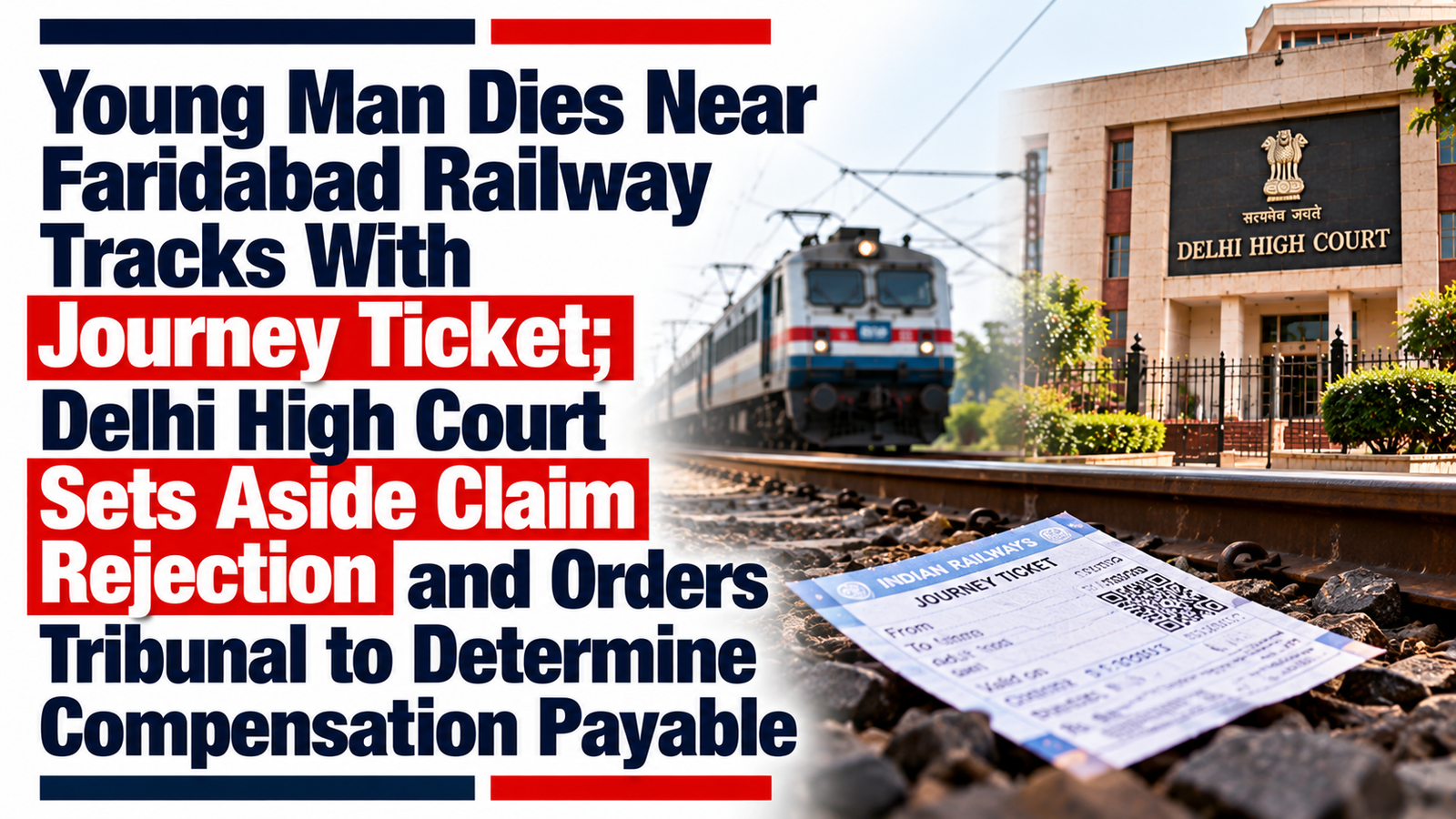
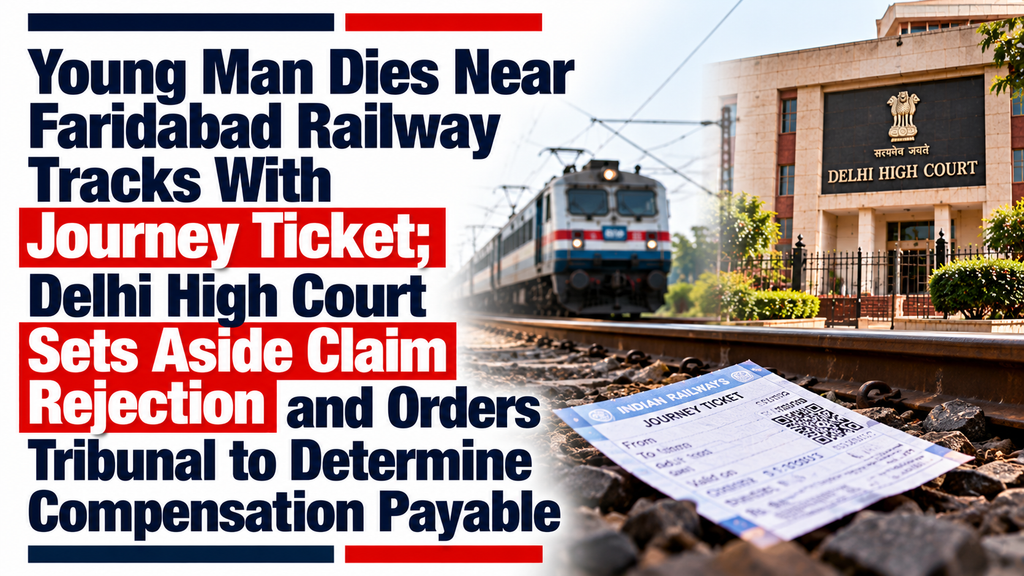
Twenty-Two-Year-Old Dies Near Faridabad Railway Tracks With Valid Train Ticket; Delhi High Court Rejects Unsupported Run-Over Theory and Directs Tribunal to Assess Family Compensation Claim
Facts
Mohd. Javed, aged about 22, was stated to have been travelling by an EMU passenger train from Mathura Junction to Faridabad on 13 January 2016. According to the claimants, heavy rush and a sudden jerk caused him to fall from the running train near the New Town Faridabad railway yard. His body was found the next morning, and a journey ticket issued at 4:17 p.m. on 13 January 2016 was recovered from his person. On 16 March 2020, the Railway Claims Tribunal rejected the family’s compensation claim, holding that neither bona fide passenger status nor an untoward railway incident had been proved. The claimant appealed under Section 23 of the Railway Claims Tribunal Act, 1987, seeking condonation of a 440-day delay.
Issues
Whether the delay in filing the appeal deserved condonation; whether the ticket recovered from the deceased established his status as a bona fide passenger under Section 2(29) of the Railways Act, 1989; whether the death could be treated as an accidental fall constituting an ‘untoward incident’ under Section 123(c)(2); and whether the Tribunal’s dismissal of compensation was sustainable on the available evidence.
Petitioner’s Arguments
The appellant submitted that the recovered railway ticket supported the deceased’s travel on the relevant train and route. The Tribunal had inferred that he was run over while crossing the tracks from the injuries and the location of the body, although no eyewitness or expert medical opinion established that account. The appellant also relied on the Supreme Court’s COVID-19 limitation-extension orders to explain the delay.
Respondent’s Arguments
The Union of India disputed both bona fide passenger status and the alleged accidental fall. It maintained that no fall from an EMU train was recorded at the relevant time and place. The location and delayed discovery of the body, the post-mortem injuries and the inquiry statements were relied upon to suggest that the deceased had been run over while crossing the railway tracks.
Analysis of the Law
Section 2(29) recognises a passenger travelling with a valid ticket or pass, while Section 123(c)(2) includes accidental falling from a passenger train within the statutory concept of an untoward incident. The existence of a recovered ticket and the manner of death require distinct evidentiary assessments. Once the claimants establish passenger status through relevant facts and circumstances, the Railways must rebut that case by cogent material. The Court examined the death on the totality of the evidence and the preponderance of probabilities, rather than treating severe injuries as conclusive proof of a track-crossing accident.
Precedent Analysis
Relying on Union of India v. Rina Devi, (2019) 3 SCC 572, and Lata v. Union of India, 2026 SCC OnLine SC 1350, the Court explained the burden-shifting approach to passenger status; even non-recovery of a ticket is not invariably fatal, whereas a recovered ticket provides stronger support. Rajendri Devi v. Union of India, 2024 SCC OnLine Del 124, and Rinavati v. Union of India, 2025 SCC OnLine Del 2976, supported evaluating crush injuries and surrounding records together. Surendra Prasad Verma v. Union of India, 2014 SCC OnLine Del 2917, cautioned against decisive inferences based merely on where or when a body was discovered.
Court’s Reasoning
No finding showed that the recovered ticket was forged, invalid or unrelated to the pleaded journey. Extensive crush injuries, including amputation, established the severity of death but not, without corroborating medical opinion, its precise mechanism. There was no eyewitness evidence of the deceased crossing the tracks and no expert opinion excluding a fall. The body’s location and discovery the following morning were likewise inconclusive. Taken cumulatively, the circumstances supported the claimants’ account on a preponderance of probabilities; the Tribunal’s contrary inference was insufficiently supported.
Conclusion
The High Court condoned the 440-day delay, allowed the appeal and set aside the Railway Claims Tribunal’s judgment. It remanded the matter for assessment of compensation in accordance with law and directed that the concerned authorities disburse the amount within two months of receiving a copy of the order. The Tribunal was directed to list the matter initially on 19 January 2027. The High Court did not itself fix a compensation amount.
Case: Mohd Isha v. Union of India
Court: High Court of Delhi, New Delhi
Case Number: FAO 33/2022; CM APPL. 7967/2022; CNR No. DLHC010069302022
Judge: Hon’ble Mr. Justice Manoj Kumar Ohri
Date: 13 October 2026 (reserved on 22 September 2026)
Result: Appeal allowed; 440-day delay condoned; Tribunal’s rejection set aside; matter remanded for assessment and disbursal of compensation.