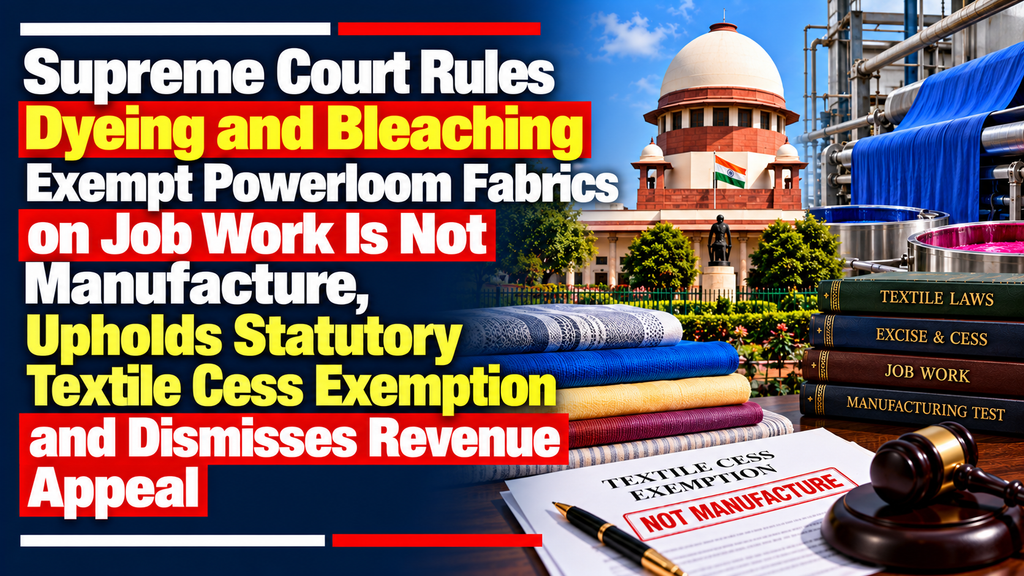
Supreme Court Rules Dyeing and Bleaching Exempt Powerloom Fabrics on Job Work Is Not Manufacture, Upholds Statutory Textile Cess Exemption and Dismisses Revenue Appeal

Supreme Court Rejects Textile Cess Demand Against Independent Fabric Processor, Holds Processing Does Not Constitute Manufacture Under Textiles Committee Act or Remove Statutory Powerloom Exemption
Facts
Premium Suiting Pvt. Ltd. independently bleached, dyed and processed 100% man-made fabrics supplied by handloom and powerloom manufacturers on a job-work basis, returning the treated fabric to those manufacturers. Following an audit objection, the Textiles Committee issued a show-cause notice on 20 August 2001 and assessed textile cess of Rs.2,68,293 under Section 5A of the Textiles Committee Act, 1963. It maintained that the statutory handloom/powerloom exemption ended when fabric underwent further processing. The Cess Appellate Tribunal upheld the assessment, relying on Chandok Textile Exporters. On 6 March 2013, the Allahabad High Court quashed the cess demand. The Assessing Officer appealed to the Supreme Court.
Issues
Whether bleaching, dyeing and finishing fabrics supplied by exempt handloom or powerloom units on job work amount to ‘manufacture’ attracting cess under Section 5A; whether the definition of ‘manufacture’ under the Central Excise Act, 1944, can be imported into the Textiles Committee Act, which does not define that expression; and whether the processor is independently liable notwithstanding the proviso exempting textiles manufactured from the handloom or powerloom industry.
Petitioner’s Arguments
The appellant-Assessing Officer argued that bleaching, dyeing and related processes were incidental or ancillary to completion of manufactured textiles and therefore constituted manufacture, drawing on Section 2(f) of the Central Excise Act. The Textile Committee’s inspecting officer treated the exemption as applicable only at the loom stage, not to subsequent processing. The Appellate Tribunal, following its earlier Chandok Textile Exporters ruling, had treated independent processors and merchant dealers as jointly and severally liable for textile cess.
Respondent’s Arguments
Premium Suiting contended that it manufactured no fresh textile product. It merely performed contracted job work on fabric already manufactured by powerloom and handloom units operating within the statutory exemption and returned the same fabric after processing. Such activity was an extension of the original manufacturers’ operations, not a separate taxable manufacturing event. Since Section 5A’s proviso expressly exempted the relevant handloom and powerloom textiles, the processor could not be made liable by borrowing an unrelated definition from another legislation.
Analysis of the Law
Section 5A(1) of the Textiles Committee Act levies an excise cess on textiles and textile machinery ‘manufactured’ in India but expressly excludes textiles manufactured from the handloom or powerloom industry. Section 5A(3) collects it from the manufacturer. Although the Act defines ‘textiles’ and ‘powerloom industry’ (the latter referring to not more than 50 powerlooms), it does not define ‘manufacture’. That expression must be interpreted in the statute’s own setting and ordinary meaning; a broadened definition in the Central Excise Act is not automatically incorporated. Here, the processor only upgraded existing exempt fabric by bleaching and dyeing; no new ‘textile manufactured’ emerged at its unit.
Precedent Analysis
The Court relied on Union of India v. R.C. Jain, (1981) 2 SCC 308, for the rule that definitions from one enactment cannot ordinarily be transplanted into another. Jagatram Ahuja v. Commissioner of Gift Tax, (2000) 8 SCC 249, explains the limited relevance of definitions in statutes that are not in pari materia. Maheshwari Fish Seed Farm v. T.N. Electricity Board, (2004) 4 SCC 705, similarly rejects treating a specialised statutory definition as controlling an expression used in a different legislative context. These authorities defeated the proposed borrowing of the Central Excise Act’s expanded concept of manufacture.
Court’s Reasoning
Justices S.V.N. Bhatti and N.V. Anjaria agreed with the High Court that the source manufacturers engaged the respondent solely for bleaching, dyeing and comparable processes. The fabric retained its character as textile manufactured by the handloom/powerloom industry; the job worker acted as an extended arm of those manufacturers. Calling the activity ‘manufacture’ only by reference to the Central Excise Act would disregard the Textiles Committee Act’s distinct scheme. The Court described the result as, at most, textile ‘upgraded’, not textile ‘manufactured’ by the respondent. Hence the express Section 5A exemption was not lost on processing.
Conclusion
On 26 October 2026, the Supreme Court dismissed Civil Appeal No. 785 of 2016 as meritless and affirmed the Allahabad High Court’s order quashing the Rs.2,68,293 textile-cess demand. On these facts, independent job-work bleaching and dyeing of exempt handloom/powerloom textiles did not constitute manufacture under Section 5A. The judgment also reiterates that courts must construe undefined statutory terms in context rather than indiscriminately import definitions from other enactments. Pending interlocutory applications ceased to survive. A distinct later cess notice mentioned in the facts was not separately adjudicated in the operative order.
Case: The Assessing Officer, Textiles Committee v. M/s. Premium Suiting Pvt. Ltd. & Anr.
Court: Supreme Court of India, Civil Appellate Jurisdiction
Case Number: Civil Appeal No. 785 of 2016; 2026 INSC 1158
Judge: Hon’ble Justices S.V.N. Bhatti and N.V. Anjaria (opinion by N.V. Anjaria, J.)
Date: 26 October 2026
Result: Appeal dismissed; Allahabad High Court judgment quashing Rs.2,68,293 textile-cess demand upheld.