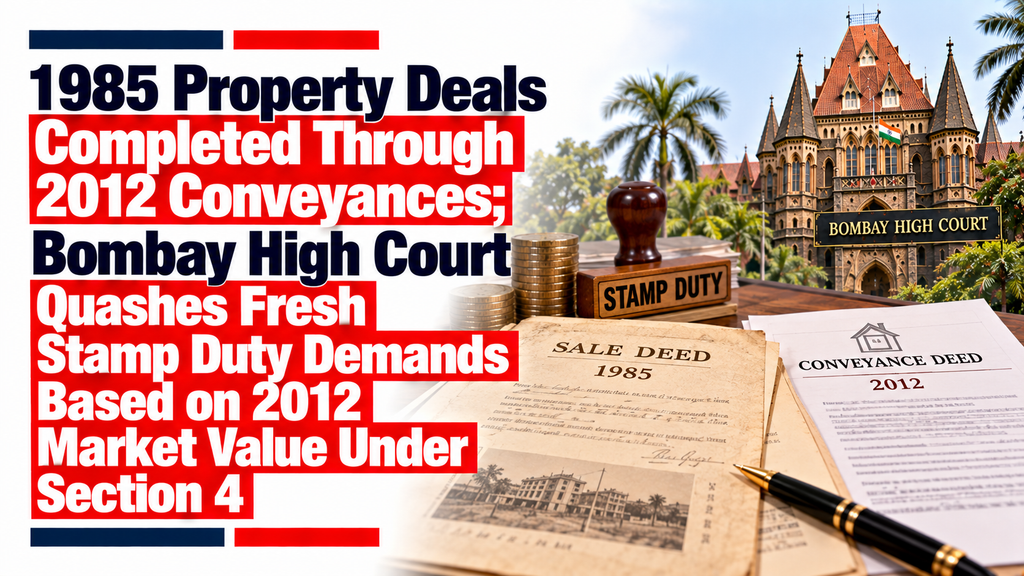
1985 Property Deals Completed Through 2012 Conveyances; Bombay High Court Quashes Fresh Stamp Duty Demands Based on 2012 Market Value Under Section 4

Stamp Authorities Treat Later Conveyances as Fresh Property Sales and Raise Huge Deficit Duty; Bombay High Court Says Entire Transaction Must Be Viewed Together
Facts
Atul Enterprises and Montal Investment filed four connected writ petitions challenging stamp-duty orders concerning several plots forming part of Laxmi Industrial Estate at Pahadi, Goregaon, Mumbai. The properties were affected by slum occupation and various development restrictions, including CRZ, mangroves, recreational-ground and road reservations.
In three matters, the petitioners had entered into Development-cum-Sale Agreements dated 9 December 1985. In the fourth, the relevant Agreement for Sale was dated 28 March 1996. Under these earlier arrangements, consideration was paid, possession was handed over, Powers of Attorney were executed, the petitioners were entered in municipal assessment records and they paid municipal taxes.
In 2012, the Slum Rehabilitation Authority required the petitioners to complete and establish their title before their redevelopment proposals could be processed. The petitioners accordingly executed and registered Conveyances dated 10 July 2012. Their case was that these Conveyances did not represent new sales in 2012 but merely completed and perfected the earlier transactions.
The Stamp Authorities initially certified stamp duty on the Conveyances by reference to the original transaction values. Subsequently, show-cause proceedings were initiated alleging substantial deficit stamp duty. In Writ Petition No.9358 of 2016, for example, the authorities treated the property as having a 2012 market value exceeding Rs.56 crore and ultimately demanded a balance stamp duty of Rs.1,43,71,275.
The Collector of Stamps passed orders dated 9 October 2014 determining deficit stamp duty on the basis that the 2012 Conveyances were fresh transactions. Appeals under Section 32B of the Maharashtra Stamp Act were dismissed by orders dated 3 March 2016. The petitioners therefore approached the Bombay High Court under Articles 226 and 227.
Issues
Whether the Development-cum-Sale Agreements of 1985 / Agreement for Sale of 1996 and the registered Conveyances of 2012 were several instruments used for completing the same underlying transactions within Section 4 of the Maharashtra Stamp Act, 1958.
Whether the Stamp Authorities could treat the 2012 Conveyances as independent fresh sales and levy stamp duty on the market value prevailing in 2012.
Whether Section 28, concerning disclosure of facts affecting stamp duty, prevented the authorities from considering the complete chain of earlier agreements, possession documents, Powers of Attorney, receipts and later Conveyances.
Whether Ready Reckoner rates could mechanically determine true market value without properly considering CRZ restrictions, mangroves, slum occupation, reservations and other limitations affecting development potential.
Whether the impugned deficit stamp duty, penalty, interest and consequential recovery proceedings were sustainable.
Petitioner’s Arguments
The petitioners argued that the 2012 Conveyances were executed only to complete and perfect title under the earlier transactions. They relied on the fact that possession and substantial consideration had passed decades earlier, Powers of Attorney had been executed and municipal taxes had been paid by them.
They contended that Section 4 requires the authority to identify whether several instruments have been used for completing one transaction. The legal inquiry therefore could not be confined to the wording or title of the final Conveyance; the complete documentary chain and substance of the transaction had to be examined.
Relying principally on Kumar Housing Corporation v. State of Maharashtra, the petitioners argued that delay in executing or registering the final conveyance does not, by itself, convert a continuous transaction into a new and independent sale.
They further argued that Section 28 and Section 4 operate in different fields. The disclosure requirement under Section 28 could not be used to defeat Section 4 merely because the final Conveyance did not repeat every recital appearing in the earlier instruments.
Separately, the petitioners challenged the valuation methodology. They argued that Ready Reckoner rates are only guidelines and cannot substitute a statutory determination of true market value, particularly where large portions of the lands were affected by CRZ-I/II, mangroves, slums, RG reservations, road reservations and other restrictions.
They also alleged breach of natural justice because relevant survey, demarcation and valuation material was not supplied to them despite being relied upon for assessing the extent and value of restricted land.
Respondent’s Arguments
The State argued that the registered Conveyances executed in 2012 did not expressly state that they were merely completion or perfection documents arising from the 1985 or 1996 transactions. According to the State, there was no sufficient recital connecting the final Conveyances with the earlier instruments.
It relied on Section 28 of the Maharashtra Stamp Act and submitted that facts affecting chargeability and market value had to be fully stated in the instrument. In the absence of proper disclosure or clear incorporation, the Stamp Authorities were entitled to assess the registered Conveyances on their own terms.
The State relied upon Praman Infrastructure Pvt. Ltd. v. State of Maharashtra to argue that an annexure can be treated as part of the instrument only where it is clearly and unambiguously incorporated into the principal deed.
It further submitted that the earlier Urban Land Ceiling restrictions had ceased after repeal of the ceiling law and that the lands had regained substantial open-market value by 2012. According to the State, properties worth very large sums could not legitimately be conveyed on nominal stamp duty by relying on decades-old transaction values.
The State defended the use of the 2012 valuation guidelines/Annual Statement of Rates under the Maharashtra Stamp (Determination of True Market Value of Property) Rules and contended that the impugned orders were neither arbitrary nor perverse.
It also pointed to allegations that forged or fabricated rent receipts had been produced in the proceedings and argued that such conduct disentitled the petitioners to discretionary writ relief.
Analysis of the Law
Section 4 of the Maharashtra Stamp Act addresses transactions completed through several instruments. The Court held that the controlling inquiry is whether the different instruments were in fact employed to complete one underlying transaction. The legal character of the transaction cannot be decided merely from the labels placed on individual documents.
The Court found that the earlier agreements had created substantive rights in favour of the petitioners. Possession had been delivered, consideration had been paid, Powers of Attorney and receipts existed, and the later Conveyances concerned the same petitioners and the same plots. There was no material showing that an entirely new bargain was entered into for the first time in 2012.
The long lapse of time between the original agreements and the final Conveyances did not, by itself, split the transaction into separate transactions. Delay may have other legal consequences, but Section 4 requires the Court and Stamp Authorities to determine whether the final instrument completed the earlier arrangement.
The Court distinguished the operation of Section 28 from Section 4. Section 28 requires disclosure of facts affecting chargeability, but it cannot be applied in a manner that renders Section 4 meaningless. When Section 4 itself contemplates ‘several instruments’, the authority must examine the complete documentary chain to determine whether those instruments collectively complete one transaction.
The Court clarified that applying Section 4 does not mean that stamp duty disappears altogether. Section 4 prescribes the manner in which duty is charged where several instruments complete one transaction: the principal instrument attracts the duty applicable to the principal transaction and the other instruments are dealt with as Section 4 provides.
Because the impugned demands rested on the fundamental premise that the 2012 Conveyances were independent fresh sales liable on 2012 market value, that premise had to be tested before separately deciding disputes over CRZ, mangroves, reservations and other valuation restrictions.
Precedent Analysis
Kumar Housing Corporation v. State of Maharashtra was central to the Court’s analysis. It established that, for Section 4, the Court must examine whether several instruments were in fact used to complete one transaction. It also held that delay in registration cannot by itself convert an otherwise continuous transaction into separate independent transactions.
Praman Infrastructure Pvt. Ltd. v. State of Maharashtra was relied upon by the State for the proposition that material recitals in an annexure may be considered when the principal deed clearly incorporates the annexure. The Court accepted the importance of proper drafting and disclosure but held that Praman Infrastructure did not eliminate the separate statutory inquiry mandated by Section 4.
Prasadnagar Co-operative Housing Society Ltd. v. State of Maharashtra, which considered the Supreme Court decision in R. Sai Bharathi v. J. Jayalalitha, was relied upon for the proposition that Ready Reckoner or guideline values are prima facie indicators and not necessarily conclusive of true market value. The petitioners invoked this principle because of extensive physical and statutory restrictions affecting the properties.
The Court ultimately found it unnecessary to finally adjudicate each valuation objection concerning CRZ, mangroves, slums and reservations because the more fundamental legal error was the treatment of the 2012 Conveyances as independent fresh sales.
Court’s Reasoning
The Court held that the documentary material supported the petitioners’ case that the earlier agreements and the 2012 Conveyances formed part of the same underlying transactions. The earlier documents had created rights, possession had passed, consideration had been paid and the later Conveyances related to the same parties and properties.
The absence of an express sentence in the 2012 Conveyances stating that they were ‘completion’ or ‘perfection’ documents was not decisive. Although such drafting would have been preferable, it could not erase the earlier instruments, possession documents, Powers of Attorney and receipts already forming part of the record.
The Court held that the authorities committed a fundamental error by treating the Conveyances as though an entirely new sale had occurred in 2012 and then applying 2012 market values. The authorities were first required to determine the legal relationship between the earlier instruments and the final Conveyances.
The Court specifically held that the Development-cum-Sale Agreements, the Agreement for Sale, connected possession documents, Powers of Attorney, receipts and the Conveyances dated 10 July 2012 constituted several instruments employed for completing the same underlying transactions within Section 4.
The Court acknowledged that the petitioners had used different descriptions for certain documents at different stages, but held that the legal character of an instrument is determined by its substance and effect, not merely by the label adopted by a party.
Once the Section 4 conclusion was reached, the controversy over whether the 2012 Ready Reckoner valuation correctly accounted for CRZ, mangroves, reservations and slum restrictions ceased to be decisive for sustaining the impugned demands. Those demands had been built on the unsustainable assumption of fresh 2012 transactions.
Accordingly, the deficit stamp duty demands and the consequential penalty, interest and recovery proceedings could not survive.
Conclusion
The Bombay High Court allowed all four writ petitions and held that the Stamp Authorities had wrongly treated the 2012 Conveyances as independent fresh property transactions.
The Court held that the earlier Development-cum-Sale Agreements / Agreement for Sale, possession documents, Powers of Attorney, receipts and the 2012 Conveyances were several instruments used for completing the same underlying transactions within Section 4 of the Maharashtra Stamp Act.
The appellate orders dated 3 March 2016 and the Collector of Stamps’ orders dated 9 October 2014 were quashed and set aside. The consequential penalty, interest and recovery proceedings founded on the alleged deficit stamp duty were also quashed.
The Court clarified that Section 4 does not create a blanket exemption from stamp duty; it governs the manner of charging duty where several instruments complete one transaction. There was no order as to costs.
Case Details
Case: Atul Enterprises through its Partner Atul N. Patel v. State of Maharashtra & Anr., with Montal Investment through its Partner Atul N. Patel v. State of Maharashtra & Anr.
Neutral Citation: 2026:BHC-AS:40230
Court: High Court of Judicature at Bombay, Civil Appellate Jurisdiction
Case Number: Writ Petition Nos. 9358, 9359, 9360 and 9361 of 2016
Judge: Justice Amit Borkar
Reserved on: 28 September 2026
Date: 5 October 2026
Key Provision: Section 4, Maharashtra Stamp Act, 1958Result: All four writ petitions allowed; appellate orders dated 3 March 2016 and Collector’s orders dated 9 October 2014 quashed; consequential penalty, interest and recovery proceedings also quashed; no order as to costs