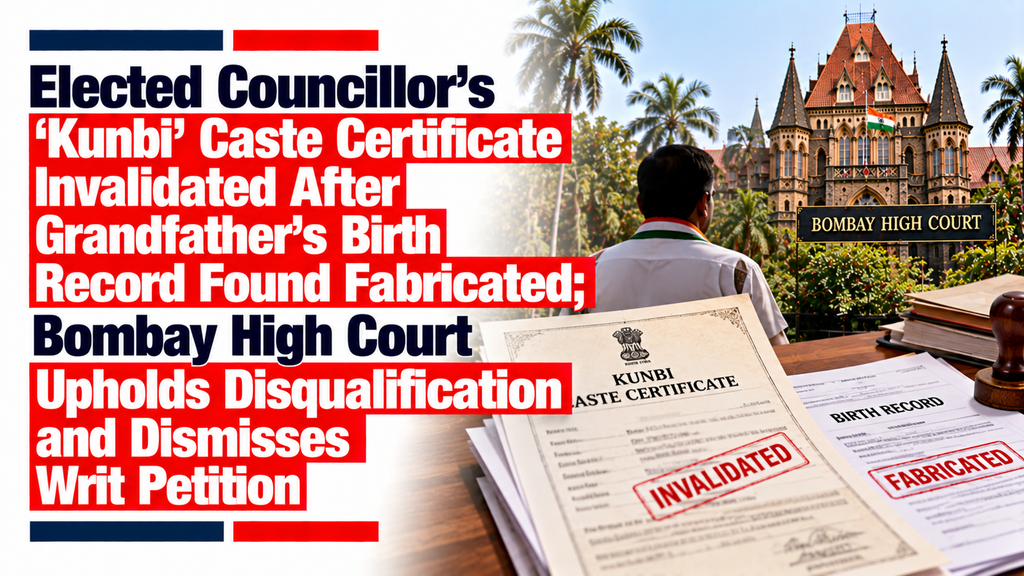
Elected Councillor’s ‘Kunbi’ Caste Certificate Invalidated After Grandfather’s Birth Record Found Fabricated; Bombay High Court Upholds Disqualification and Dismisses Writ Petition

Councillor Challenges Second Vigilance Inquiry Into OBC Caste Claim; Bombay High Court Says Scrutiny Committee Can Re-Examine Documents and Refuses Relief After Finding Fabrication
Facts
The Petitioner, Rupali Kashinath Shigwan @ Rupali Amol Jadhav, had been issued a caste certificate dated 8 July 2016 by the Sub-Divisional Officer, Mahad, certifying that she belonged to the ‘Kunbi’ Other Backward Class (OBC).
For verification of the caste certificate, the Petitioner relied upon, among other material, her father’s School Leaving Certificate showing caste as ‘Kunbi’, Form 14 relating to Suryakant Tukaram Madhu Shigwan stated to be her paternal uncle, and Form 14 dated 27 February 1932 relating to Pandurang Narayan Rama Shigwan, stated to be her grandfather, showing caste as ‘Kunbi’.
The Petitioner contested the Municipal Council election and was declared elected as Councillor from Ward No.8 on 21 December 2025.
Respondent No.6, the defeated candidate and complainant before the Scrutiny Committee, produced a School Leaving Certificate of the Petitioner’s father showing his caste as ‘Hindu Maratha’. He also produced genealogy material and an affidavit of Suryakant Tukaram Shigwan stating that the Petitioner’s father had borrowed his caste certificate and wrongly shown him as a paternal uncle in the genealogy.
The Headmaster of Zilla Parishad Primary High School, Pen reported on 28 January 2026 that the school register corresponding to the Petitioner’s father’s leaving certificate showed his caste as ‘Hindu Maratha’.
The Vigilance Cell initially examined Form 14 relating to the Petitioner’s grandfather. The Tehsildar’s communication dated 21 May 2026 stated that the document appeared to be without rewriting, cancellation or change of ink, and the first Vigilance Cell report dated 29 May 2026 treated the record as being in order.
After hearing the parties, however, the Scrutiny Committee directed re-examination of the grandfather’s Form 14. A subsequent Vigilance Cell inquiry found infirmities in the record. The report was supplied to the Petitioner, she submitted her written response and was heard before the matter was closed for orders.
By order dated 10 August 2026, the Scrutiny Committee rejected the Petitioner’s claim to ‘Kunbi’ caste, cancelled her caste certificate and directed its confiscation. By a further order dated 18 August 2026, the Collector, Raigad disqualified her from the post of Councillor.
The Petitioner approached the Bombay High Court seeking quashing of both orders and a direction to issue caste validity in her favour.
Issues
Whether the Scrutiny Committee could direct a second or further Vigilance Cell inquiry into one of the documents after the first Vigilance Cell report had supported the Petitioner’s case.
Whether Rule 17(7) of the 2012 Caste Certificate Rules required the Scrutiny Committee to separately record reasons before seeking re-examination of the grandfather’s Form 14.
Whether the subsequent Vigilance Cell report could validly be relied upon when it contradicted the earlier report and the Tehsildar’s initial view.
Whether the Petitioner’s additional pre-Constitution document, produced for the first time before the High Court, justified remand to the Scrutiny Committee.
Whether the newly introduced appellate remedy under Section 6B of the amended caste-certificate legislation constituted an effective alternative remedy in the absence of SOPs, Rules or independent machinery for OBC appeals.
Whether invalidation of the caste certificate resulted in termination of the Petitioner’s election as Councillor under the statutory deeming provision.
Petitioner’s Arguments
The Petitioner argued that the Scrutiny Committee could not discard the favourable Vigilance Cell report dated 29 May 2026 and order a fresh inquiry without recording reasons as required by Rule 17(7).
She relied upon Ashwini Ramchandra Bhogam v. State of Maharashtra and Kranti Associates v. Masood Ahmed Khan to contend that reasons are indispensable to administrative and quasi-judicial decision-making.
The Petitioner emphasised that the matter had been closed for orders and reopened, and that officers who initially found the grandfather’s birth record genuine subsequently changed their view without an adequate explanation.
Relying on Dnyaneshwar S/o. Shankarrao Dongare and Vaishali Baban Dhumal, she submitted that a re-inquiry cannot be ordered merely on the ipse dixit of the Scrutiny Committee and that reasons and procedural fairness are essential.
The Petitioner also produced an additional Form 14 relating to the son of her great-grandfather, Rama Ambaji Shigwan, said to contain a ‘Kunbi’ caste entry dated 16 September 1893. She sought remand so that this pre-Constitution document could be examined by the Scrutiny Committee.
Although Section 6B introduced an appellate remedy from orders of the Scrutiny Committee, the Petitioner contended that the remedy was not practically effective because no independent machinery, Rules or SOPs had been provided for the Appellate Authority.
Respondents’ Arguments
Respondent No.6 argued that the Scrutiny Committee had not discarded the entire first Vigilance Cell report. It merely directed re-examination of one material document, namely Form 14 relating to the Petitioner’s grandfather, after considering the submissions made before it.
The subsequent Vigilance Cell and Tehsildar material was supplied to the Petitioner, and she was given an opportunity to respond. Her written say and oral submissions were considered before the caste claim was invalidated.
The Respondent relied upon Rule 17(7), which expressly states that findings of the Vigilance Cell are not binding on the Scrutiny Committee because the Vigilance inquiry is intended for its internal assistance. It was therefore argued that the Committee had power to seek further examination when necessary.
Respondent No.6 also relied on the father’s school record showing ‘Hindu Maratha’ and the affidavit of Suryakant Tukaram Shigwan, who disputed the claimed relationship and stated that his caste certificate had been used in the genealogy.
It was further argued that the Petitioner had an appellate remedy under Section 6B and that any new document could be produced in such appeal.
Finally, Respondent No.6 submitted that the Petitioner had approached the High Court without clean hands because she relied upon a fabricated document and a tampered genealogy, and therefore did not deserve discretionary relief under Article 226.
Analysis of the Law
Rule 17(7) provides that the findings of the Vigilance Cell are not binding upon the Scrutiny Committee because the Vigilance inquiry is intended for the Committee’s internal assistance. The High Court held that this necessarily permits the Committee to seek a further report where re-examination of a document is required; otherwise, the purpose of Vigilance Cell assistance would be frustrated.
The Court distinguished between discarding an entire Vigilance Cell report and directing re-examination of one document dealt with in that report. The statutory obligation to record reasons for discarding a Vigilance report could not be mechanically applied as though the Committee had rejected the first report in its entirety.
Natural justice was satisfied because both Vigilance Cell reports were considered, the subsequent adverse material was furnished to the Petitioner, and she was afforded an opportunity to submit her say before the final order was passed.
The Court itself noted from the grandfather’s Form 14 that there was rewriting, cancellation and change of ink. It therefore found no infirmity in the Scrutiny Committee accepting the subsequent Vigilance Cell report and rejecting that document.
On the appellate remedy under Section 6B, the Court took note of the State’s statement that no SOPs had been issued for the Appellate Authority, particularly for OBC appeals, and also referred to an earlier decision recording the absence of independent machinery and formulated Rules. Consequently, the Court did not reject the writ petition merely on the ground of alternative remedy.
Nevertheless, the Court observed prospectively that once an effective Section 6B appellate mechanism is operational, that remedy would ordinarily have to be exhausted before invoking Article 226.
Precedent Analysis
Ashwini Ramchandra Bhogam v. State of Maharashtra was distinguished. In that case, the Scrutiny Committee had discarded the entire Vigilance Cell report without recording reasons. Here, the Committee did not discard the entire report but ordered re-examination of one particular document and later gave reasons for accepting the subsequent report.
Kranti Associates v. Masood Ahmed Khan was acknowledged for the principle that reasons are the backbone of administrative and judicial decisions. The Court held that the impugned Scrutiny Committee order did contain reasons for accepting the subsequent Vigilance Cell report.
Dnyaneshwar S/o. Shankarrao Dongare was relied upon by the Petitioner to challenge repeated Vigilance inquiries without reasons. The High Court found the present facts materially different because the Committee had specifically required re-examination of the grandfather’s Form 14 after considering the rival submissions.
Vaishali Baban Dhumal recognised the power to direct re-inquiry but insisted upon natural justice and fair play. The Court found those requirements satisfied because the subsequent report was supplied to the Petitioner and she was permitted to respond.
Shaila Baban Ranjane @ Shaila Balkrishna Kharat was relied upon to seek remand on the basis of a newly produced pre-Constitution document. The Court declined to follow that course in the present case because of its findings regarding fabrication and the Petitioner’s conduct.
Vishakha Sharad Raut concerned the newly created Section 6B appellate remedy and the possibility of producing additional documents before the Appellate Authority. The Court held that it did not govern the present case because the State itself admitted that SOPs had not been issued for OBC appeals.
Mr. Ashutosh s/o Shivajirao Abhyankar was referred to for the observation that, despite establishment of the Appellate Authority, independent machinery and Rules or Regulations had not yet been provided.
Court’s Reasoning
The High Court found that the Petitioner’s principal challenge – that the Scrutiny Committee had illegally discarded the first Vigilance Cell report without reasons – was factually misplaced. The Committee had not rejected the entire report; it had required re-examination of one significant document.
Since Rule 17(7) makes Vigilance Cell findings non-binding and treats the inquiry as internal assistance, the Scrutiny Committee possessed the power to seek a further report where it considered re-examination necessary.
The Court found that procedural fairness had been observed. The Petitioner received the subsequent report, filed her written response and was heard before the Scrutiny Committee passed its final order.
Most importantly, the Court itself found rewriting, cancellation and change of ink apparent in the grandfather’s Form 14. It therefore upheld the Committee’s reliance upon the subsequent Vigilance Cell report.
The Court refused to remand the matter merely because the Petitioner produced another old document during the writ proceedings. In light of the finding that the earlier Form 14 was fabricated and that the genealogy had been tampered with by presenting Suryakant Tukaram Shigwan as a paternal uncle, the Court held that the Petitioner had not approached it with clean hands and was not entitled to indulgence.
Although the Court did not treat Section 6B as an effective alternative remedy in the present case because the State admitted the absence of SOPs for OBC appeals, it urged the Government to formulate Rules, Regulations and SOPs so that the statutory appellate mechanism could function effectively.
Finally, the Court applied the deeming provision under Section 10(4): once the caste certificate was invalidated, the Petitioner’s election was deemed terminated retrospectively from the date on which she contested the election. She therefore could not claim continuation as Councillor.
Conclusion
The Bombay High Court dismissed the writ petition and upheld the Scrutiny Committee’s order dated 10 August 2026 invalidating the Petitioner’s ‘Kunbi’ OBC caste certificate.
The Court held that the Scrutiny Committee could direct re-examination of a particular document through the Vigilance Cell and was not bound by the first Vigilance report. The Petitioner had been afforded adequate opportunity to respond to the subsequent adverse report.
The Court declined to remand the matter for consideration of the additional pre-Constitution document produced during the writ proceedings, particularly because it found that the Petitioner had relied upon a fabricated Form 14 and had tampered with the genealogy.
Consequently, the Petitioner could not continue as Councillor because Section 10(4) deemed her election terminated upon invalidation of the caste certificate. The writ petition was dismissed with no order as to costs.
Case Details
Case: Rupali Kashinath Shigwan @ Rupali Amol Jadhav v. State of Maharashtra & Ors.
Neutral Citation: 2026:BHC-AS:40252-DB
Court: High Court of Judicature at Bombay, Civil Appellate Jurisdiction
Case Number: Writ Petition No. 10970 of 2026
Bench: Justice R.I. Chagla and Justice Firdosh P. Pooniwalla
Judgment by: Justice R.I. Chagla
Reserved on: 10 September 2026
Pronounced on: 5 October 2026Result: Writ Petition dismissed; caste invalidation and consequential loss of right to continue as Councillor sustained; no order as to costs