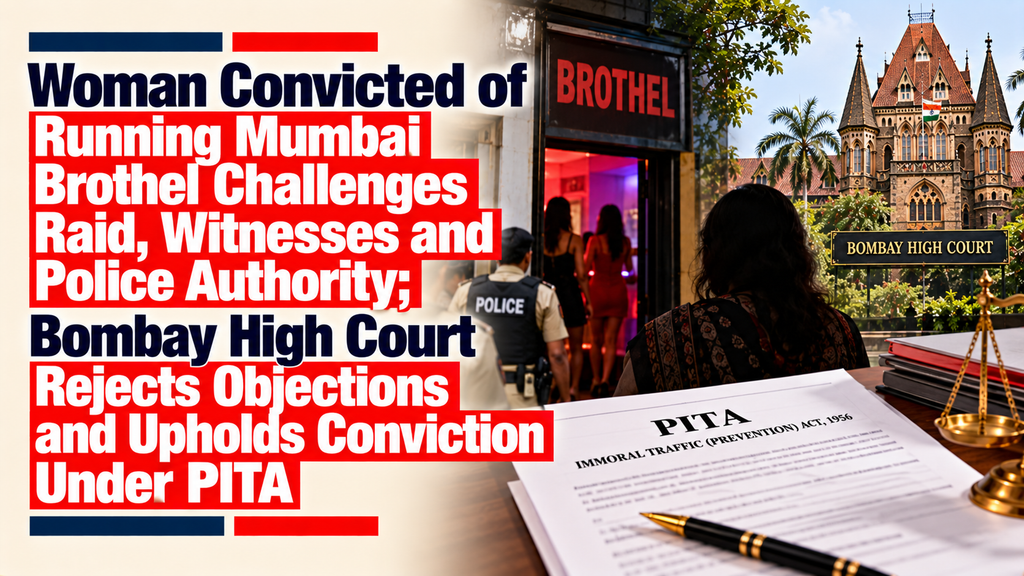
Woman Convicted of Running Mumbai Brothel Challenges Raid, Witnesses and Police Authority; Bombay High Court Rejects Objections and Upholds Conviction Under PITA

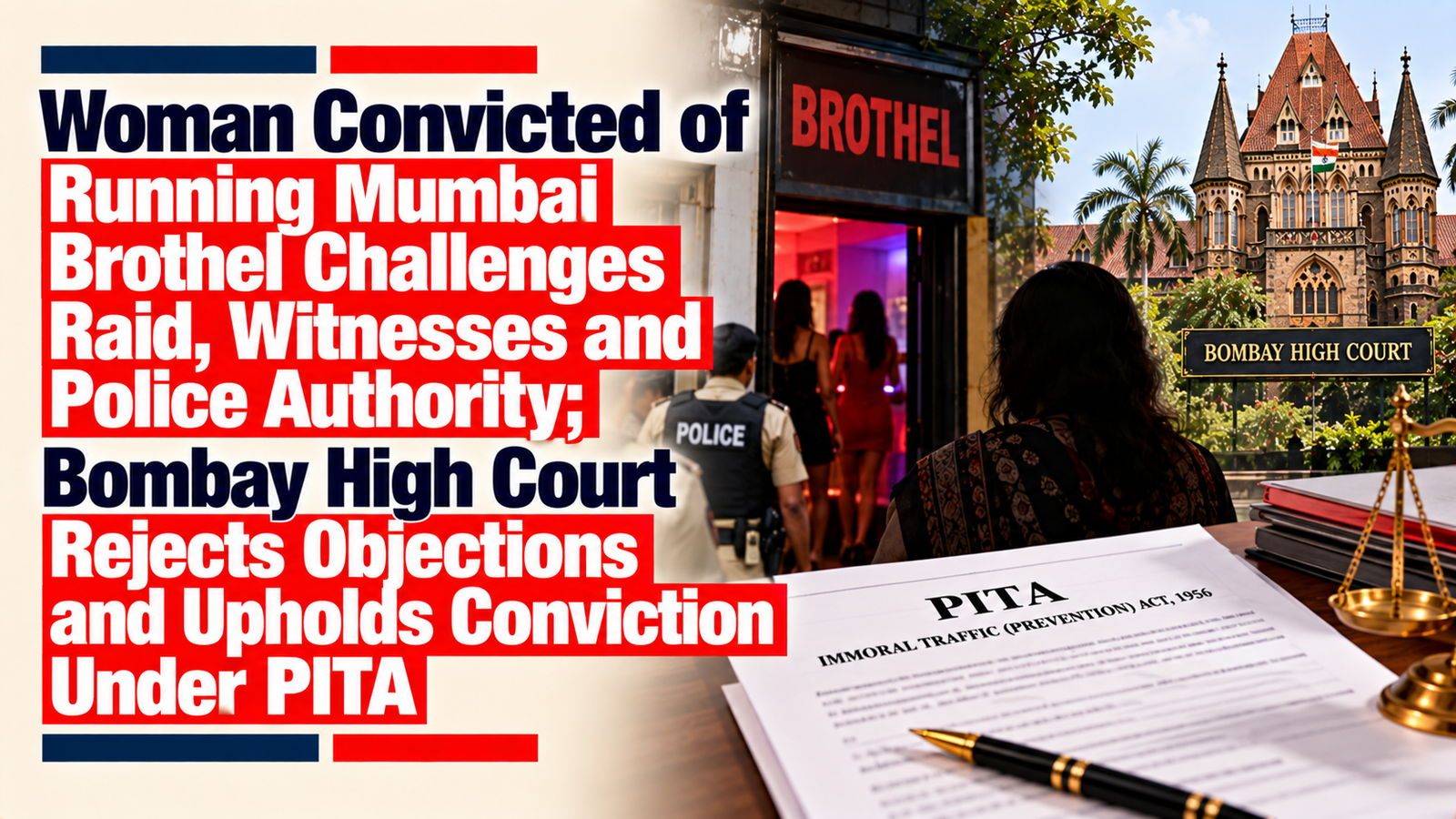
Accused Says Trafficking Victim Was an Illegal Immigrant and NGO Witnesses Were Interested; Bombay High Court Rejects Victim-Shaming Defence and Dismisses Revision
Facts
On 17 February 2011, the NGO Rescue Foundation informed D.B. Marg Police Station that girls were allegedly being detained for prostitution in Room Nos. 8 and 10 of Krishna Building, Pavwala Street, Grant Road, Mumbai. Acting on the information, the police arranged a raid with NGO representatives, a panch witness and a decoy customer.
During the raid, the police found Rani Pratap Singh at the premises. According to the prosecution, she identified herself as the manager and conductor of the brothel. The decoy customer was found with one victim, while another girl was found in another cabin. Tissue papers and condom packets were seized, and the pre-marked Rs.500 note given to the decoy customer was allegedly recovered from Rani.
The prosecution alleged that the women stated that they were engaged in prostitution at the premises and that their earnings were shared with Rani. Special LAC No.16 of 2011 was registered and, after investigation, a charge-sheet was filed.
The Metropolitan Magistrate, Special Court for ITPA, convicted Rani for offences under Sections 3, 4, 5 and 6 of the Immoral Traffic (Prevention) Act, 1956. She was sentenced to two years’ rigorous imprisonment under Sections 3 and 4 and three years’ rigorous imprisonment under Sections 5 and 6, with fines; the substantive sentences were directed to run concurrently.
Her Criminal Appeal No.150 of 2014 was dismissed by the Additional Sessions Judge on 5 October 2015, confirming both conviction and sentence. She then invoked the Bombay High Court’s revisional jurisdiction under Sections 397 and 401 CrPC.
Issues
Whether the conviction could be sustained when the raid and prosecution substantially relied upon NGO-linked witnesses and a panch witness who had previously acted in police cases.
Whether the victim’s alleged status as a Bangladeshi illegal immigrant affected her credibility or the criminal liability of the accused.
Whether the Investigating Officer was duly authorised under Sections 13 and 14 of PITA and whether any defect in authorisation vitiated the raid, investigation and prosecution.
Whether ‘detention’ for the purpose of Section 6 PITA had been proved.
Whether the alleged discrepancies concerning telephone and electricity bills created doubt about the place where prostitution was being carried on.
Whether the concurrent factual findings of the Magistrate and Sessions Court disclosed perversity or miscarriage of justice warranting interference in criminal revision.
Petitioner/Applicant’s Arguments
Rani argued that the entire action originated from Rescue Foundation and that persons associated with the NGO acted as the panch and decoy customer. According to her, they were interested witnesses and the prosecution’s failure to examine genuinely independent witnesses weakened the case.
She attacked the credibility of PW-1, contending that the victim had changed her versions concerning her age, marital status, nationality and whether she had a child.
She further argued that PW-1 was a Bangladeshi illegal immigrant and that no deportation action had been taken against her. On that basis, she contended that such a witness should not be relied upon to convict an Indian citizen.
The applicant argued that ‘detention’ as required under Section 6 PITA had not been established.
She also challenged the authority of the Investigating Officer, arguing that he was not a Special Police Officer and that the authorisation at Exhibit 28 was only general in nature and did not satisfy Sections 13 and 14 PITA.
Finally, relying on telephone and electricity bills referring to a different building, she contended that the prosecution had failed to prove the place of prostitution.
Respondent’s Arguments
The State relied upon the concurrent conviction recorded by the Magistrate and affirmed by the Sessions Court and argued that no revisional interference was warranted.
It submitted that NGO workers participating in action against illegal trafficking activity do not become interested witnesses merely because of their association with the NGO. Their evidence was sufficiently corroborated by the other prosecution material.
The State further argued that, for the offence under Section 6 PITA, the victim’s consent or otherwise was immaterial and that the offence stood proved from the overall evidence.
It supported the authorisation of the Investigating Officer and the validity of the raid and investigation.
Analysis of the Law
The High Court first rejected the argument based on the victim’s alleged immigration status. It held that even assuming the victim was an illegal immigrant, that circumstance did not make the alleged offence less serious and could not provide a legal basis for refusing to prosecute or convict the perpetrator. Immigration consequences and protection against trafficking operate in separate legal fields.
The Court emphasised that PITA is directed at commercial sexual exploitation and those who benefit from it, rather than at punishing or degrading persons subjected to prostitution or trafficking. A victim does not lose human dignity or legal protection because she is described as an ‘illegal immigrant’, ‘sex worker’ or ‘rescued woman’.
On witnesses, the Court recognised the practical realities of raids on brothels and known places of prostitution. Independent members of the public may be unwilling or unavailable to participate. Accordingly, NGO volunteers assisting the raid cannot automatically be branded as interested witnesses merely because they work with an organisation engaged in rescue operations.
Regarding the Investigating Officer’s authority, the Court examined Exhibit 28 and found a specific office order dated 14 February 2011 issued by the Assistant Commissioner of Police, who was the Special Police Officer under PITA. The order authorised PW-5, an Inspector of Police, to exercise power under the proviso to Section 14. Since an Inspector is above the prescribed rank, the statutory requirement was satisfied.
The Court also applied the restricted scope of criminal revisional jurisdiction. Where both the Magistrate and the Sessions Court have appreciated the evidence and recorded concurrent findings of fact, the High Court ordinarily cannot undertake a fresh re-appreciation merely to reach another possible conclusion. Intervention requires perversity, material illegality or miscarriage of justice.
Precedent Analysis
Prajwala v. Union of India, 2026 SCC OnLine SC 1053, was relied upon to explain the modern focus of the Immoral Traffic (Prevention) Act. The Supreme Court had noted the statutory shift away from scrutinising persons in prostitution towards targeting those engaged in commercial exploitation. The Bombay High Court used this principle to reject the attempt to diminish the victim’s protection because of her alleged immigration status.
Yakub Abdul Razak Memon v. State of Maharashtra, (2013) 13 SCC 1, was relied upon in relation to panch witnesses. The Court noted that police are not required to search for panch witnesses from distant locations and that proximity to a police station or previous participation does not by itself destroy credibility in the absence of contrary material.
Delhi Administration v. Ram Singh, Smt. Jaya Rama Gauda v. State of Maharashtra and C.P. Raju v. State of Kerala were relied upon by the applicant regarding the statutory requirement of proper authorisation under PITA. The Court distinguished their application because Exhibit 28 demonstrated that PW-5 had in fact been specially authorised by the competent Special Police Officer.
Mohd. Hussain Babamiyan Ramzan v. State of Maharashtra, State of Gujarat through CBI v. Kumudchandra Pranjivan Shah and Inderjit Singh Gurumal Singh v. State of Maharashtra were invoked against allegedly stock, pliable or non-independent witnesses. The Court held that those cases involved materially different offences and factual settings. A brothel raid presents distinct practical difficulties in securing independent witnesses.
State v. Manimaran, (2019) 13 SCC 670, referring to State of Kerala v. Puttumana Illath Jathavedan Namboodiri, (1999) 2 SCC 452, was applied on the scope of revision. The Court reiterated that the revisional court ordinarily should not re-appreciate evidence already evaluated by the trial and appellate courts where concurrent factual findings have been recorded.
Court’s Reasoning
The High Court strongly rejected the submission that the victim’s alleged Bangladeshi or illegal-immigrant status made her evidence unworthy of consideration or made the prosecution of an Indian citizen inappropriate. The Court characterised this approach as victim shaming and held that an immigration label cannot extinguish a person’s dignity or protection from trafficking.
The Court accepted the testimony of the NGO-linked witnesses. In the context of brothel raids, it considered it unrealistic to insist upon completely independent members of society and held that volunteers participating in anti-trafficking operations could not be discarded merely because of their NGO association.
The objection to the panch witness was similarly rejected. His shop being close to the police chowky and his previous participation as a panch did not, by themselves, establish that he was unreliable or pliable.
On the statutory-authorisation challenge, the Court found the applicant’s argument factually incorrect. Exhibit 28 showed that the Assistant Commissioner of Police, acting as Special Police Officer, had specifically authorised PW-5, an Inspector, under the relevant proviso to Section 14 PITA. The raid, investigation and prosecution were therefore not vitiated on that ground.
The discrepancy concerning telephone and electricity bills did not assist Rani. Those documents were relevant primarily to Accused No.2, who had already received the benefit of doubt and was acquitted. Rani herself had been arrested at Krishna Building and was identified by prosecution witnesses as being present at the raided premises.
The Court also rejected the Section 6 argument concerning detention, observing that consent is immaterial under that provision and that the overall corroborative evidence was sufficient.
Finally, the Court held that both courts below had concurrently assessed the evidence and that revisional jurisdiction did not permit a fresh re-appreciation in the absence of perversity or miscarriage of justice. No such defect was found.
Conclusion
The Bombay High Court dismissed Rani Pratap Singh’s Criminal Revision Application and upheld her conviction and sentence under Sections 3, 4, 5 and 6 of the Immoral Traffic (Prevention) Act, 1956.
The Court held that the victim’s alleged illegal-immigrant status did not diminish her dignity, credibility merely by reason of that status, or entitlement to protection against trafficking. It also rejected the contention that NGO witnesses were necessarily interested witnesses and found the Investigating Officer duly authorised under PITA.
No perversity or miscarriage of justice was found in the concurrent decisions of the Magistrate and Sessions Court. The applicant’s bail bond and surety were cancelled, and she was granted four weeks to surrender.
Case Details
Case: Rani Pratap Singh v. State of Maharashtra
Court: High Court of Judicature at Bombay, Criminal Appellate Jurisdiction
Case Number: Criminal Revision Application No. 461 of 2015
Judge: Justice M.M. Sathaye
Date: 1 October 2026Result: Criminal Revision Application dismissed; conviction and sentence under Sections 3, 4, 5 and 6 of PITA upheld; bail bond and surety cancelled; four weeks granted to surrender.