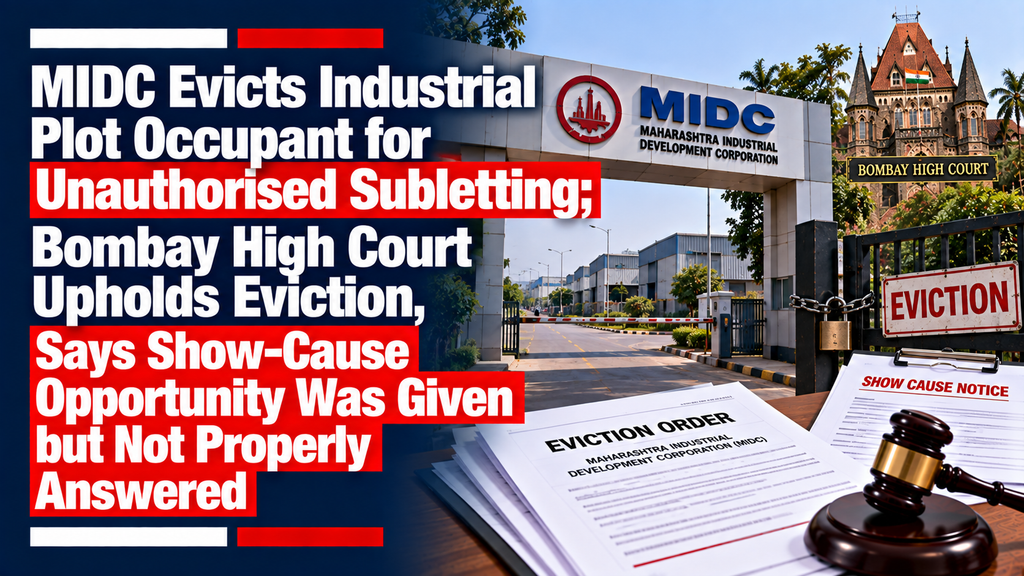
MIDC Evicts Industrial Plot Occupant for Unauthorised Subletting; Bombay High Court Upholds Eviction, Says Show-Cause Opportunity Was Given but Not Properly Answered

Industrial Unit Challenges MIDC Eviction as Beyond Show-Cause Notice; Bombay High Court Dismisses Plea, Says Common Subletting Ground Independently Sustained the Order
Facts
Jay Steel Rolling and Engineering Works, through its sole proprietor Amit Lokendra Jain, challenged eviction proceedings concerning Plot No. B-4, Wagle Estate Industrial Area, Thane. The premises originated in an Agreement to Lease dated 25 November 1961 executed by MIDC in favour of M.B. Patel, proprietor of Mohanlal and Company, for setting up an industry.
The industrial undertaking, including the re-rolling mill, fixtures and leasehold interest, was subsequently agreed to be sold to the petitioner. On 14 November 1972, MIDC permitted assignment and transfer of the leasehold rights to Lokender Bhagwan Jain and Tejaswani Bhagwan Jain, then partners of the petitioner. A sale certificate dated 2 March 1974 recorded payment of Rs.3,31,000 for the rolling mill.
After Tejaswani Jain’s death, Lokender Jain became sole owner of the leasehold rights. By a registered Will dated 3 March 2010, he bequeathed the leasehold rights to Amit Lokendra Jain. Lokender Jain died on 10 December 2013. Amit filed a probate petition and, on 24 March 2014, applied to MIDC for transfer of the premises in his name.
On 20 December 2016, MIDC issued a demand notice alleging unauthorised subletting and demanded Rs.1,51,79,700, threatening termination if payment was not made. On 19 July 2017, MIDC terminated the Agreement to Lease and directed delivery of vacant possession. The petitioner challenged those actions in Writ Petition No. 9771 of 2017. In that proceeding, MIDC stated that it had taken possession on 2 August 2017.
On 19 March 2019, MIDC issued a fresh eviction notice under Section 4(2) of the Bombay Government Premises (Eviction) Act, 1955, alleging breach of Clause 3(j) through unauthorised subletting and failure to execute a lease deed after transfer. The petitioner claimed to have replied on 26 March 2019, disputing the subletting charges and requesting MIDC to await the earlier writ petition.
On 11 December 2019, MIDC passed an eviction order directing the petitioner to vacate within one month. The petitioner appealed under Section 7 of the Act. The Principal District Judge, Thane dismissed Regular Civil Appeal No. 19 of 2020 on 6 February 2020 and confirmed the eviction. Jay Steel then invoked the Bombay High Court’s supervisory jurisdiction under Article 227.
Issues
Whether MIDC’s eviction order was invalid because it allegedly travelled beyond the grounds stated in the show-cause/eviction notice.
Whether the petitioner was denied natural justice because its alleged reply dated 26 March 2019 was not considered and no personal hearing was granted.
Whether the common allegation of unauthorised subletting appearing in both the notice and final eviction order was independently sufficient to sustain eviction.
Whether the Principal District Judge’s order disclosed perversity or a fundamental legal error warranting interference under Article 227.
Petitioner’s Arguments
The petitioner argued that the 19 March 2019 notice identified only two alleged breaches—unauthorised subletting under Clause 3(j) of the Agreement to Lease and failure to execute a lease deed after transfer—whereas the final eviction order relied on additional grounds. It therefore contended that the final order impermissibly travelled beyond the show-cause notice.
It submitted that the eviction order was non-speaking and substantially reproduced the allegations without identifying supporting material or independently analysing the charges.
The petitioner maintained that it had submitted a reply dated 26 March 2019 bearing MIDC’s acknowledgment, but MIDC proceeded on the incorrect basis that no reply had been filed. It also argued that no personal hearing was afforded, violating natural justice.
On subletting, it contended that neither the notice nor the order contained sufficient material establishing how unauthorised subletting had been proved. It further disputed MIDC’s shifting position regarding when possession had been resumed.
The petitioner relied on Subhash Vishwanath Kolapkar v. Assistant Collector, Associate Switch Gears and Projects Ltd. v. State of U.P., UMC Technologies (P) Ltd. v. Food Corporation of India, Moonline Express Cargo (P) Ltd. v. Union of India and Atlas Cycles Haryana Ltd. v. State of U.P. to emphasise natural justice and the rule that a final adverse order should not rest on grounds outside the show-cause notice.
Respondent’s Arguments
MIDC argued that the eviction proceedings were validly initiated and that the Principal District Judge had correctly upheld them. It stressed that the petitioner did not file an effective response to the 19 March 2019 notice and did not appear before the competent authority to answer the allegations.
MIDC maintained that possession had been resumed on 2 August 2017 and that unauthorised persons were thereafter inducted into the premises, necessitating fresh eviction proceedings in 2019. It further asserted that the petitioner had stopped industrial activity and illegally sublet the premises.
It argued that the final eviction order did not materially depart from the notice because unauthorised subletting was a common and central ground in both documents.
Relying on Garment Craft v. Prakash Chandra Goel, MIDC submitted that Article 227 is supervisory, not appellate, and does not permit the High Court to re-weigh evidence or substitute factual conclusions merely because another view is possible.
MIDC also relied on State of Maharashtra v. Ramdas Shrinivas Nayak regarding the petitioner’s attempt to rely on the alleged 26 March 2019 reply at the writ stage, and on State of Maharashtra v. Babulal Kriparam Takkamore for the principle that an order resting on several grounds is not invalid merely because some grounds are defective if an existing relevant ground independently sustains the result.
Analysis of the Law
The High Court emphasised the limited nature of Article 227 jurisdiction. It is a correctional and supervisory power, not a first appeal. Interference is ordinarily justified only where a subordinate court or quasi-judicial authority has reached an unreasonable or perverse conclusion, committed a grave dereliction of duty, or violated fundamental principles of law or justice.
Section 4 of the Bombay Government Premises (Eviction) Act, 1955 permits eviction where an authorised occupant has, among other things, sublet the whole or part of Government premises without permission or otherwise acted contrary to the terms governing occupation. Before eviction, Section 4(2) requires written notice specifying the proposed ground and giving persons concerned an opportunity to show cause.
The Court found that MIDC had issued the statutory notice specifying unauthorised subletting and had called upon the petitioner to show cause. Thus, the statutory opportunity contemplated by Section 4 was afforded.
The petitioner’s alleged reply did not materially answer the charges. It primarily referred to the pendency of the earlier writ petition and requested that MIDC not proceed. Further, the petitioner had not properly placed the alleged reply or the natural-justice grievance before the District Court. On these facts, the Court rejected the contention that the petitioner had been denied an opportunity of hearing.
The Court further held that the allegation of illegal subletting was expressly common to both the notice and the final eviction order. Therefore, even if the final order referred to additional matters, the common and independently relevant subletting ground prevented the order from being invalidated merely on that account.
Precedent Analysis
Garment Craft v. Prakash Chandra Goel, (2022) 4 SCC 181, was relied upon for the restricted scope of Article 227. The High Court accepted the principle that supervisory jurisdiction does not convert it into a first appellate court for re-appreciating evidence and substituting factual conclusions.
State of Maharashtra v. Ramdas Shrinivas Nayak, (1982) 2 SCC 463, was invoked by MIDC against the petitioner’s attempt to rely on the alleged reply dated 26 March 2019 when that aspect had not been properly urged before the court below.
State of Maharashtra v. Babulal Kriparam Takkamore, AIR 1967 SC 1353, was central to the Court’s treatment of the ‘beyond notice’ argument. The Court applied the principle that inclusion of an irrelevant or non-existent ground in a quasi-judicial order does not necessarily invalidate the order where another existing and relevant ground independently supports the same conclusion. Here, unauthorised subletting was common to both the notice and the final order.
The petitioner’s authorities—Subhash Vishwanath Kolapkar, Associate Switch Gears, UMC Technologies, Moonline Express Cargo and Atlas Cycles Haryana—were relied upon to stress natural justice and consistency between show-cause notice and final action. The Court distinguished them on the facts because Jay Steel had been served with a notice specifying the subletting allegation and had been given an opportunity to answer it.
Associate Switch Gears was specifically distinguished because that case involved a material change between the ground in the show-cause notice and the ground ultimately used by the authorities. In Jay Steel’s case, by contrast, illegal subletting remained a common ground throughout.
Court’s Reasoning
The High Court held that no perversity or arbitrariness was demonstrated in the Principal District Judge’s decision. The dispute primarily concerned MIDC’s exercise of statutory eviction powers, and the subordinate court had considered the relevant notice, eviction order and allegations.
The Court rejected the natural-justice challenge. Although the petitioner asserted that it had filed a reply on 26 March 2019, that plea had not been properly raised before the District Court. More importantly, the reply itself did not substantively answer the charges; it principally requested MIDC to await the pending earlier writ petition.
The Court held that there was no denial of opportunity: MIDC had issued a notice setting out the allegations and called upon the petitioner to show cause. The petitioner could not later complain of denial of natural justice when it had not effectively availed itself of the opportunity.
The contention that the eviction order travelled beyond the notice was also rejected. Illegal subletting under Clause 3(j) was expressly present in both the notice and the final order. Applying Babulal Kriparam Takkamore, the Court held that even if other grounds in the final order were questioned, the surviving relevant ground of unauthorised subletting could independently sustain the action.
The Court also noted that the subletting allegation had not been disproved or sufficiently answered by the petitioner. It therefore agreed with the District Court that the requirements of Section 4 had been followed and that eviction was validly upheld.
Finally, the Court recorded that possession of the premises was undisputedly with MIDC. It found no infirmity in the District Court’s judgment or MIDC’s eviction proceedings that justified exercise of Article 227 jurisdiction.
Conclusion
The Bombay High Court dismissed Jay Steel Rolling and Engineering Works’ writ petition and refused to interfere with the Principal District Judge’s order confirming MIDC’s eviction proceedings.
The Court held that the petitioner had been given a statutory opportunity to show cause and could not establish denial of natural justice merely because its alleged reply was not considered, particularly when the reply did not substantively answer the charges and had not been properly relied upon before the District Court.
It further held that unauthorised subletting was a common ground in both the eviction notice and final order and was sufficient to defeat the argument that the final order travelled beyond the notice.
Accordingly, the judgment dated 6 February 2020 and MIDC’s eviction proceedings were left undisturbed. The writ petition was dismissed with no order as to costs.
Case Details
Case: Jay Steel Rolling and Engineering Works through its Sole Proprietor Mr. Amit Lokendra Jain v. Maharashtra Industrial Development Corporation
Court: High Court of Judicature at Bombay, Civil Appellate Jurisdiction
Case Number: Writ Petition No. 2337 of 2023
Judge: Justice Aarti Sathe
Date: 1 October 2026Result: Writ Petition dismissed; Principal District Judge’s order dated 6 February 2020 and MIDC eviction proceedings upheld; no costs