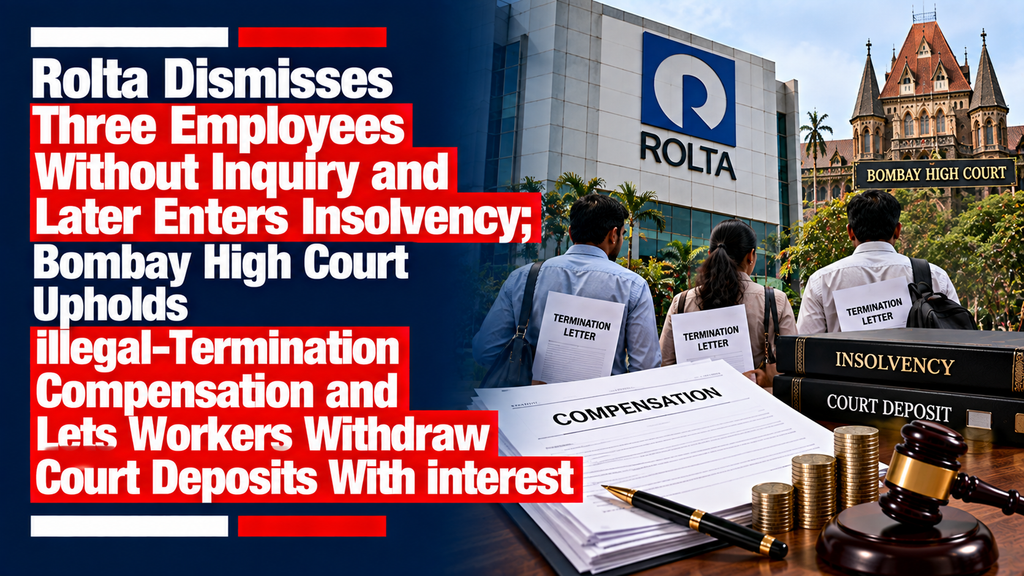
Rolta Dismisses Three Employees Without Inquiry and Later Enters Insolvency; Bombay High Court Upholds Illegal-Termination Compensation and Lets Workers Withdraw Court Deposits With Interest

Workers’ Compensation Awards Pre-Date Rolta’s Insolvency Resolution; Bombay High Court Says Crystallised Court Deposits Belong to Employees and Cannot Return to New Management
Facts
Rolta India Limited employed Anil Vishwanath Nandoskar, Milind Krishna Gawade and Sanil Suresh Manjrekar as Data Preparation Operators. The company transferred them from Mumbai to Chennai, Calcutta and Chandigarh respectively. The employees challenged the transfers as an unfair labour practice before the Industrial Court, Mumbai, but were denied interim relief and consequently reported at their transferred locations.
The employees later applied for leave and returned to Mumbai. On 7 June 2004, Rolta terminated their services through composite ‘charge sheet-cum-dismissal orders’, alleging refusal to join and work at the transferred places. No domestic inquiry was held before dismissal.
The employees sought reinstatement. References were made to the Eleventh Labour Court, Mumbai. By Awards dated 7 February 2011, the Labour Court held the terminations illegal but declined reinstatement, continuity of service and back wages. Instead, it awarded each employee Rs.2,50,000 with interest at 6% per annum from 21 December 2005 until realisation.
Both sides challenged the Awards. Rolta challenged the finding of illegal termination, while the employees sought greater relief. When Rolta’s writ petitions were admitted on 4 July 2011, the Bombay High Court stayed implementation on condition that Rolta deposit the awarded compensation. Those amounts remained invested in fixed deposits with the Court.
Much later, Rolta entered the Corporate Insolvency Resolution Process on 19 January 2023. A resolution plan was accepted and new management took over with effect from 15 December 2023. Rolta then argued that the employees had not registered their claims before the Resolution Professional and, under the IBC ‘clean slate’ principle, their claims stood extinguished. It sought withdrawal of the amounts deposited in Court.
By the time the petitions were finally heard, the employees no longer sought reinstatement or back wages because they had secured alternate employment. They were willing to accept the entire deposited amounts with accrued interest as compensation.
Issues
Whether the Labour Court’s finding that the employees were illegally terminated without inquiry and in violation of natural justice required interference.
Whether the employees’ rights under the 7 February 2011 Labour Court Awards survived Rolta’s subsequent CIRP and approval of the resolution plan in 2023.
Whether amounts deposited by Rolta in the High Court as a condition for stay of the Labour Court Awards could be reclaimed by the new management as assets of the corporate debtor under the IBC ‘clean slate’ principle.
Whether the employees were entitled to withdraw the deposited compensation together with accrued interest despite not registering claims before the Resolution Professional.
Petitioner’s Arguments
Rolta contended that CIRP had been initiated against the company and the approved resolution plan had resulted in new management taking over the company. It invoked the ‘clean slate’ principle and argued that because the employees had not registered their claims before the Resolution Professional, those claims stood extinguished and could not be imposed upon the successful resolution applicant.
Rolta relied principally upon Ahmednagar Forgings Limited v. Dongare Ganesh D. to contend that employee claims omitted from an approved resolution plan cannot survive the plan.
It further argued that the money deposited in the High Court remained an asset of the corporate debtor and therefore belonged to the new management. In support, it relied upon Siti Networks Limited v. Rajiv Suri, Reliance Naval and Engineering Limited v. Afcons Infrastructure Limited, and the Delhi High Court decision in McNally Bharat Engineering Company Limited v. Metso India Pvt. Ltd.
Rolta accordingly sought disposal of the petitions in light of the approved resolution plan and permission for the new management to withdraw the entire deposited amounts with accrued interest.
Respondent’s Arguments
The employees argued that the Labour Court Awards were passed on 7 February 2011, almost twelve years before commencement of CIRP. Their rights had therefore already been adjudicated and crystallised long before insolvency proceedings commenced.
They contended that the subsequent CIRP and resolution plan could not extinguish rights already crystallised under final industrial adjudication.
The employees further submitted that the amounts deposited in the High Court were not freely available corporate assets. They had been deposited pursuant to the Court’s conditional stay order specifically to secure the monetary entitlement created by the Labour Court Awards. Reliance was placed on Rajendra Prasad Bansal v. Reliance Communication Limited.
The employees gave up their claims for reinstatement and back wages and restricted their relief to withdrawal of the deposited compensation with accrued interest.
Analysis of the Law
The High Court first examined the legality of termination. Rolta had dismissed the employees through composite charge-sheet-cum-dismissal orders without holding any inquiry. The Court held that the dismissals were effected in gross violation of natural justice. Rolta did not demonstrate that the Labour Court’s finding of illegal termination was perverse. The finding was therefore upheld.
The principal legal question then shifted to the interaction between the Labour Court Awards and Rolta’s later insolvency resolution. The Court distinguished between claims that remain pending and unadjudicated when CIRP begins and rights that have already been finally adjudicated before CIRP.
Here, the Labour Court had adjudicated the references on 7 February 2011. CIRP began only on 19 January 2023 and the resolution plan was approved on 15 December 2023. The employees’ monetary rights under the Awards had therefore crystallised years before the insolvency process.
The Court also considered the legal character of money deposited during labour litigation. It explained that High Courts frequently require an employer challenging a monetary labour award to deposit the awarded sum as a condition of stay. Such a deposit secures the workman’s entitlement during the employer’s challenge and prevents prolonged litigation from defeating the benefit of the award.
The Court stated that, in labour-related disputes, an amount deposited to secure an award actually belongs to the workman or employee for whose benefit it is secured. Payment is merely delayed while the challenge remains pending.
Although the parties debated whether every court deposit becomes part of the corporate debtor’s assets, the Court found it unnecessary to decide that broad proposition. In this case, the Awards had attained finality and the particular deposits represented the employees’ crystallised entitlement. Their failure to withdraw the money before CIRP did not automatically transfer entitlement to the new management.
Precedent Analysis
Ahmednagar Forgings Limited v. Dongare Ganesh D. was the principal authority relied upon by Rolta. In that case, CIRP commenced while the employees’ industrial proceedings were still pending. The resolution plan was later approved without providing for those claims. Applying Supreme Court authority including Electrosteel Steel Limited v. Ispat Carrier Private Limited and Committee of Creditors of Essar Steel India Ltd. v. Satish Kumar Gupta, the Court had held that claims outside the approved resolution plan stood extinguished.
The present Court distinguished Ahmednagar Forgings on facts. Here, the industrial references were not pending when CIRP commenced. They had been finally adjudicated by Awards dated 7 February 2011, long before the 2023 CIRP. Thus, unlike an undecided labour claim, the employees already possessed crystallised rights.
Rajendra Prasad Bansal v. Reliance Communication Limited was relied upon by the employees for the proposition concerning amounts deposited under court control. The Court considered this line of authority while explaining that labour deposits are made to secure the employee’s adjudicated entitlement.
Rolta also relied on Siti Networks Limited v. Rajiv Suri, Reliance Naval and Engineering Limited v. Afcons Infrastructure Limited, and McNally Bharat Engineering Company Limited v. Metso India Pvt. Ltd. concerning the status of deposits and the effect of insolvency resolution. The Court ultimately held that it was unnecessary to decide the broad conflict over whether every court deposit constitutes an asset of the corporate debtor because the deposits in this case were made pursuant to Awards that had already attained finality.
Court’s Reasoning
The Court found no basis to disturb the Labour Court’s conclusion that the terminations were illegal. Rolta had dismissed the employees without holding an inquiry and in total violation of natural justice, and it did not establish perversity in the Labour Court’s finding.
The employees had meanwhile abandoned their challenge seeking reinstatement and back wages. Consequently, the Labour Court Awards awarding monetary compensation could be maintained.
The decisive distinction for insolvency purposes was chronology. The employees’ claims had been adjudicated in 2011; CIRP commenced only in 2023. Their rights to benefits under the Awards had therefore crystallised before the insolvency process.
The Court observed that if Section 14 IBC were strictly applied to Rolta’s pending writ petitions, those employer challenges would abate, leaving the Awards final. Because Rolta had deposited the compensation as a condition of obtaining stay, the employees’ right to withdraw the secured amounts had also crystallised.
The Court rejected the proposition that the mere fact that the employees had not sought withdrawal before CIRP meant the new management acquired the money. The deposits existed specifically to secure the employees’ entitlement while Rolta’s challenge was pending.
The approximate maturity values recorded by the Court were Rs.5,30,224 and Rs.2,05,838 for Anil Nandoskar; Rs.5,30,224 and Rs.2,12,050 for Milind Gawade; and Rs.5,30,224 and Rs.2,05,837 for Sanil Manjrekar, subject to actual maturity.
The Court therefore permitted all three employees to withdraw the entire deposited amounts with accrued interest. It clarified that these sums would represent the compensation payable under the Labour Court Awards and that the employees would not be entitled to any further service-related benefits.
After pronouncement, Rolta sought a four-week stay of the operative order. The High Court refused the request.
Conclusion
The Bombay High Court upheld the Labour Court’s finding that Rolta had illegally terminated the three employees without inquiry and in violation of natural justice.
It held that the employees’ rights under the 7 February 2011 Awards had crystallised long before Rolta entered CIRP in 2023. The later resolution plan and ‘clean slate’ principle did not entitle the new management to take back money that had been deposited in Court to secure those already adjudicated awards.
The Court left the Labour Court Awards undisturbed and permitted Anil Vishwanath Nandoskar, Milind Krishna Gawade and Sanil Suresh Manjrekar to withdraw the entire amounts deposited by Rolta together with accrued interest. Those amounts were to be treated as their compensation. No further service-related benefits were payable.
All connected writ petitions were disposed of, and Rolta’s request for a four-week stay was rejected.
Case Details
Case: Rolta India Limited v. Anil Vishwanath Nandoskar & connected matters, including Sanil Suresh Manjrekar v. Rolta India Limited
Court: High Court of Judicature at Bombay, Ordinary Original Civil Jurisdiction
Case Number: Writ Petition Nos. 1049, 1050, 1051, 1537, 1565 and 1566 of 2011
Judge: Justice Sandeep V. Marne
Date: 1 October 2026Result: Labour Court Awards upheld; employees permitted to withdraw the entire amounts deposited by Rolta with accrued interest as compensation; no further service-related benefits; all writ petitions disposed of; employer’s request for stay rejected.