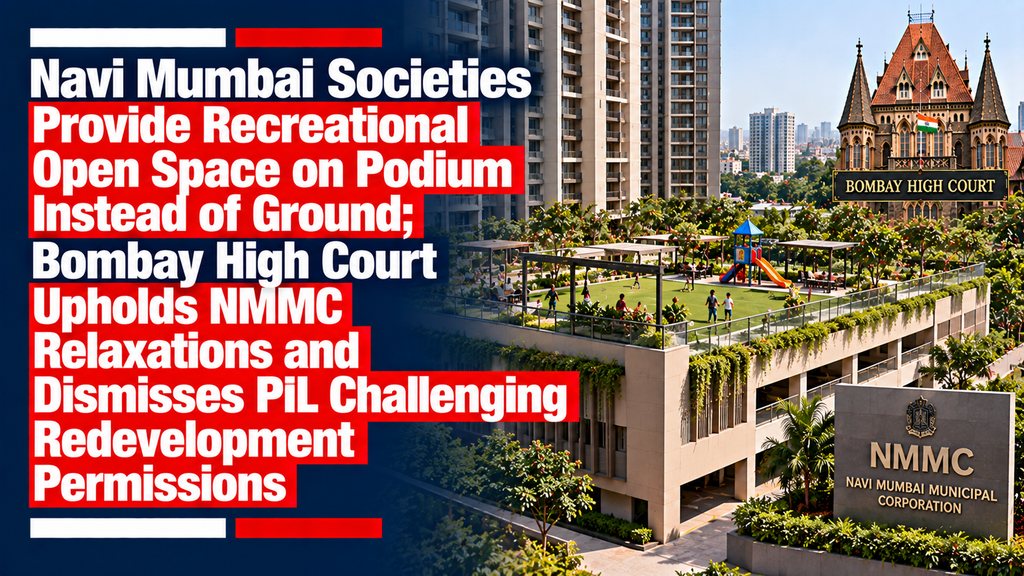
Navi Mumbai Societies Provide Recreational Open Space on Podium Instead of Ground; Bombay High Court Upholds NMMC Relaxations and Dismisses PIL Challenging Redevelopment Permissions

PIL Challenges Podium-Level Open Spaces in CIDCO Redevelopment Projects; Bombay High Court Says UDCPR Permits Entire Recreational Open Space on Podium if Open-to-Sky
Facts
Sandeep S. Thakur filed a Public Interest Litigation under Article 226 challenging development permissions granted by the State of Maharashtra and the Navi Mumbai Municipal Corporation (NMMC) to five cooperative housing societies, including Seaview Residency Cooperative Housing Society, for redevelopment projects in Navi Mumbai.
The dispute concerned the requirement of Recreational Open Space (ROS) under the Unified Development Control and Promotion Regulations, 2020 (UDCPR). The petitioner contended that Regulation 10.10.2(3)(vi), applicable to CIDCO/NMMC redevelopment, required 10% or 15% ROS, depending upon plot area, to be provided on the ground, clearly open-to-sky, over and above the podium garden.
The petitioner alleged that NMMC had improperly granted concessions to Respondent Nos.3 to 7 permitting ROS to be provided under the general provisions of Regulation 3.4.1, including at podium level, instead of insisting upon the stipulated ROS on ground. He sought withdrawal of the concessions and quashing of the development permissions.
The respondent societies explained that the redevelopments involved old and dilapidated CIDCO buildings, rehabilitation obligations, height restrictions, road setbacks and substantial parking requirements. They contended that these planning constraints justified case-specific relaxation under Regulation 2.4 and that the total prescribed ROS had not been reduced.
In the case of Seaview Residency, the Court recorded the submission that 15% of the net land area of 7,428.853 sq. metres worked out to approximately 1,114.328 sq. metres. The society stated that 1,264.693 sq. metres was provided at the sixth-floor podium level, 146.118 sq. metres at ground level, together with other open-space/amenity components.
Issue
Whether Regulation 10.10.2(3)(vi) mandatorily requires the prescribed Recreational Open Space in CIDCO/NMMC redevelopment projects to be provided on natural ground or ‘mother earth’, thereby prohibiting its provision at podium level.
Whether the non obstante clause in Chapter 10 of the UDCPR excludes the operation of general Regulations such as Regulations 2.4, 3.4.1, 3.4.7 and 9.13.
Whether NMMC could exercise discretionary power under Regulation 2.4 to relax or modify the manner in which ROS was provided in individual redevelopment projects.
Whether the petitioner established arbitrariness, perversity, fabrication or other illegality in the concessions and development permissions granted to the respondent societies.
Petitioner’s Arguments
The petitioner argued that Chapter 10 is a city-specific regime and that its non obstante clause gives Regulation 10.10.2 overriding effect over the general provisions of the UDCPR.
He contended that Regulation 10.10.2(3)(vi) expressly requires compulsory ROS to be provided ‘on ground’, ‘clearly open-to-sky’ and ‘over and above podium garden’. Therefore, according to him, podium-level ROS could not substitute the mandatory ground-level open space.
He alleged that NMMC had selectively granted concessions to certain developers and societies, defeating the planning intent behind mandatory open spaces and potentially forcing residents to use public recreational spaces in the vicinity.
He also relied on information obtained through RTI proceedings and contended that the concessions were impermissible departures from a mandatory development regulation.
Respondents’ Arguments
The societies and NMMC contended that the UDCPR must be read as an integrated regulatory scheme. The non obstante language in Chapter 10 operates only where there is an actual conflict and does not automatically displace all general regulations.
They argued that Regulations 3.4.1, 3.4.7 and 9.13 permit ROS at podium level so long as it remains open-to-sky, and Regulation 2.4 expressly gives the planning authority discretionary power to modify dimensions or provisions in cases of demonstrable hardship, subject to health, fire, structural and public-safety safeguards.
The respondents emphasised practical redevelopment constraints, including rehabilitation of existing members, airport-related height restrictions, road setbacks and extensive parking requirements. They maintained that the concessions concerned the location or fragmentation of ROS and did not eliminate the prescribed quantum of open space.
They further argued that the PIL was delayed, selectively targeted only certain societies and lacked factual material showing that NMMC’s exercise of discretion was arbitrary, mala fide or based on false information.
Entire Recreational Open Space Can Be Provided on Podium
The High Court held that the expression ‘over and above podium garden’ must be understood in the context of the UDCPR as a whole. Reading Regulations 10.10.2(3)(vi), 9.13, 3.4.1(iii), 3.4.7 and the definition of podium together, the Court concluded that 100% of the required ROS can be provided at podium level, provided that it is entirely open-to-sky and the podium garden is also provided.
The Court observed that the statutory definition of ROS does not use expressions such as ‘natural ground’, ‘mother earth’, ‘virgin soil’ or ‘at-grade location’, nor does it expressly prohibit ROS on a podium. The Court therefore declined to introduce such limitations into the regulations by implication.
Regulation 2.4 Permits Case-Specific Relaxation
The Court held that the discretionary power under Regulation 2.4 remains applicable and must be exercised on a case-to-case basis. It permits modification of dimensions or provisions where clearly demonstrable hardship exists, provided the relaxation does not compromise health, fire, structural or public safety.
The fact that NMMC had granted the concession to only five of seven plots considered by the petitioner was treated as an indication that the authority had not mechanically granted a blanket exemption but had applied its mind to individual cases.
Non Obstante Clause Does Not Wipe Out the General UDCPR
The Court rejected the proposition that the word ‘notwithstanding’ in Chapter 10 excludes Regulations 2.4, 3.4.1, 3.4.7 and 9.13 altogether. Such an interpretation would make significant parts of Chapter 10 unworkable.
Applying the principle of harmonious construction, the Court held that the city-specific provisions prevail only to the extent of an actual inconsistency. General UDCPR provisions continue to govern city-specific development where they do not conflict with Chapter 10.
The Court relied upon Mohd. Abdul Samad v. State of Telangana to explain that a non obstante clause operates to resolve conflict and should not be construed more widely than necessary. It consequently held that Regulation 10.10.2(3)(vi) cannot be treated as overriding every other operative provision of the UDCPR.
No Factual Foundation for Alleged Abuse of Planning Power
The Court found no material showing that the planning constraints placed before NMMC were concocted, imaginary or false. Nor had the petitioner demonstrated that permissions granted to the respondent societies were obtained through fabricated documents or false reports.
The petitioner’s contention that residents would necessarily crowd public recreational spaces if ROS was not located at ground level was held to be an unsubstantiated assertion. The Court found no factual foundation for this claimed public consequence.
The Court also held that the petitioner had failed to establish perversity in NMMC’s exercise of discretionary power under Regulation 2.4 sufficient to warrant interference under Article 226.
NGT Order Did Not Affect Earlier Environmental Clearance
The petitioner relied upon an order of the National Green Tribunal dated 13 September 2022. The High Court held that this did not assist him in relation to the relevant redevelopment where environmental clearance had already been issued on 30 August 2022, since the subsequent NGT order could not be applied retrospectively.
Court’s Observations on PIL, Transparency and Civic Participation
Although the PIL ultimately failed, the Court initially acknowledged that the petitioner’s concern appeared to reflect a genuine public interest in ensuring that architects, developers and planning authorities do not misuse professional expertise to defeat mandatory planning requirements.
At the same time, the Court recorded factors weighing against the petitioner: absence of town-planning expertise, failure to raise the issue earlier, selective challenge to only five societies, and lack of particulars showing why the concessions were arbitrary.
The Court was critical of opacity in civic administration. It observed that public authorities must be transparent and should not ‘play hide and seek’ with information sought by citizens. It encouraged civic authorities to improve communication, public participation and openness, including through meetings or digital platforms for grievances and community oversight.
Court’s Reasoning
The Court read the UDCPR holistically rather than treating Regulation 10.10.2 as a self-contained code. It found that the general development regulations and the city-specific provisions are capable of harmonious operation.
On this construction, the mandatory quantum of ROS applicable to CIDCO/NMMC projects remains protected, but its provision at podium level is not prohibited merely because it is not on natural ground. What is material is that the required ROS remains clearly open-to-sky and that the applicable planning requirements are satisfied.
NMMC’s Regulation 2.4 discretion was legally available, and the petitioner failed to establish that its exercise in the impugned redevelopment permissions was arbitrary, perverse or based on false material.
Accordingly, the legal foundation for quashing the development permissions failed.
Conclusion
The Bombay High Court dismissed Public Interest Litigation No.26 of 2024 and declined to interfere with the redevelopment permissions granted to the respondent societies.
The Court held that the UDCPR permits the required Recreational Open Space to be provided at podium level, including 100% of the ROS, provided it is entirely open-to-sky and the relevant regulatory conditions are satisfied. Regulation 2.4 continues to confer case-specific discretionary relaxation upon the planning authority.
The Court further held that Chapter 10’s non obstante clause does not exclude the general UDCPR provisions except to the extent of an actual conflict. The petitioner had failed to establish perversity or illegality in NMMC’s exercise of discretion. The connected Interim Application was also disposed of.
Case Details
Case: Sandeep S. Thakur v. State of Maharashtra & Ors.
Neutral Citation: 2026:BHC-AS:39993-DB
Court: High Court of Judicature at Bombay, Civil Appellate Jurisdiction
Case Number: Public Interest Litigation No. 26 of 2024 with Interim Application No. 4772 of 2026
Bench: Justice A. S. Gadkari and Justice Kamal Khata
Judgment by: Justice Kamal Khata
Reserved on: 6 July 2026
Pronounced on: 1 October 2026
Key Regulations: UDCPR Regulations 2.4, 3.4.1, 3.4.7, 9.13 and 10.10.2Result: PIL dismissed; connected Interim Application disposed of.