

HEADNOTE
Case Title: Kaushlender Bhardwaj v. State (NCT of Delhi) & Anr.
Court: Delhi High Court
Bench: Hon’ble Mr. Justice Girish Kathpalia
Date of Judgment: 21 January 2026
Case Number: W.P. (Crl.) No. 222/2026
Laws/Sections Involved:
Section 279, Indian Penal Code, 1860 (rash driving);
Section 337, Indian Penal Code, 1860 (causing hurt by act endangering life);
Article 226, Constitution of India (inherent writ jurisdiction)
Keywords: quashing of FIR, compromise, rash and negligent driving, minor injuries, Section 279 IPC, Section 337 IPC, Delhi High Court
Summary
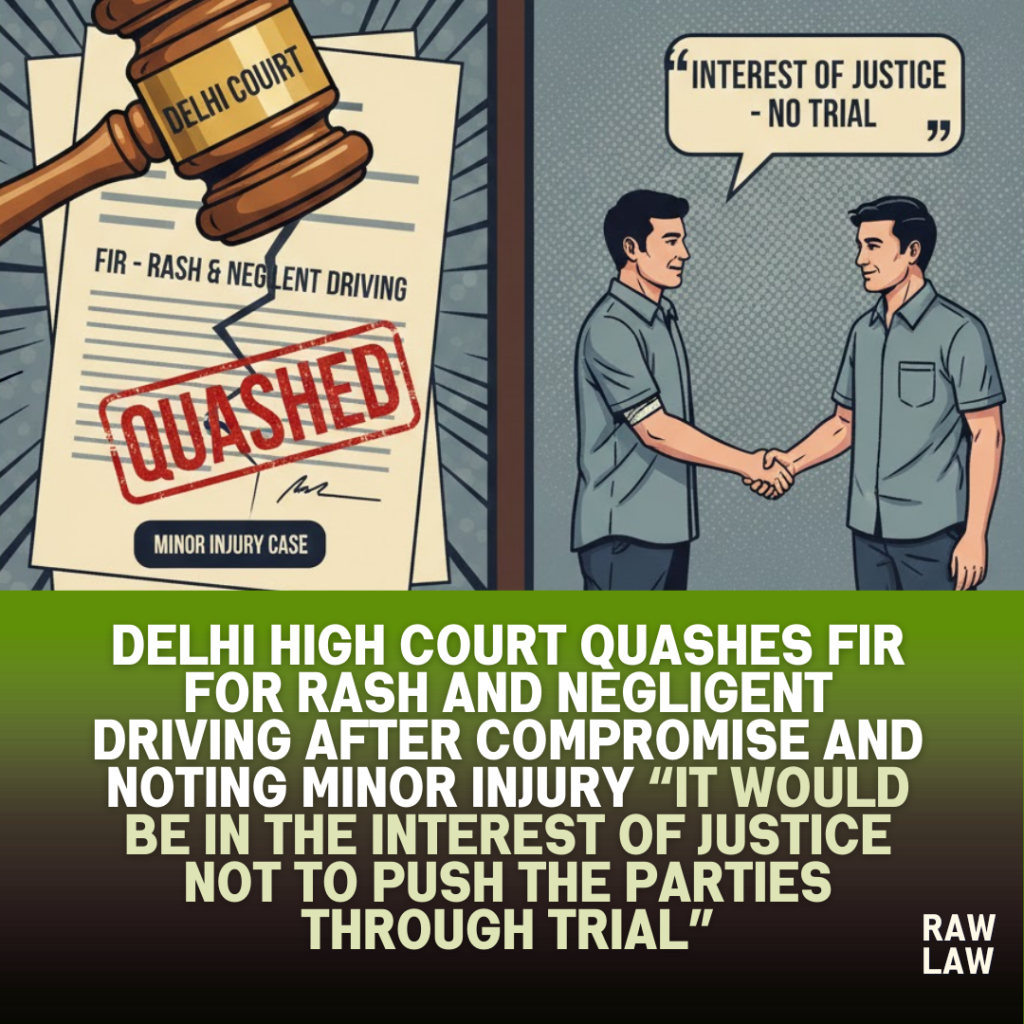
The Delhi High Court quashed an FIR registered under Sections 279 and 337 IPC against Kaushlender Bhardwaj after noting that the complainant had amicably settled the dispute and did not wish to pursue the criminal proceedings. The Court observed that the alleged incident involved a road accident resulting in only a minor abrasion, as reflected in the medical record, and that even the complainant was suspected to be under the influence of alcohol at the time of the incident. Taking into account the consensual settlement, the nature of injuries, and the State’s no-objection to quashing, the Court held that continuation of the criminal proceedings would serve no useful purpose. Emphasising that criminal law should not be used to perpetuate avoidable litigation in minor offences, the Court exercised its inherent jurisdiction to secure the ends of justice and prevent abuse of process.
Court’s decision
The Delhi High Court exercised its writ jurisdiction to quash FIR No. 639/2022 registered at Police Station Narela under Sections 279 and 337 of the IPC, holding that continuation of the criminal proceedings would not serve the ends of justice. Justice Girish Kathpalia noted that the complainant and the accused had amicably resolved their dispute and that the complainant categorically expressed his unwillingness to pursue the trial. In light of the compromise, the minor nature of injuries, and the State’s express no-objection, the Court concluded that forcing the parties to undergo a full-fledged criminal trial would amount to unnecessary harassment and abuse of the judicial process.
Factual background
The FIR stemmed from a road accident allegedly caused by the petitioner, Kaushlender Bhardwaj, who was accused of driving his vehicle in a rash and negligent manner and hitting the complainant. On the basis of this allegation, the police registered an FIR under Sections 279 and 337 IPC, dealing with rash driving and causing hurt by an act endangering life or personal safety.
During the pendency of the proceedings, the parties arrived at an amicable settlement. The complainant (respondent no. 2) appeared before the Court along with his counsel and stated unequivocally that he had resolved the dispute with the petitioner and did not wish to continue with the criminal case.
Stand of the State and the complainant
The learned Additional Standing Counsel appearing for the State, on instructions from the Investigating Officer, informed the Court that the prosecution had no objection to the FIR being quashed in view of the settlement between the parties. The complainant was personally identified by the Investigating Officer and confirmed before the Court that the compromise was voluntary and without any coercion.
This convergence of positions—between the accused, the complainant, and the State—played a significant role in the Court’s assessment of whether continuation of the proceedings was warranted.
Medical evidence and surrounding circumstances
A notable aspect of the Court’s reasoning was its reference to the medical evidence on record. The medico-legal certificate reflected only a single abrasion on the back of the complainant, indicating that the injury suffered was minor in nature. The Court also took note of the doctor’s observation in the MLC that the complainant was suspected to be under the influence of alcohol at the time of the incident.
While the Court did not delve into the merits of culpability, these surrounding circumstances were relevant in assessing whether the case involved any element of grave public interest warranting prosecution despite the settlement.
Legal principles governing quashing on compromise
The judgment implicitly applies settled principles laid down by the Supreme Court that criminal proceedings involving non-heinous offences, particularly those arising out of personal disputes or accidents causing minor injuries, can be quashed on the basis of compromise if continuation of the proceedings would amount to abuse of process and if the quashing does not adversely affect societal interests.
Sections 279 and 337 IPC, though not compoundable under Section 320 CrPC, have repeatedly been held by constitutional courts to be amenable to quashing under inherent or writ jurisdiction where the offence is private in nature, injuries are minor, and the victim has voluntarily settled the dispute.
Court’s reasoning
Justice Kathpalia observed that the object of criminal law is not to compel parties to litigate when the underlying dispute has been resolved and no public interest is at stake. The Court was satisfied that the compromise was genuine and that the injuries were not serious. In such circumstances, insisting on a criminal trial would neither advance justice nor serve any deterrent purpose.
The Court succinctly observed that it would be “in the interest of justice” not to push the parties through a trial, thereby emphasising judicial economy and the need to prevent misuse of criminal proceedings in minor matters.
Final order
Accordingly, the High Court allowed the writ petition and quashed FIR No. 639/2022 registered at Police Station Narela under Sections 279 and 337 IPC, along with all proceedings arising therefrom. The Court clarified that the quashing was based on the peculiar facts of the case, including the compromise and the minor nature of the alleged injuries.
Conclusion
The ruling reaffirms the Delhi High Court’s pragmatic approach in dealing with criminal cases arising out of minor road accidents. By prioritising settlement, proportionality, and judicial efficiency, the Court ensured that criminal law was not used as a punitive tool where reconciliation had already been achieved.
Implications
This decision strengthens the jurisprudence on quashing FIRs in cases of minor offences under the IPC, particularly road accident cases involving simple injuries. It underscores that where parties have settled amicably and no overriding public interest is involved, courts should lean in favour of closure rather than prolonged criminal trials.
Also Read: Delhi High Court clarifies GST appellate jurisdiction in multi-noticee ITC fraud cases


