

HEADNOTE
Nisha (Respondent No.2) v. State (GNCT of Delhi) & Anr. (arising from FIR No.115/2016)
Court: High Court of Delhi
Bench: Justice Amit Mahajan
Date of Judgment: 11 December 2025
Citation: CRL.M.C. 8880/2025
Laws / Sections Involved: Sections 498A, 406, 34 IPC; Sections 4 & 5 Dowry Prohibition Act, 1961; Section 528 Bharatiya Nagarik Suraksha Sanhita, 2023 (erstwhile Section 482 CrPC)
Keywords: FIR quashing, matrimonial dispute, Section 498A IPC, Dowry Prohibition Act, settlement, inherent powers
Summary:
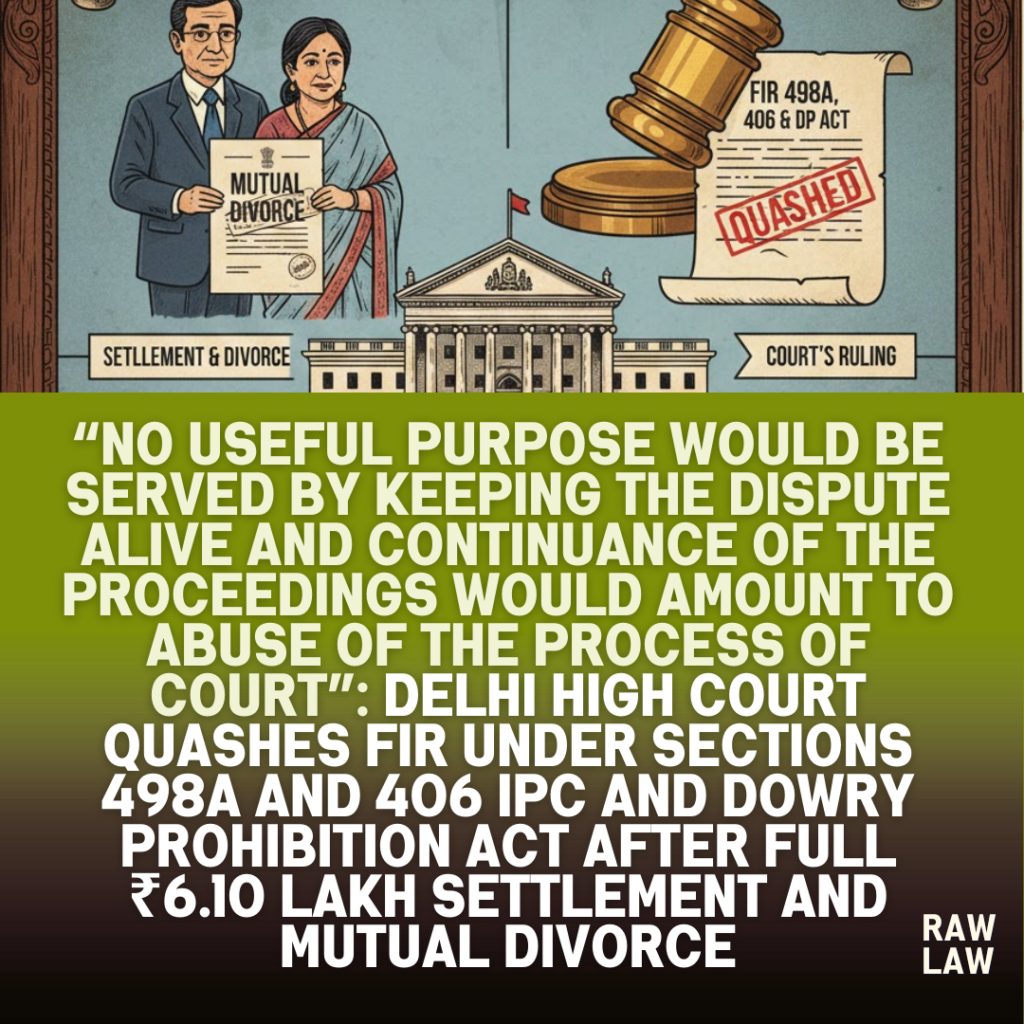
The Delhi High Court quashed a nine-year-old FIR registered for offences under Sections 498A and 406 IPC and Sections 4 and 5 of the Dowry Prohibition Act after noting that the matrimonial dispute between the parties had been amicably resolved through mediation. The Court recorded that the spouses had obtained a decree of divorce by mutual consent and that the entire settlement amount of ₹6.10 lakh had been paid to the complainant-wife, who raised no objection to quashing of proceedings. Relying on settled Supreme Court jurisprudence, the Court held that continuation of criminal proceedings arising out of a purely matrimonial dispute would amount to abuse of the process of law. Emphasising that the object of criminal law is not to perpetuate private disputes once parties have settled, the Court exercised its inherent powers to secure the ends of justice.
Court’s decision
The Delhi High Court allowed the petition and quashed FIR No. 115/2016 registered at Police Station Jyoti Nagar for offences under Sections 498A, 406 and 34 IPC and Sections 4 and 5 of the Dowry Prohibition Act, along with all consequential proceedings. The Court held that in light of the complete and voluntary settlement between the parties, continuation of the criminal case would serve no useful purpose and would amount to abuse of the process of law. Exercising its inherent powers under Section 528 of the Bharatiya Nagarik Suraksha Sanhita, the Court secured the ends of justice by bringing the long-standing matrimonial dispute to a close.
Facts
The marriage between petitioner no.1 and respondent no.2 was solemnised on 9 July 2011 in accordance with Hindu rites and customs. One child was born out of the wedlock. Over time, matrimonial discord arose between the parties, leading to separation. In February 2016, the wife lodged a complaint alleging cruelty and dowry-related harassment by her husband and his family members, which culminated in registration of FIR No.115/2016 under Sections 498A and 406 IPC and Sections 4 and 5 of the Dowry Prohibition Act. Petitioners no.2 and 3 were family members of the husband. Criminal proceedings remained pending for several years.
Issues
The principal issue before the High Court was whether criminal proceedings involving non-compoundable offences under Section 498A IPC and the Dowry Prohibition Act could be quashed in exercise of inherent powers, on the basis of a voluntary settlement between the estranged spouses. The Court was also required to consider whether the nature of the allegations justified continuation of prosecution despite the fact that the parties had amicably resolved all disputes, obtained divorce by mutual consent, and fulfilled the financial terms of settlement.
Petitioner’s arguments
The petitioners submitted that the entire dispute was matrimonial in nature and had been amicably settled before the Delhi Mediation Centre, Karkardooma Courts, through a written settlement dated 30 July 2025. It was argued that the spouses had already obtained a decree of divorce by mutual consent and intended to move on peacefully with their lives. The petitioners pointed out that out of the total settlement amount of ₹6.10 lakh, ₹5.10 lakh had already been paid and the balance ₹1 lakh was handed over to the complainant-wife by demand draft in Court. It was contended that continuation of criminal proceedings would be oppressive and purposeless.
Respondent’s arguments
Respondent no.2, the complainant-wife, appeared in person before the Court and categorically stated that she had received the entire settlement amount and had no objection to quashing of the FIR and all proceedings arising therefrom. The State, represented by the Additional Public Prosecutor, did not oppose the petition in view of the settlement and the nature of the dispute. It was acknowledged that while some of the offences were non-compoundable, the High Court possessed inherent powers to quash proceedings to secure the ends of justice.
Analysis of the law
The Court examined the scope of its inherent powers under Section 528 of the Bharatiya Nagarik Suraksha Sanhita, 2023, which preserves the High Court’s authority to prevent abuse of process and to secure justice. The Court reiterated that the power to quash criminal proceedings on the basis of settlement is distinct from statutory compounding under criminal procedure law. While certain offences are non-compoundable, the High Court can still intervene where the dispute is essentially private, personal, and does not have a serious societal impact. Matrimonial disputes, particularly those arising out of marital discord, stand on a different footing from heinous crimes.
Precedent analysis
The Court relied extensively on Supreme Court precedents governing quashing of criminal proceedings on the basis of compromise. Reference was made to Narinder Singh v. State of Punjab, where the Supreme Court laid down guiding principles for accepting settlements, emphasising the need to secure ends of justice and prevent abuse of process. The Court also referred to Parbatbhai Aahir v. State of Gujarat, which summarised the jurisprudence on quashing non-compoundable offences, holding that criminal cases with predominant civil or matrimonial flavour may be quashed if the possibility of conviction is remote and continuation would cause injustice.
Court’s reasoning
Justice Amit Mahajan observed that the dispute in the present case arose purely out of a matrimonial relationship and that the parties had resolved their differences completely and voluntarily. The Court noted that the complainant-wife had affirmed receipt of the entire settlement amount and had expressly consented to quashing of the FIR. In such circumstances, the likelihood of conviction was remote, as the complainant herself no longer wished to pursue the allegations. The Court reasoned that keeping the criminal proceedings alive would only prolong bitterness and amount to misuse of the judicial process.
Conclusion
The High Court concluded that the present case was a fit one for exercise of inherent powers. FIR No.115/2016 and all consequential proceedings were quashed. The Court clarified that it had not examined the legality of the settlement itself or any issues relating to custody or rights of the minor child, and expressly safeguarded the legal rights of the child, making it clear that the present order would not affect those rights in any manner. The petition was accordingly allowed.
Implications
This judgment reaffirms the consistent judicial approach that criminal proceedings arising from matrimonial disputes should not be allowed to continue once parties have genuinely settled their differences. It underscores the role of mediation and negotiated settlements in reducing prolonged criminal litigation in family matters. The ruling also reinforces that while offences under Section 498A IPC and the Dowry Prohibition Act are non-compoundable, High Courts retain broad inherent powers to quash such proceedings in appropriate cases to prevent abuse of process and to promote finality and peace between parties.
CASE LAW REFERENCES
• Narinder Singh v. State of Punjab – Guidelines for quashing criminal proceedings on settlement
• Parbatbhai Aahir v. State of Gujarat – Principles governing inherent powers to quash non-compoundable offences
• Gian Singh v. State of Punjab – Matrimonial disputes with civil flavour can be quashed after settlement
FAQs
Q1. Can FIRs under Section 498A IPC be quashed after settlement?
Yes. High Courts can quash such FIRs if the dispute is matrimonial in nature and parties have voluntarily settled.
Q2. Are Dowry Prohibition Act offences compoundable?
They are non-compoundable, but can still be quashed by the High Court under inherent powers in appropriate cases.
Q3. Does quashing affect children’s legal rights?
No. Courts generally clarify that rights of minor children remain unaffected.


