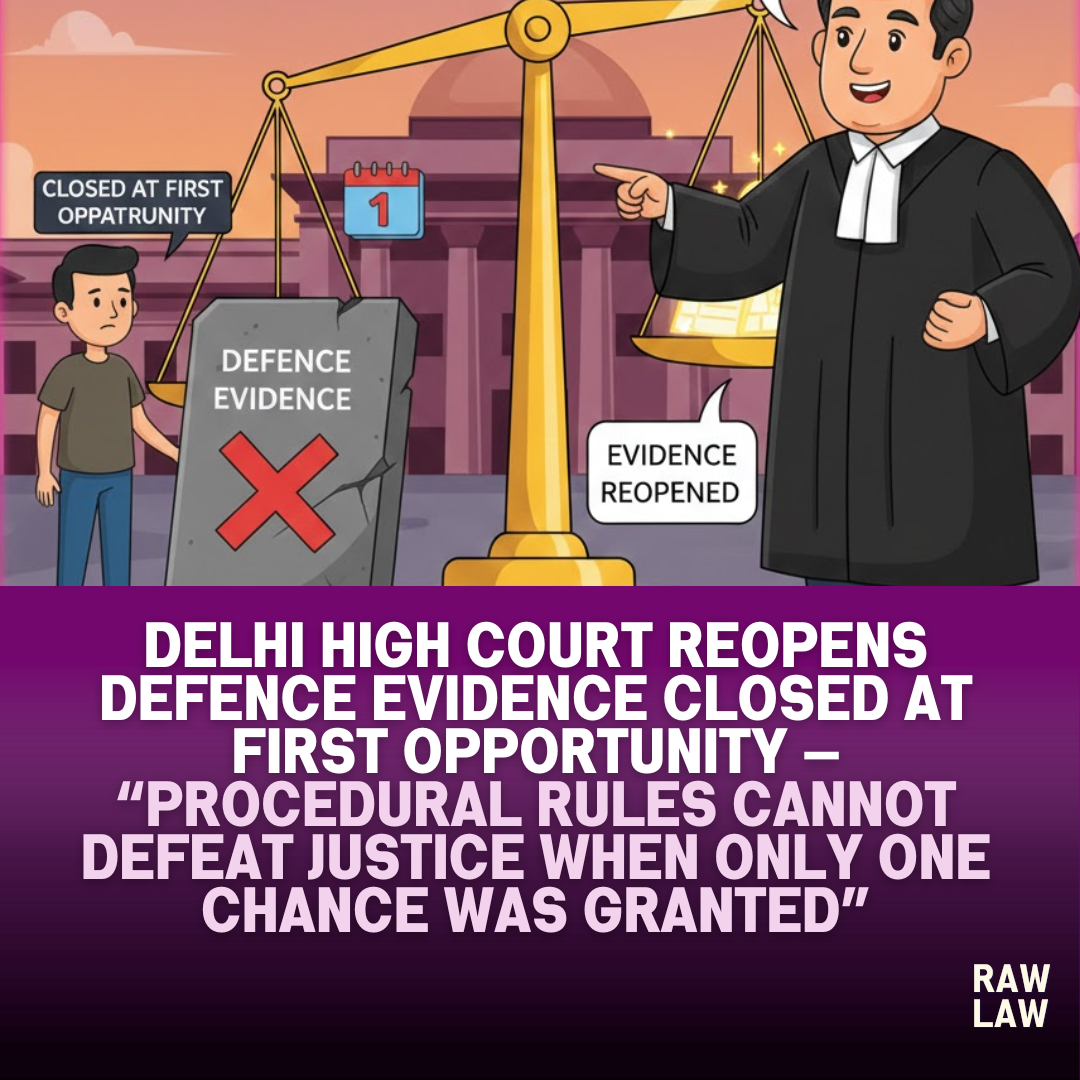
Delhi High Court reopens defence evidence closed at first opportunity — “Procedural rules cannot defeat justice when only one chance was granted”

Court’s decision
The Delhi High Court set aside a trial court order that had closed the defendant’s evidence at the very first opportunity and granted one final chance to lead evidence. Holding that such mechanical closure was unduly harsh, the Court ruled that where only a single opportunity has been afforded, denial of further chance would cause grave injustice. Emphasising that procedural law is meant to advance justice and not thwart it, the Court exercised supervisory jurisdiction under Article 227 of the Constitution to reopen the defence evidence.
Facts
The petition arose from a civil suit pending before a Delhi trial court, where the petitioner was arrayed as a defendant. The plaintiff’s evidence in the suit was concluded on 24 May 2018. Thereafter, the matter was listed for recording of the defendant’s evidence on 13 August 2018.
On the said date, no defence witness was present before the trial court. Without granting any further opportunity or considering the consequences of closure, the trial court passed an order closing the evidence of the defendant. Aggrieved by this order, the defendant approached the Delhi High Court under Article 227 of the Constitution, contending that the closure of evidence at the very first opportunity was arbitrary and resulted in serious prejudice.
Issues
The primary issue before the High Court was whether the trial court acted within its jurisdiction in closing the defendant’s evidence after granting only one opportunity. The Court was also required to consider whether supervisory interference under Article 227 was justified to prevent miscarriage of justice arising from rigid application of procedural rules.
Petitioner’s arguments
The petitioner argued that the trial court adopted an excessively technical approach by closing the defence evidence on the very first date fixed for that purpose. It was contended that civil disputes should ordinarily be decided after affording parties a reasonable opportunity to substantiate their case through evidence.
The petitioner submitted that denial of any further opportunity would irreversibly prejudice her defence and amount to grave injustice. Stress was laid on the principle that while courts are empowered to regulate proceedings and prevent delay, such powers must be exercised judiciously and proportionately, especially when no pattern of dilatory conduct is demonstrated.
Respondents’ arguments
No one appeared on behalf of the respondents before the High Court. The matter, therefore, proceeded on the basis of the record and submissions advanced by the petitioner.
Analysis of the law
The High Court examined the scope of its supervisory jurisdiction under Article 227 of the Constitution of India. It reiterated that while trial courts possess discretion to close evidence in appropriate cases, such discretion must be exercised with circumspection. Closure of evidence has serious civil consequences and directly affects a party’s right to prove its case.
The Court emphasised that procedural rules under the Code of Civil Procedure, 1908 are intended to facilitate fair adjudication. They are not meant to be applied in a manner that defeats substantive justice, particularly when a party has not been shown to be abusing the process of court or repeatedly defaulting.
Precedent analysis
Although the order was brief, it aligns with consistent judicial authority holding that evidence should not be shut out mechanically. Courts have repeatedly observed that where denial of opportunity to lead evidence would result in irreparable prejudice, a pragmatic and justice-oriented approach must prevail over procedural rigidity.
The High Court’s reasoning also resonates with settled principles that supervisory jurisdiction can be exercised to correct procedural orders that, though technically permissible, operate harshly and disproportionately in the facts of a given case.
Court’s reasoning
On a perusal of the trial court record, the High Court noted that the plaintiff’s evidence had concluded on 24 May 2018 and that the defence was afforded only one opportunity on 13 August 2018. On that very date, in the absence of witnesses, the defence evidence was closed.
The Court held that granting only one opportunity and closing evidence on the same was unjustified. It observed that there was no material to indicate repeated defaults or intentional delay on the part of the defendant. In these circumstances, the Court concluded that it would be in the interest of justice to grant one more opportunity to the petitioner to lead her evidence.
Conclusion
The Delhi High Court allowed the petition and set aside the impugned order dated 13 August 2018. The petitioner was granted one additional opportunity to lead her evidence before the trial court. The Court clarified that the petition stood disposed of and all pending applications were closed.
Implications
This judgment reinforces the principle that civil litigation should be decided on merits rather than on technical defaults, particularly at the stage of evidence. It serves as a reminder to trial courts that while procedural discipline is essential, closure of evidence should be a measure of last resort. For litigants, the ruling underscores that supervisory jurisdiction under Article 227 remains available to correct harsh procedural orders that risk causing irreversible injustice.
Case law references
- Supervisory jurisdiction under Article 227 (general principle)
Held: High Courts may intervene to prevent grave procedural injustice without acting as appellate courts.
Applied: Used to reopen defence evidence closed at the first opportunity. - Closure of evidence in civil trials (general principle)
Held: Evidence should not be shut out mechanically where denial would cause irreparable prejudice.
Applied: Basis for granting one additional opportunity.
FAQs
Q1. Can a trial court close evidence after granting only one opportunity?
Courts have the power to regulate proceedings, but closure of evidence at the very first opportunity is generally viewed as harsh and may be interfered with to prevent injustice.
Q2. Can the High Court reopen evidence under Article 227?
Yes. In exceptional cases, the High Court can exercise supervisory jurisdiction to reopen evidence where procedural orders cause grave prejudice.
Q3. Does granting another opportunity undermine procedural discipline?
No. Courts balance discipline with fairness, often granting a limited additional opportunity where justice so demands.