

1. Court’s decision
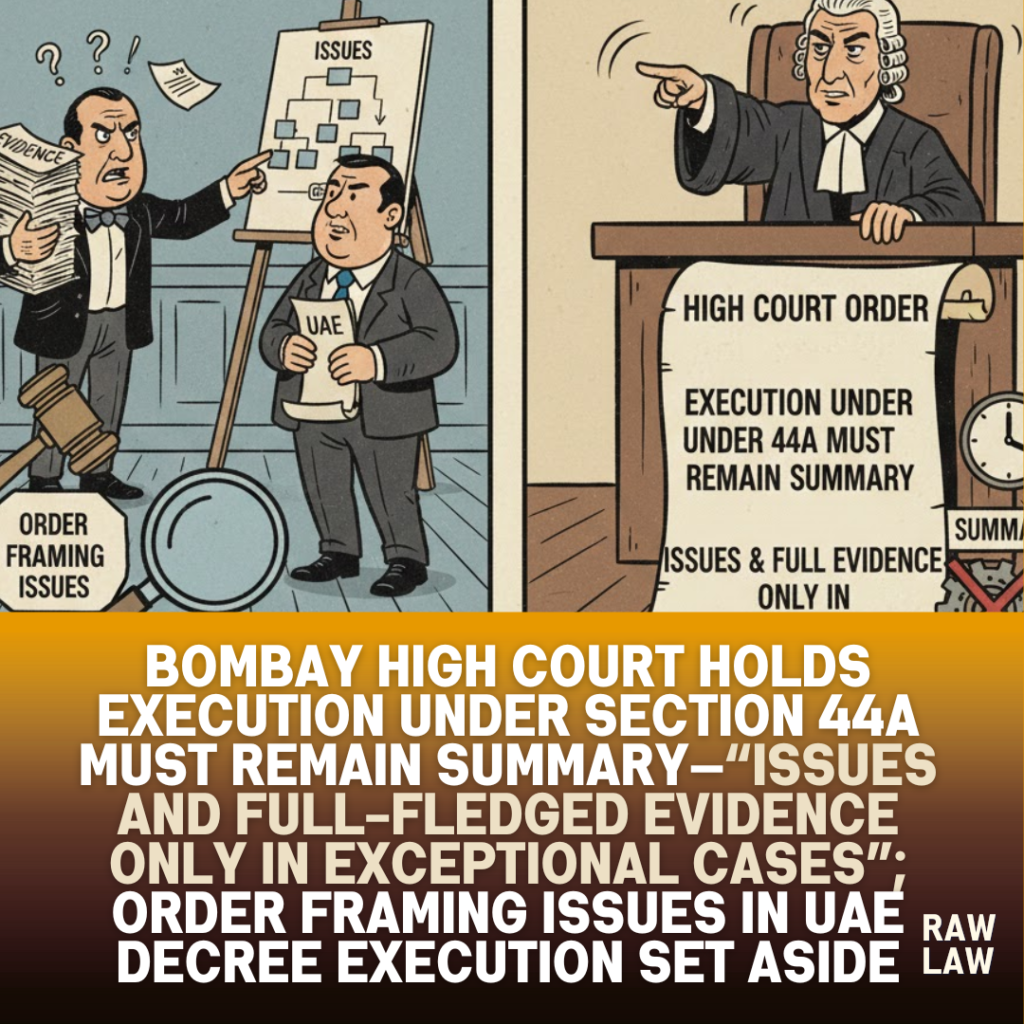
The Bombay High Court set aside the District Judge’s order framing issues and permitting parties to lead evidence in execution proceedings filed under Section 44A of the Code of Civil Procedure for enforcement of a decree passed by the Fujairah Civil Court, UAE. The Court held that execution of a foreign decree from a reciprocating territory must ordinarily remain summary in nature, and framing of issues coupled with a full-fledged evidentiary exercise is not the norm. It ruled that such a course is permissible only in exceptional circumstances, which were not demonstrated in the present case. The impugned order was therefore quashed.
2. Facts
The petitioners, decree holders, obtained a money decree from the Fujairah Civil Court in the United Arab Emirates against the respondent. The decree arose out of a Memorandum of Understanding executed in 2007 concerning sale of business interests in a confectionery company operating in Fujairah Free Zone. The Fujairah Civil Court passed a default judgment in January 2013 holding the respondent liable for a substantial monetary amount with interest.
Since the respondent allegedly had no assets in the UAE, the decree holders sought enforcement in India. Initially, when execution proceedings were filed, the UAE had not yet been notified as a reciprocating territory under Section 44A CPC. After dismissal of earlier proceedings, the Government of India notified the UAE as a reciprocating territory in January 2020. Thereafter, fresh execution proceedings were filed before the District Court at Pune under Section 44A.
The judgment debtor raised objections under Sections 13 and 47 CPC, alleging that the foreign decree was not on merits, violated principles of natural justice, was obtained by fraud, and that the execution was barred by limitation. The District Judge framed multiple issues and granted liberty to lead evidence. That order was challenged before the High Court.
3. Issues
The central legal issue was whether an executing court, while dealing with a foreign decree from a reciprocating territory under Section 44A CPC, can routinely frame issues and permit recording of evidence when objections under Section 13 are raised.
A related issue was whether such execution proceedings should resemble a full-fledged civil trial, similar to a suit on a foreign judgment from a non-reciprocating territory. The Court also examined the scope of inquiry under Section 13 (exceptions to conclusiveness of foreign judgments) and Section 47 CPC in the context of execution.
4. Petitioners’ arguments
The petitioners contended that Section 44A creates a clear legislative distinction between decrees from reciprocating and non-reciprocating territories. For reciprocating territories, the foreign decree can be executed directly “as if” it were a domestic decree. Framing of issues and permitting evidence would defeat the legislative intent of ensuring swift and summary execution.
They argued that objections under Section 13 must ordinarily be determined on the basis of the decree and the foreign court record. The burden to prove existence of exceptions lies on the judgment debtor. Routine framing of issues transforms execution into a trial, nullifying the statutory advantage under Section 44A. They further submitted that no exceptional circumstances were recorded by the executing court justifying such an elaborate procedure.
5. Respondent’s arguments
The respondent defended the impugned order, arguing that the executing court had merely framed issues and allowed evidence without adjudicating the objections finally. It was submitted that serious questions were raised under Section 13, including allegations of fraud, breach of natural justice, and lack of adjudication on merits.
The respondent contended that limitation and maintainability issues went to the root of the matter. According to him, exceptional circumstances existed warranting a detailed inquiry. Reliance was placed on precedents suggesting that execution courts can frame issues where prudence so demands.
6. Analysis of the law
The High Court undertook a detailed examination of Sections 13, 14, 44A and 47 CPC. It reiterated that while foreign judgments are presumed to be pronounced by courts of competent jurisdiction, conclusiveness is subject to the six exceptions in Section 13.
The Court emphasized the structural distinction: in non-reciprocating territories, a fresh suit must be filed on the foreign judgment; in reciprocating territories, execution can proceed directly. However, even under Section 44A, the executing court may refuse execution if exceptions under Section 13 are established.
Crucially, the Court held that inquiry under Section 44A(3) must ordinarily be summary in nature. If every objection results in framing of issues and recording of evidence, the statutory scheme would collapse into a full-fledged trial, erasing the distinction created by Parliament.
7. Precedent analysis
The Court relied heavily on Marine Geotechnics, which clarified that while Section 13 applies equally to reciprocating and non-reciprocating territories, the stage and burden differ. In reciprocating territories, objections are raised in execution, not through a separate suit.
The Court also drew guidance from Alcon Electronics and Arvind Kotecha, where it was held that inquiry under Section 13 may require examination of pleadings and proceedings but does not mandate a trial in every case.
On execution procedure, reliance was placed on C.V. Joshi to hold that framing of issues in execution is a matter of prudence, not a rule. Further, Rahul S. Shah was cited to underline that evidence in execution proceedings should be permitted only in exceptional and rare cases.
8. Court’s reasoning
The Court scrutinised the executing court’s observations, which highlighted alleged defects in service, claims of suppression of documents, and limitation objections. However, the High Court found that the executing court had not recorded specific exceptional circumstances justifying conversion of execution into a trial.
It reiterated that the burden to establish Section 13 exceptions lies on the judgment debtor. The inquiry must be confined to material on record, including the foreign court proceedings. Framing of issues and granting liberty to lead evidence should not be mechanical or routine.
The Court held that although exceptional cases may justify limited evidence, such discretion must be exercised cautiously and with recorded reasons. In the absence of demonstrated necessity, directing a full evidentiary exercise was contrary to legislative intent and binding precedent.
9. Conclusion
The High Court concluded that execution under Section 44A CPC must remain distinct from a suit on a foreign judgment. The District Judge’s order framing issues and permitting evidence was set aside, reaffirming that objections under Section 13 should ordinarily be decided summarily on available material unless rare and exceptional circumstances exist.
10. Implications
This ruling strengthens enforcement of foreign decrees from reciprocating territories by reaffirming their quasi-domestic status. It prevents dilatory tactics that convert execution into prolonged trials.
For litigants, the judgment clarifies that allegations of fraud, breach of natural justice, or non-merits adjudication must be substantiated convincingly before the executing court resorts to framing issues. For execution courts, the decision reinforces that summary disposal is the norm and evidentiary proceedings are the exception.
Case Law References
Marine Geotechnics LLC v. Coastal Marine Construction and Engineering Ltd. – Distinguished between reciprocating and non-reciprocating territories; burden under Section 13 lies on judgment debtor in execution.
Alcon Electronics Pvt. Ltd. v. Celem S.A. – Held that executing courts cannot re-examine merits once due process is followed; Section 13 exceptions are limited.
Arvind Jeram Kotecha v. Prabhudas Damodar Kotecha – Clarified scope of inquiry under Section 13 and burden on objector.
C.V. Joshi v. Elphinstone Spinning and Weaving Mills Co. Ltd. – Framing of issues in execution is a matter of prudence, not mandate.
Rahul S. Shah v. Jinendra Kumar Gandhi – Evidence in execution proceedings permissible only in exceptional and rare cases.
FAQs
1. Can a foreign decree from UAE be executed directly in India?
Yes. Once notified as a reciprocating territory under Section 44A CPC, a UAE court decree can be executed directly in India as if it were a domestic decree, subject to Section 13 exceptions.
2. Does raising objections under Section 13 CPC automatically require a full trial?
No. Inquiry under Section 13 in execution proceedings is ordinarily summary. Evidence is permitted only in exceptional cases where facts cannot be determined otherwise.
3. Who bears the burden to prove exceptions under Section 13?
In execution under Section 44A, the burden lies on the judgment debtor to prove that the foreign decree falls within clauses (a) to (f) of Section 13 CPC.


