

1. Court’s decision
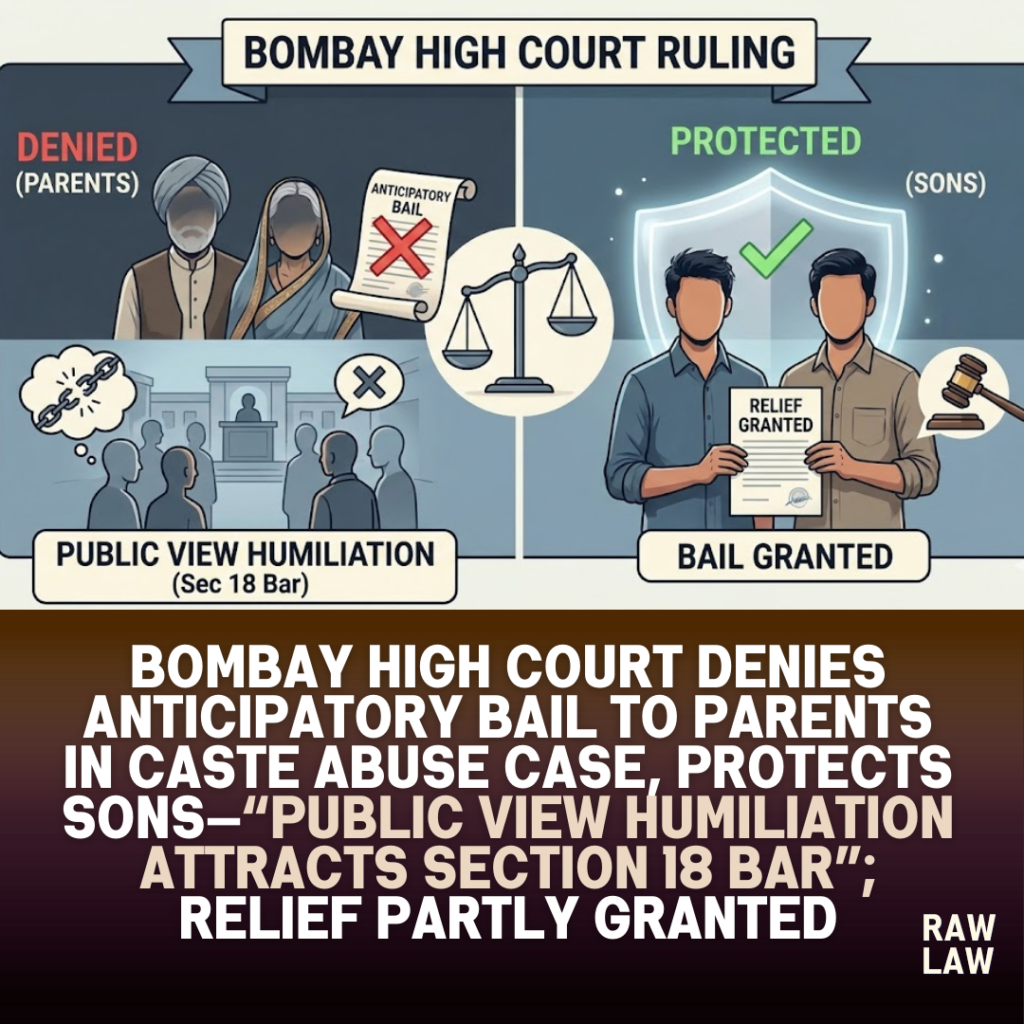
The Bombay High Court (Aurangabad Bench) partly allowed a criminal appeal under Section 14-A of the Scheduled Castes and Scheduled Tribes (Prevention of Atrocities) Act. The Court refused anticipatory bail to appellant Nos.1 and 2 (parents), holding that prima facie offences under Sections 3(1)(r), 3(1)(s), and 3(2)(va) of the Act were made out against them.
However, the Court granted anticipatory bail protection to appellant Nos.3 and 4 (college-going sons), observing that no specific caste-based allegations were attributed to them. The interim protection was extended to them during trial.
2. Facts
Crime No.494 of 2025 was registered at Amalner Police Station based on an FIR lodged by a woman belonging to the Scheduled Caste community. She alleged that on 12 November 2025 at around 5:00 p.m., near a public water tap in village Manjardi, the accused abused her in filthy language and assaulted her.
Accused No.2 allegedly uttered caste-based insults, including remarks targeting her caste identity, and directed her to vacate the house. The incident occurred in a public place and was witnessed by neighbours who intervened.
The FIR invoked provisions of the Bharatiya Nyaya Sanhita and Sections 3(1)(r), 3(1)(s), and 3(2)(va) of the Atrocities Act.
3. Issues
The Court examined:
• Whether Section 18 of the SC/ST Act created an absolute bar to anticipatory bail.
• Whether the FIR disclosed a prima facie offence under Sections 3(1)(r), 3(1)(s), and 3(2)(va).
• Whether all accused stood on the same footing regarding caste-based allegations.
• Whether the delay of 13 days in lodging the FIR affected bail consideration.
4. Appellants’ arguments
The appellants contended that the FIR was a counterblast to an earlier non-cognizable complaint lodged by appellant No.1 on the same day of the incident. They argued that the 13-day delay in filing the FIR cast serious doubt on its authenticity.
It was submitted that the alleged incident never occurred and that relations between the families were previously cordial. Appellant No.1 was a sitting Gram Panchayat member, appellant No.2 an agriculturist, and appellant Nos.3 and 4 were students.
They relied on Shajan Skaria v. State of Kerala to argue that mere knowledge of caste does not attract Section 3(1)(r) unless there is intent to humiliate.
5. Respondents’ arguments
The prosecution argued that the incident occurred at a public tap, within public view, and that casteist abuses were specifically alleged against accused No.2. Witnesses supported the informant’s version.
It was contended that once a prima facie offence under Section 3 of the Act is disclosed, Section 18 bars anticipatory bail.
Reliance was placed on Kiran v. Rajkumar Jivraj Jain, wherein the Supreme Court clarified that anticipatory bail is barred where specific accusations under the Act are made, unless no prima facie case is disclosed.
6. Analysis of the law
The Court reiterated that Section 18 excludes anticipatory bail where prima facie allegations under the Atrocities Act exist. However, the bar is not absolute if, on the face of the FIR, no offence under Section 3 is made out.
Referring to Supreme Court precedents, the Court observed that intentional humiliation in public view on the ground of caste attracts Section 3(1)(r).
The Court examined whether allegations specifically attributed caste-based abuse to each accused. The FIR clearly alleged caste insults by accused No.2 and participation by accused No.1.
7. Precedent analysis
The Court relied upon:
• Shajan Skaria v. State of Kerala – Intent to humiliate on the ground of caste is essential.
• Kiran v. Rajkumar Jivraj Jain – Section 18 creates a bar unless no prima facie case is disclosed.
• Karuppudayar v. State – Offence under Section 3(1)(r)/(s) requires occurrence in public view.
Applying these precedents, the Court held that allegations against appellant Nos.1 and 2 prima facie satisfied statutory ingredients, whereas no specific caste-based abuse was attributed to appellant Nos.3 and 4.
8. Court’s reasoning
The Court observed that the alleged caste-based abuse occurred at a public tap in the presence of neighbours. Such public humiliation attracts Section 3(1)(r) and 3(1)(s).
Statements in the charge-sheet supported allegations against appellant Nos.1 and 2. Therefore, the statutory bar under Section 18 applied to them.
However, the material did not indicate that appellant Nos.3 and 4 had uttered casteist words. In absence of specific allegations, no prima facie offence under the Act was made out against them.
The impugned order was therefore quashed to that limited extent.
9. Conclusion
The appeal was partly allowed.
• Appeal dismissed for appellant Nos.1 and 2, who were directed to surrender within two weeks.
• Appeal allowed for appellant Nos.3 and 4; anticipatory bail protection extended during pendency of trial.
The interim protection earlier granted was recalled for parents but continued for the sons.
10. Implications
This ruling reiterates:
• Section 18 of the SC/ST Act bars anticipatory bail where prima facie caste-based public humiliation is alleged.
• Courts must confine analysis to FIR averments without conducting a mini-trial.
• Individual roles matter—blanket denial of bail is impermissible without specific allegations.
• Public view remains a crucial ingredient under Sections 3(1)(r) and 3(1)(s).
The decision strengthens judicial scrutiny in anticipatory bail appeals under the Atrocities Act while safeguarding individualised assessment.
Case Law References
Shajan Skaria v. State of Kerala (2024 SCC OnLine SC 2249) – Intent to humiliate on caste grounds is essential ingredient.
Kiran v. Rajkumar Jivraj Jain (AIR 2025 SC 4083) – Section 18 creates a bar to anticipatory bail unless no prima facie offence is disclosed.
Karuppudayar v. State (2025(2) CGLJ 316) – Offence under Section 3(1)(r)/(s) must occur in public view.
FAQs
1. Is anticipatory bail completely barred under the SC/ST Act?
No. While Section 18 creates a bar, courts may grant anticipatory bail if no prima facie offence under Section 3 is disclosed in the FIR.
2. Does every insult against a Scheduled Caste member attract Section 3(1)(r)?
No. The insult must be intentional and on the ground of caste, and must occur in public view.
3. Can co-accused be treated differently in anticipatory bail?
Yes. Courts must assess individual roles; absence of specific allegations may justify relief.


