

Court’s decision
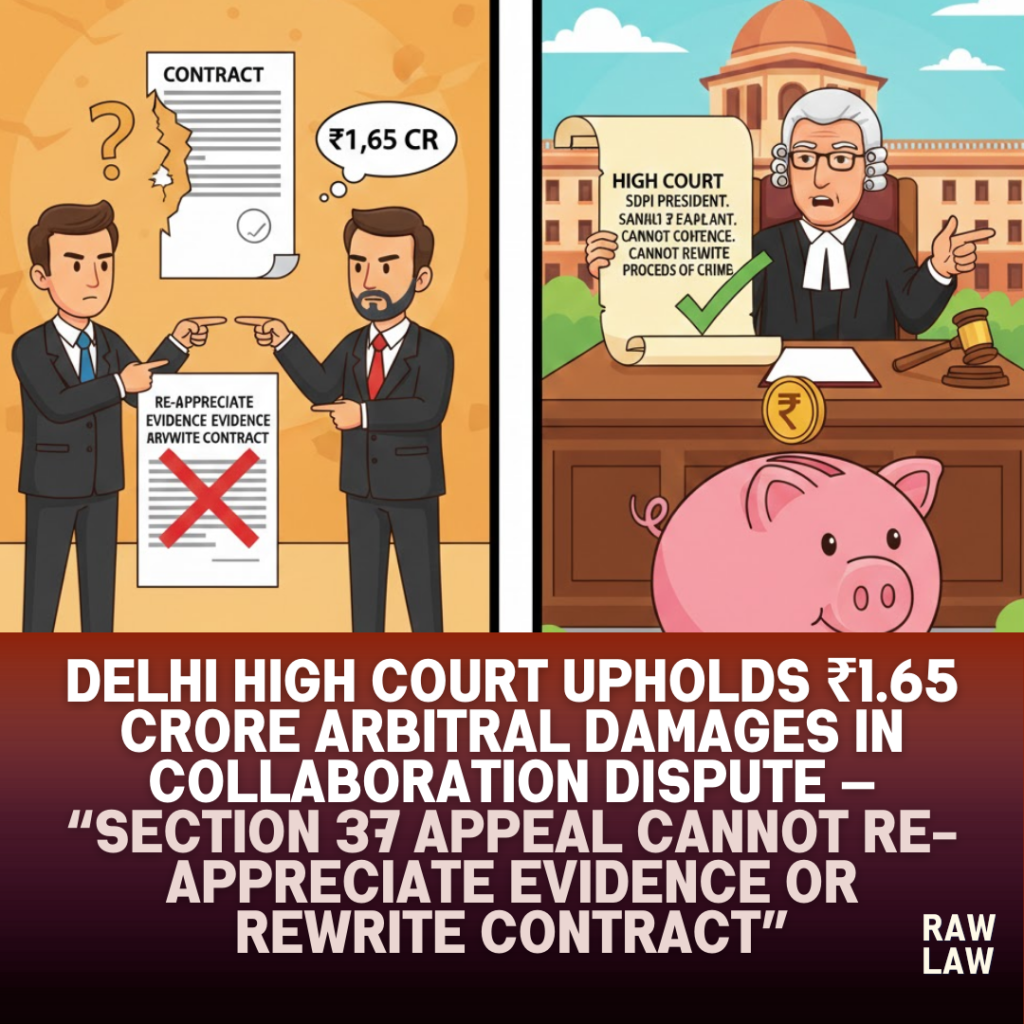
The Delhi High Court dismissed an appeal under Section 37 of the Arbitration and Conciliation Act, 1996, affirming the learned Single Judge’s refusal to set aside an arbitral award dated 20.11.2020. The Court held that the arbitral tribunal’s findings on wrongful termination of a collaboration agreement and award of ₹1.65 crore as damages were reasoned, plausible, and beyond interference. Emphasising the narrow scope of Sections 34 and 37, the Bench ruled that courts cannot re-weigh evidence or substitute contractual interpretation merely because another view is possible.
Facts
The dispute arose from a Collaboration Agreement dated 07.11.2011 concerning a 1148 sq. yd. property at Ishwar Nagar, Mathura Road, New Delhi. The owner agreed to grant development rights to the builder, who undertook to bear construction costs and pay ₹5.20 crore in stages.
Under the agreement, the owner was obligated to obtain building plan sanction within 60 days. The builder paid ₹50 lakh upfront. However, the owner allegedly delayed applying for sanction and failed to intimate approval. Correspondence between the parties escalated into termination of the agreement by the owner on 22.03.2014.
The builder invoked arbitration seeking specific performance or, alternatively, damages. During proceedings, a settlement dated 18.09.2017 recorded a mutually agreed figure of ₹1.65 crore, though no consent award was passed due to absence of a board resolution from the owner company.
The Sole Arbitrator declined specific performance but held termination illegal and awarded ₹1.65 crore with 12% interest and costs. A Section 34 challenge failed, leading to the present Section 37 appeal.
Issues
The High Court examined:
- Whether the arbitral award suffered from patent illegality warranting interference under Sections 34 or 37.
- Whether absence of a separately framed issue on “readiness and willingness” vitiated the award.
- Whether damages could be awarded after declining specific performance.
- Whether Clause (v)(d) of the agreement barred damages against the owner.
- Whether reliance on the 18.09.2017 settlement figure was legally impermissible.
Appellant’s arguments
The appellant-owner argued that the builder failed to prove continuous readiness and willingness under Section 16(c) of the Specific Relief Act, 1963. It relied on cross-examination admissions suggesting conditional willingness subject to price revision.
It was further contended that Clause (v)(d) imposed penalties only on the builder for delay, and no reciprocal damages were envisaged against the owner. The award of ₹1.65 crore was said to be contrary to contract.
The appellant also argued that the arbitrator erred in not framing a distinct issue on readiness and willingness and improperly relied on an unperfected settlement.
Respondent’s arguments
The respondent-builder submitted that the arbitrator and Single Judge concurrently found the agreement concluded and enforceable, and the termination illegal.
It was argued that under Sections 73 and 74 of the Indian Contract Act, once breach was established, damages naturally followed.
The builder emphasised that the 18.09.2017 settlement reflected the parties’ own valuation of compensation and was rightly used evidentially, though not treated as a consent award.
It was also submitted that Section 37 confers a narrow supervisory jurisdiction and does not permit reappreciation of evidence.
Analysis of the law
The Court reiterated the settled principles governing Sections 34 and 37 of the Arbitration Act. Citing Supreme Court precedents including Punjab State Civil Supplies Corpn. Ltd. v. Sanman Rice Mills, MMTC Ltd. v. Vedanta Ltd., and Dyna Technologies v. Crompton Greaves, the Bench underscored that appellate interference is confined to patent illegality or public policy violation.
The Court clarified that an arbitral tribunal’s interpretation of contract must prevail if plausible. Reappraisal of evidence or substitution of contractual construction is impermissible.
On readiness and willingness, the Court noted that the arbitrator had considered pleadings, conduct, and settlement discussions. The absence of a separately numbered issue was not fatal, since the controversy was substantively addressed.
Precedent analysis
Relying on Punjab State Civil Supplies Corpn. Ltd. v. Sanman Rice Mills (2024), the Court emphasised that Section 37 appeals are even narrower than Section 34 challenges.
In MMTC Ltd. v. Vedanta Ltd., the Supreme Court held that appellate courts cannot independently reassess merits.
The High Court applied these precedents to conclude that the arbitral findings were plausible and immune from interference.
Court’s reasoning
The Court found that the owner delayed applying for building sanction by nearly 175 days beyond the agreed period and failed to establish bona fide compliance.
The arbitrator’s conclusion that termination dated 22.03.2014 was illegal was grounded in contractual obligations and correspondence.
After declining specific performance under Section 14 of the Specific Relief Act (due to continuous supervision requirements), the tribunal rightly considered damages under Sections 73 and 74 of the Contract Act.
Regarding Clause (v)(d), the Court held that absence of an express damages clause against the owner does not bar statutory compensation for breach.
The ₹1.65 crore figure, recorded during settlement, was treated as the best available evidence of loss, not as a consent award. This evidentiary reliance was legally permissible.
Conclusion
The Delhi High Court dismissed the appeal, holding that the arbitral award did not suffer from perversity, patent illegality, or violation of public policy. The concurrent findings of the arbitrator and Single Judge warranted judicial restraint.
Implications
This judgment reinforces the finality of arbitral awards and the limited scope of judicial intervention under Sections 34 and 37.
It clarifies that refusal of specific performance does not preclude damages for breach.
The ruling also affirms that settlement discussions, even if not perfected into a consent award, may serve as evidentiary benchmarks for quantifying loss.
For commercial arbitration practitioners, the decision underscores that Section 37 is not a second appeal on merits.
Case law references
- Punjab State Civil Supplies Corpn. Ltd. v. Sanman Rice Mills (2024 SCC OnLine SC 2632) — Section 37 scope limited to Section 34 grounds.
- MMTC Ltd. v. Vedanta Ltd. (2019) 4 SCC 163 — Appellate court cannot independently reassess arbitral merits.
- Dyna Technologies Pvt. Ltd. v. Crompton Greaves Ltd. (2019) 20 SCC 1 — Interference only where perversity goes to root.
- Bharat Coking Coal Ltd. v. L.K. Ahuja (2004) 5 SCC 109 — Arbitrator’s plausible view must prevail.
FAQs
1. Can a High Court re-evaluate evidence in a Section 37 arbitration appeal?
No. Section 37 provides a narrow supervisory jurisdiction limited to grounds available under Section 34. Reappreciation of evidence is impermissible.
2. Can damages be awarded if specific performance is refused?
Yes. If breach is established, monetary compensation may be granted under Sections 73 and 74 of the Contract Act even where specific performance is declined.
3. Can an unperfected settlement influence arbitral damages?
Yes. While it cannot be treated as a consent award without proper authorisation, it may serve as evidentiary material reflecting the parties’ valuation of loss.


