
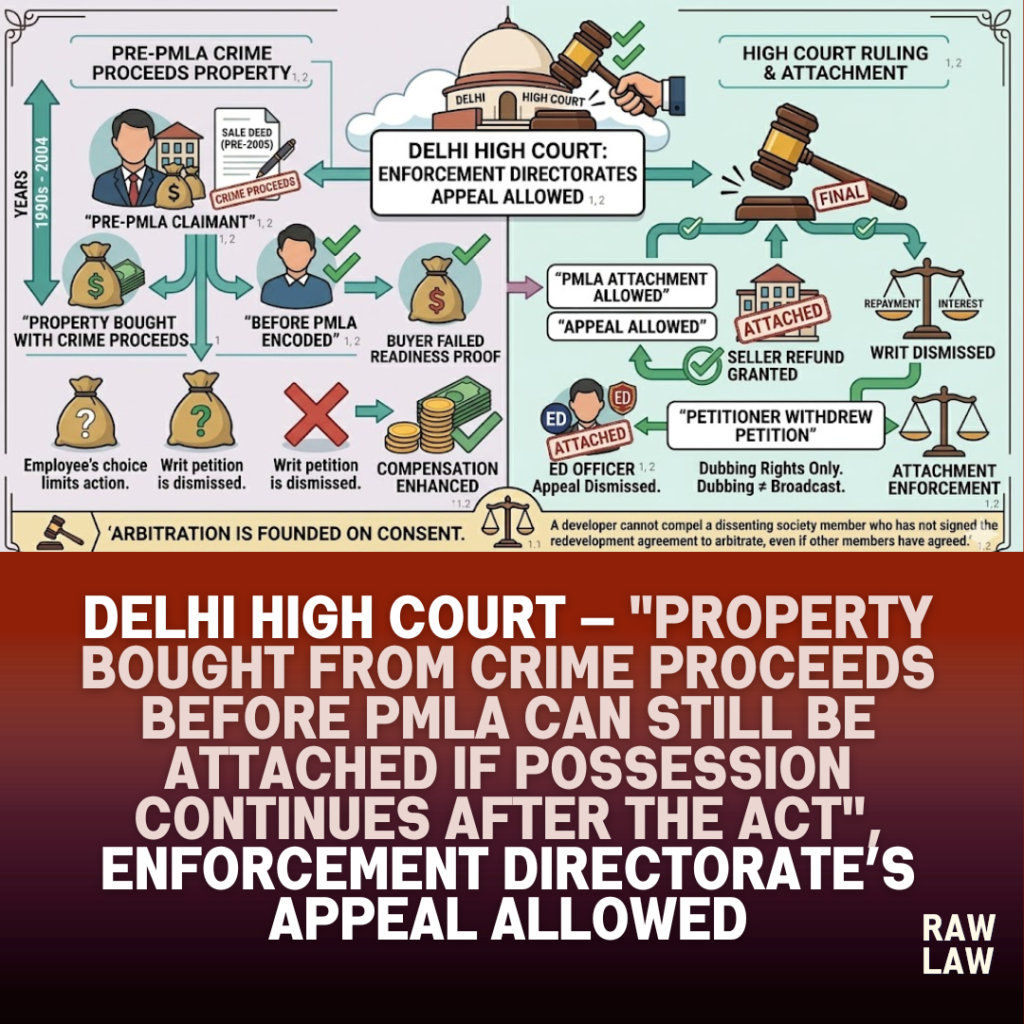

Court’s decision
The Delhi High Court overturned the judgment of a Single Judge that had quashed a provisional attachment order issued by the Enforcement Directorate. The appellate bench ruled that the earlier interpretation incorrectly treated the laundering process as complete once the proceeds of crime were integrated into the economy before the law came into force.
The Court held that the statutory definition of money laundering under the Prevention of Money Laundering Act includes continuing possession, use, or enjoyment of property derived from criminal activity. Therefore, even if the property was acquired before the Act became operational, its continued possession after the Act came into force could attract proceedings under the statute.
Accordingly, the Court allowed the appeal filed by the Enforcement Directorate and restored the provisional attachment proceedings.
Facts
The dispute arose from allegations of corruption involving transactions related to the import and sale of raw sugar through government cooperative institutions. A complaint filed with the Central Bureau of Investigation alleged that an official of a cooperative federation had entered into fraudulent agreements with a private company for the import of sugar on a high seas sale basis.
According to the investigation, the agreements were structured in a manner that allowed the private entity to gain undue financial benefit at the expense of the cooperative body. The investigation further alleged that large sums of money were transferred through a network of companies controlled by individuals associated with the scheme.
The funds were eventually transferred to a private company where the spouse of the accused official was a director. Shortly thereafter, the company purchased a residential property in New Delhi using funds traced to these transactions.
Years later, the Enforcement Directorate initiated proceedings under the Prevention of Money Laundering Act and issued a provisional attachment order against the property. The agency alleged that the property had been purchased using proceeds of crime derived from the fraudulent transactions.
The company challenged the attachment before the High Court, arguing that the property had been purchased in 2005, prior to the enactment of the statute governing money laundering. A Single Judge accepted this argument and quashed the attachment order, prompting the Enforcement Directorate to file the present appeal.
Issues
The principal legal questions before the Division Bench were:
- Whether property purchased using proceeds of crime before the Prevention of Money Laundering Act came into force can be attached under the statute.
- Whether the offence of money laundering is a continuing offence that extends beyond the initial acquisition of property derived from criminal activity.
- Whether continued possession of property derived from criminal proceeds after the enactment of the statute falls within the definition of money laundering.
- Whether the Single Judge erred in holding that the laundering process had been completed prior to the statute’s enactment.
Petitioner’s arguments
The Enforcement Directorate argued that the Single Judge had incorrectly limited the scope of the statute by treating the laundering process as completed once the proceeds of crime were integrated into the financial system.
The agency contended that the statutory definition of “proceeds of crime” includes property derived or obtained directly or indirectly from criminal activity. Therefore, the immovable property purchased using the illicit funds itself constituted proceeds of crime.
It was further argued that the statutory definition of money laundering expressly includes possession, acquisition, and use of proceeds of crime. As long as a person continues to possess or use property derived from criminal activity, the offence continues.
The Enforcement Directorate therefore asserted that attachment of the property was legally valid because the accused continued to enjoy and possess the property even after the statute came into force.
Respondent’s arguments
The respondent company argued that the property had been purchased in 2005, before the enactment of the Prevention of Money Laundering Act. According to the respondent, the alleged laundering process had been completed long before the statute came into operation.
It was contended that applying the statute to such transactions would effectively give the law retrospective operation, which is impermissible for penal statutes under constitutional principles.
The respondent further argued that the offence of money laundering cannot be treated as a continuing offence merely because a person continues to hold property that was allegedly purchased using proceeds of crime.
Therefore, the respondent submitted that the provisional attachment order was legally unsustainable.
Analysis of the law
The Court analysed the statutory framework of the Prevention of Money Laundering Act, particularly Sections 3, 5, and 8, which collectively govern the offence of money laundering and attachment of property derived from criminal activity.
The Court observed that these provisions operate as an integrated scheme. Section 3 defines the offence of money laundering, while Section 5 empowers authorities to provisionally attach property believed to be involved in the laundering process.
The statutory definition of money laundering includes various forms of involvement with proceeds of crime, including concealment, possession, acquisition, or use of such proceeds.
The Court emphasized that the use of the word “includes” in the definition indicates that the scope of the offence is intentionally broad and encompasses a range of activities connected to criminal proceeds.
Precedent analysis
The Court referred to the Supreme Court’s landmark judgment in Vijay Madanlal Choudhary v. Union of India, which upheld the constitutional validity of key provisions of the Prevention of Money Laundering Act and clarified the broad scope of the offence of money laundering.
The Bench also considered other judicial precedents that interpret money laundering as a continuing activity linked to possession and enjoyment of proceeds of crime.
The Court distinguished earlier judicial reasoning that treated the laundering process as completed once illicit funds were integrated into the financial system.
Instead, the Court emphasized that continued possession or enjoyment of property derived from criminal activity can itself constitute an ongoing offence under the statute.
Court’s reasoning
The Court identified several errors in the reasoning of the Single Judge. First, the earlier judgment incorrectly treated only the original money received from the crime as “proceeds of crime”, ignoring that property purchased using such funds also falls within the statutory definition.
Second, the Single Judge wrongly concluded that the offence of money laundering ends once the illicit funds are integrated into the economy. The Court clarified that the statutory language covers possession and use of proceeds of crime as part of the laundering process.
Third, the earlier judgment overlooked the inclusive nature of the statutory definition of money laundering, which intentionally expands the scope of the offence.
The Court therefore held that continued possession and enjoyment of property derived from criminal activity after the statute came into force can constitute money laundering.
Conclusion
The Delhi High Court concluded that property purchased using proceeds of crime prior to the enactment of the Prevention of Money Laundering Act can still be attached if the accused continues to possess or enjoy the property after the statute came into force.
The Court held that the offence of money laundering is a continuing activity and that the Single Judge had misinterpreted the statutory framework. Consequently, the appeal filed by the Enforcement Directorate was allowed and the provisional attachment proceedings were revived.
Implications
This judgment significantly strengthens the enforcement framework of the Prevention of Money Laundering Act. It clarifies that property acquired from criminal proceeds prior to the enactment of the statute does not automatically fall outside its reach.
By recognising money laundering as a continuing offence, the ruling enables enforcement agencies to proceed against individuals who continue to possess or enjoy assets derived from criminal activity even years after the initial offence.
The decision also aligns the interpretation of the statute with broader judicial trends that emphasise the importance of tracing and confiscating criminal proceeds.
Case Law References
Vijay Madanlal Choudhary v. Union of India
The Supreme Court upheld the constitutional validity of major provisions of the Prevention of Money Laundering Act and clarified the broad scope of the offence of money laundering.
Syed Yakoob v. K.S. Radhakrishnan
The Supreme Court explained the limited scope of judicial review under writ jurisdiction and clarified that courts should not re-evaluate factual findings unless there is a clear error of law.
FAQs
1. Can property bought before the Prevention of Money Laundering Act be attached later?
Yes. If the property was purchased using proceeds of crime and the person continues to possess or use it after the Act came into force, it can be attached under the statute.
2. Is money laundering considered a continuing offence under Indian law?
Yes. Courts have held that possession, use, or enjoyment of proceeds of crime can constitute a continuing activity under the definition of money laundering.
3. What qualifies as “proceeds of crime” under the Prevention of Money Laundering Act?
The term includes property or assets derived directly or indirectly from criminal activity related to a scheduled offence, including property purchased using such funds.


