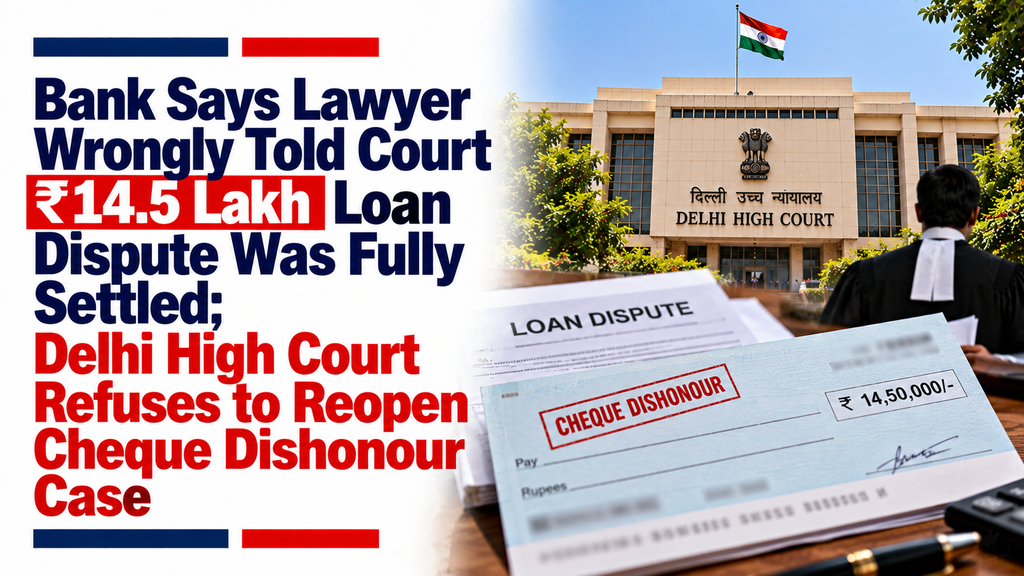
Bank Says Lawyer Wrongly Told Court ₹14.5 Lakh Loan Dispute Was Fully Settled; Delhi High Court Refuses to Reopen Cheque Dishonour Case

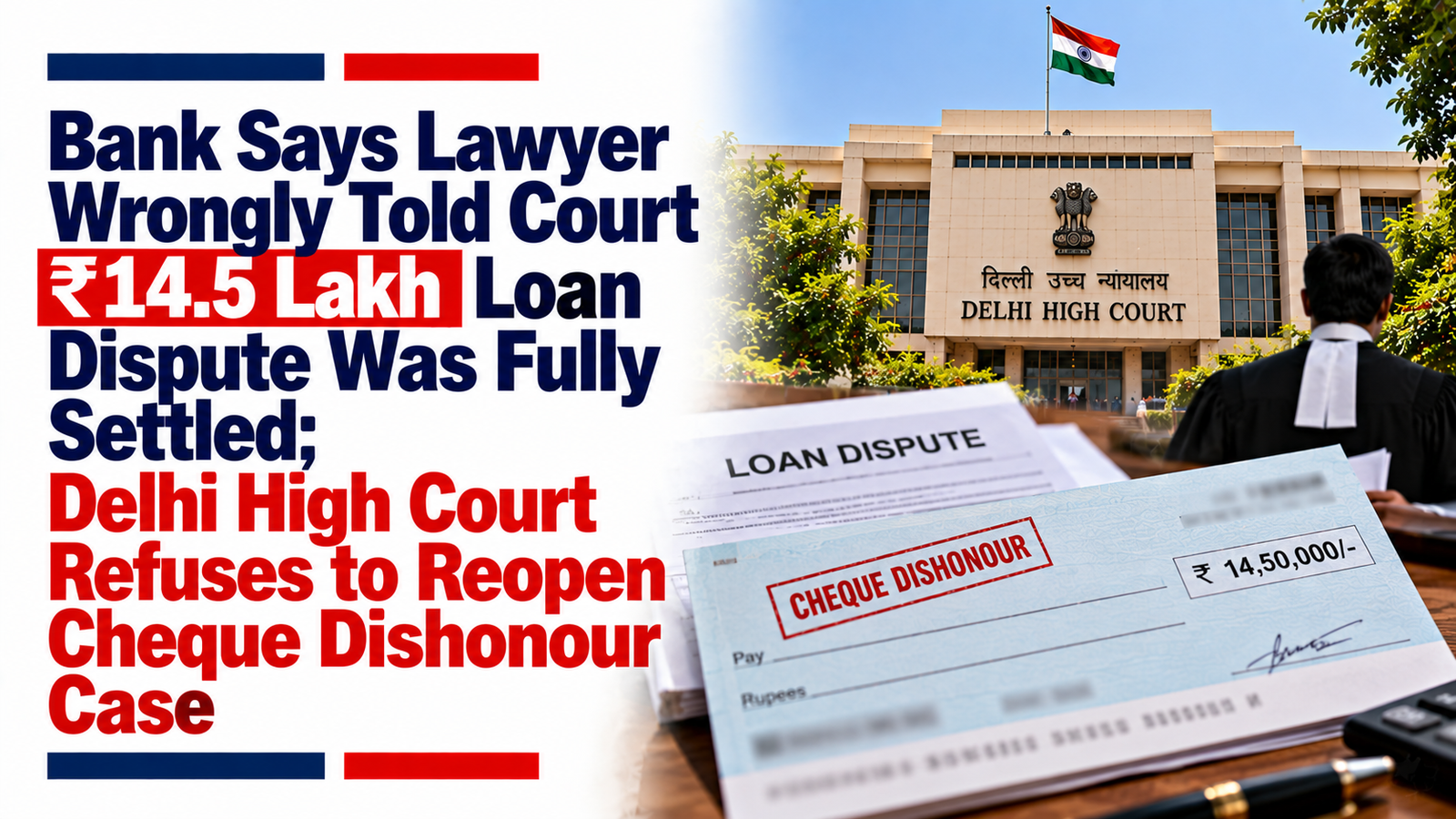
Can Client Disown Lawyer’s Statement Made Without Instructions? Delhi High Court Refuses to Reopen Compounded Cheque Dishonour Proceedings
Facts
Equitas Small Finance Bank Ltd. filed a writ petition seeking recall of a Lok Adalat award dated 14 September 2024 and restoration of its cheque dishonour complaint against Nirmala Bai Shanthilal and others.
The respondents had obtained a ₹14.50 lakh loan from the Bank in March 2021 and mortgaged immovable property at Wheeler Road, Cleveland Town, Bengaluru as collateral. A post-dated cheque drawn on their joint account was also issued in favour of the Bank.
After repayment defaults, the account was classified as an NPA on 3 August 2023, and the Bank issued a notice under Section 13(2) of the SARFAESI Act. The account was subsequently regularised after intermittent payments and assurances from the borrowers.
The Bank presented the post-dated cheque on 8 January 2024, but it was dishonoured with the remark “Refer to Drawer.” After the statutory notice failed to secure payment, the Bank instituted proceedings under Sections 138 and 142 of the Negotiable Instruments Act.
The Crucial Settlement Statements
On 8 August 2024, the Bank’s counsel told the Magistrate that the dispute had been settled and that the Bank had received full and final payment of the cheque amount.
The Magistrate recorded a separate statement of counsel and referred the case to the National Lok Adalat.
Then, on 14 September 2024, substantially the same statement was made before the Lok Adalat: the Bank had received the entire settlement amount to its satisfaction and wanted the proceedings compounded.
The Lok Adalat accordingly disposed of the complaint as compounded under Section 147 of the NI Act and acquitted the respondents. The actual Lok Adalat order reproduced on page 4 records the settlement, satisfaction of the cheque amount and consequent acquittal.
What the Bank Later Claimed
Almost 13 months later, on 25 September 2025, the Bank sought revival of the complaint.
It claimed its previous counsel had misunderstood the Bank’s instructions and wrongly assumed that the outstanding amount had been fully paid.
According to the Bank, there had actually been:
- no settlement or compromise;
- no discharge of liability; and
- no payment satisfying the cheque amount.
It argued that counsel’s representations had been made under confusion, without authority from the Bank and had never been ratified.
The Magistrate rejected the revival application because a criminal court could not alter or review the earlier order. The Bank then approached the Delhi High Court.
Petitioner’s Arguments
The Bank’s principal case was that its counsel’s statement could not bind it because the lawyer had acted without instructions or authority.
What the Bank had actually communicated, according to it, was merely that the borrowers were willing to cure the default—not that payment had already been made or the matter had been finally settled.
Therefore, the Lok Adalat award was said to rest entirely upon a mistaken representation by counsel, rather than an actual settlement between the parties.
Respondents’ Arguments
The respondents did not appear before the High Court.
The Court therefore examined the petition principally on the Bank’s own pleadings and the existing judicial record.
Analysis of the Law
1. Counsel Made the Settlement Statement Twice
The Court attached considerable significance to the fact that this was not an isolated mistaken statement.
The Bank’s nominated counsel first made the statement before the Magistrate on 8 August 2024.
The same position was then reiterated before the Lok Adalat on 14 September 2024.
On both occasions, separate statements of counsel were recorded. The Court therefore observed that the representation which the Bank was attempting to disown had effectively received the “imprimatur of two Courts.”
2. Thirteen-Month Silence Seriously Undermined the Bank’s Case
The Bank raised the alleged absence of authority for the first time only on 25 September 2025, approximately 13 months after the original statement.
The Court found another circumstance particularly significant: although the Bank accused its earlier lawyer of acting without authority, it was again represented by the same lawyer, and no proceedings had been initiated against him for the alleged misconduct.
That delay and conduct raised serious doubt regarding the Bank’s later version.
3. Advocate Is Not Merely a Mechanical Agent
The Court emphasised that the lawyer was the Bank’s own nominated counsel and held a duly executed vakalatnama.
It described counsel as an officer of the Court and not a “mere mechanical agent” of the client.
If the Bank genuinely believed that its lawyer had twice made unauthorised statements fundamentally contrary to its instructions, its prolonged silence and failure to seek clarification or take action against him were difficult to reconcile with that allegation.
4. Bank Could Not “Wriggle Out” of Its Counsel’s Statements
The Magistrate and Lok Adalat had both acted upon representations made by the Bank’s own nominated counsel.
Those statements themselves were not disputed as having actually been made.
The Court therefore held that the Bank could not subsequently “wriggle out” of what had transpired merely by alleging lack of authority. It characterised the later explanation as appearing to be an afterthought unsupported by convincing particulars or supporting affidavit.
5. Bank’s Own Versions Were Inconsistent
The Court also noticed an internal inconsistency.
On one hand, the Bank claimed there had never been any settlement and no money had been received.
On the other hand, it claimed that the borrowers had been given an opportunity to make payment following an oral request and had subsequently taken advantage of the Lok Adalat award by going back on their promise to settle the outstanding dues.
This weakened the attempt to portray the entire settlement representation as nothing more than an accidental misunderstanding.
Court’s Reasoning
The Court considered it institutionally important that litigants cannot casually disown representations made by duly appointed advocates before courts.
Permitting parties to reopen concluded judicial proceedings merely by later asserting that their counsel lacked instructions would undermine the reliability of representations made by advocates and could create what the Court described as a “chaotic situation.”
The Court stated that the Bank could not be permitted to have a “second bite at the cherry.”
More fundamentally, it held that an attempt to resile from counsel’s statement on the plea of lack of instructions, authority or ratification in these circumstances would strike at the foundation of the advocate-client relationship and undermine the sanctity of counsel’s role in assisting courts.
Conclusion
The Delhi High Court dismissed the writ petition in limine.
It refused to recall the Lok Adalat award or revive the Section 138 NI Act complaint.
The result is that the 14 September 2024 Lok Adalat settlement continues to stand, under which the cheque dishonour proceedings were compounded and the respondents were acquitted.
The judgment’s central proposition is that, on these facts, a litigant cannot wait for months and then disown repeated statements voluntarily made by its duly authorised counsel before two judicial forums merely by alleging that counsel acted without instructions.
Case: Equitas Small Finance Bank Ltd. v. Mrs Nirmala Bai Shanthilal & Ors.
Court: Delhi High Court
Case No.: W.P.(CRL) 2380/2026
Judge: Justice Saurabh Banerjee
Date: 24 September 2026
Result: Writ petition dismissed in limine; Lok Adalat award and compounding of the Section 138 complaint left undisturbed.