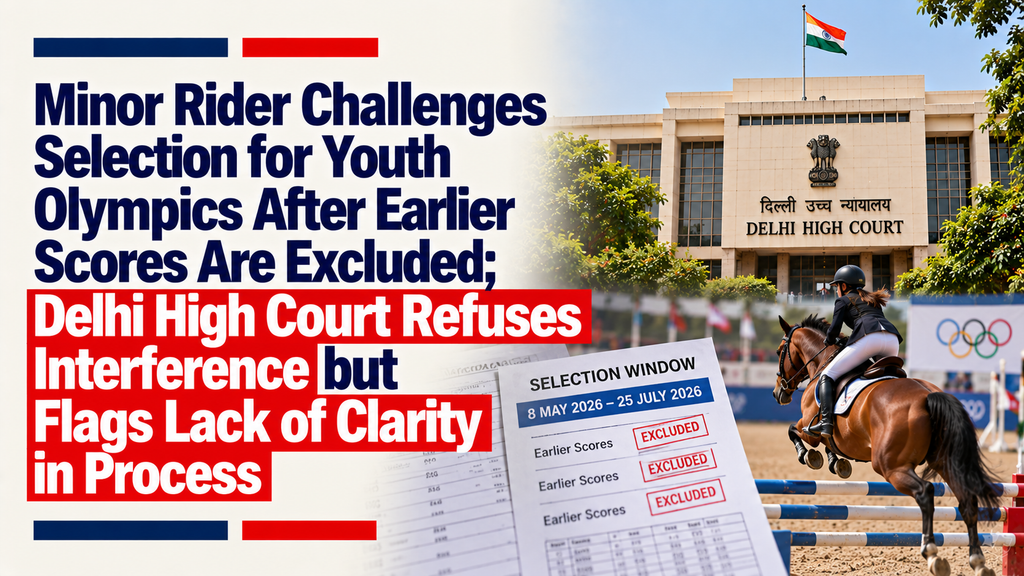
Minor Rider Challenges Selection for Youth Olympics After Earlier Scores Are Excluded; Delhi High Court Refuses Interference but Flags Lack of Clarity in Process

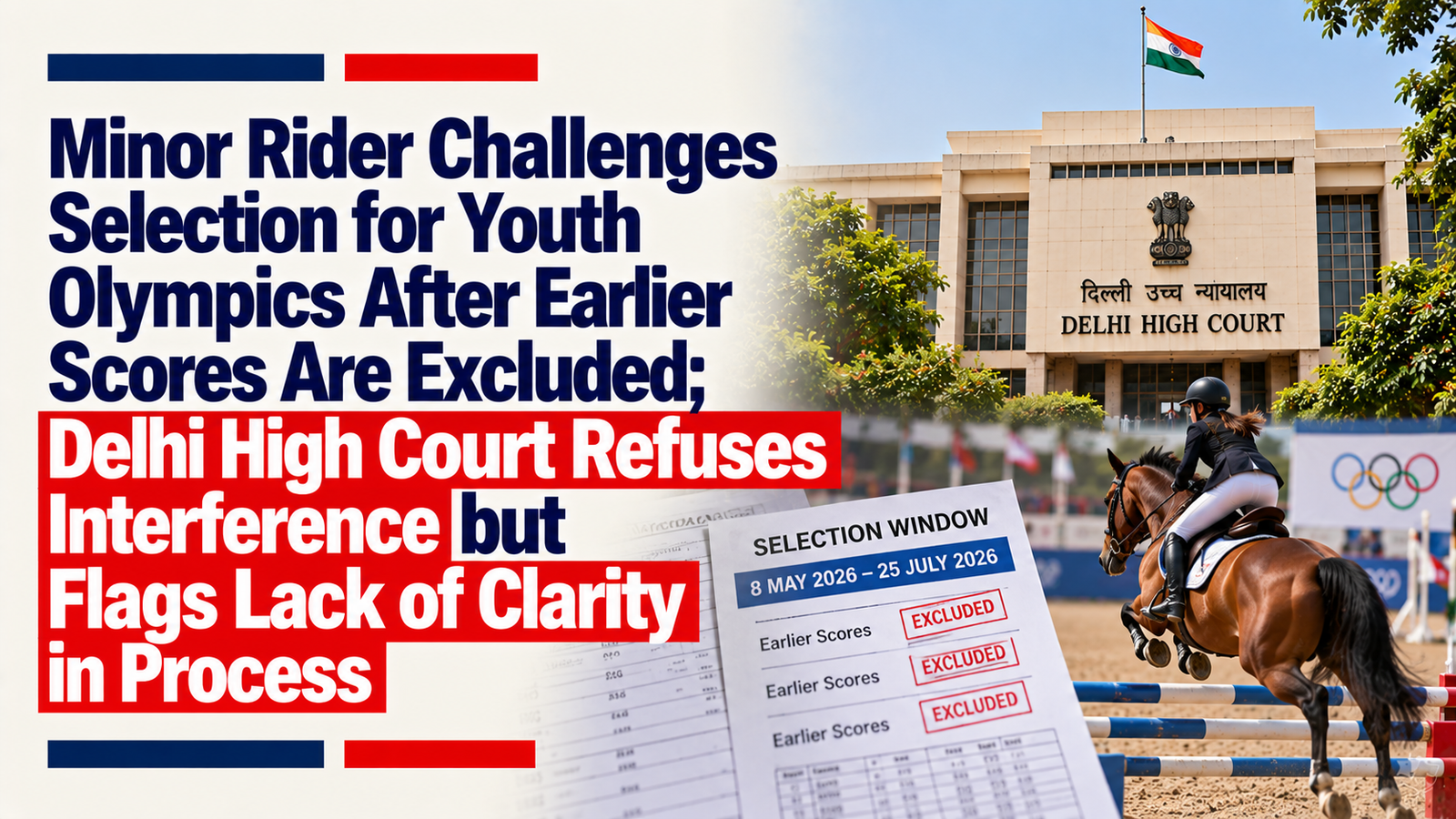
Equestrian Federation Changes Rider Rankings After Reviewing Seven Candidates; Delhi High Court Rejects Minor Athlete’s Challenge to Youth Olympics Selection
Facts
The appeal was filed by Vaasvi Khaitan, a minor equestrian rider through her father Vedant Khaitan, challenging the selection process conducted by the Ad Hoc Committee governing the Equestrian Federation of India (EFI) for India’s Show Jumping representative at the Youth Olympic Games 2026 in Dakar, Senegal.
For participation, riders were required to obtain a Certificate of Capability (COC) under Fédération Équestre Internationale (FEI) requirements. The EFI selection criteria provided that where more than one athlete possessed a valid COC, candidates would be assessed on factors including technical difficulty, consistency of international performance, recency of results, stability of the horse-rider combination and championship readiness.
Between December 2025 and May 2026, Vaasvi obtained eight qualifying scores in CSI1 competitions in Europe*.
On 13 May 2026, the Selection Committee considered Vaasvi and Neil Kendall’s results for 2025–26 and selected Vaasvi to represent India, with Neil Kendall as reserve rider. EFI subsequently informed FEI on 19 May that Vaasvi had been selected.
The controversy arose because the selection process did not end there.
Selection Was Reopened
On 20 May 2026, FEI confirmed that seven Indian riders, including Vaasvi, possessed valid COCs.
EFI then informed all seven riders that they were under consideration for the Youth Olympics and sought their latest competition results. Final selection was to consider recent performance, consistency, competitiveness and overall merit.
Vaasvi subsequently obtained two additional qualifying scores in France.
On 6 August 2026, the Selection Committee conducted the selection and ranked:
Respondent No. 5 — First / Selected Rider
Vaasvi Khaitan — Second / Reserve Rider
Respondent No. 6 — Third.
Vaasvi challenged that decision, following which the Selection Committee reconsidered the matter.
On 24 August 2026, after review, the rankings changed again:
Respondent No. 5 — First / Selected Rider
Respondent No. 6 — Second / Reserve Rider 1
Vaasvi Khaitan — Third / Reserve Rider 2.
Core Dispute
The real dispute concerned the selection window.
EFI ultimately considered performances during 8 May 2026 to 25 July 2026, together with the relevant COC result.
Vaasvi argued that performances beginning from 8 November 2025 should have been considered. According to her, fixing 8 May 2026 as the opening date retrospectively excluded seven qualifying scores she had already achieved.
The Single Judge rejected her challenge. She therefore filed the present Letters Patent Appeal before the Division Bench.
Appellant’s Arguments
Vaasvi’s central argument was that no published selection criterion prescribed 8 May 2026 as the opening date.
The selection criteria referred to factors such as consistency and recency of performance. While “recency” could justify assigning different weight to older performances, she argued, it could not justify completely excluding all performances before 8 May.
She relied heavily on the 13 May 2026 selection, where the Selection Committee itself had considered results from 2025–26 and selected her to represent India.
According to her, this demonstrated that EFI itself initially understood the selection criteria as permitting consideration of results obtained before 8 May 2026.
She further argued that no formal minute, resolution or communication ever recorded that her 13 May selection had been cancelled or recalled.
Most importantly, she claimed that if all qualifying scores were uniformly considered, she had:
- 10 qualifying scores;
- Respondent No. 5 had 5; and
- Respondent No. 6 had 4.
She therefore sought recalculation of the order of merit rather than a completely fresh selection exercise.
Respondents’ Arguments
EFI argued that 8 November 2025 was never prescribed as the commencement of the final selection window.
The November 2025 competitions were relevant for obtaining the COC and India’s eligibility but did not commence the final comparative selection exercise.
According to EFI, the Selection Criteria were publicly uploaded only on 8 May 2026, making that the logical commencement point.
EFI also argued that the 13 May exercise could not constitute final selection because only Vaasvi and Neil Kendall had been comparatively considered at that stage, whereas ultimately seven riders possessed valid COCs.
Further, after all seven riders were brought into the process on 10 June, Vaasvi participated without objection and herself submitted additional post-8 May scores for consideration.
Analysis of the Law
1. No Evidence Established 8 November 2025 as the Selection Window
The Division Bench found that the absence of an expressly stated opening date did not automatically establish Vaasvi’s proposed date of 8 November 2025.
The November competitions were undoubtedly Youth Olympic qualifying competitions, but that did not necessarily mean that every performance from that date onward formed part of the final comparative selection exercise.
This distinction between eligibility/qualification and final selection on comparative merit was central to the judgment.
2. Initial Selection of Vaasvi Was Not Final
The Court accepted that the minutes dated 13 May expressly recorded Vaasvi’s selection.
However, only two riders had been comparatively assessed at that stage.
Once FEI confirmed that all seven riders possessed valid COCs, EFI brought all seven into a common final-selection process.
The Court therefore held:
The 13 May selection could not be regarded as having concluded the selection process for YOG 2026.
3. Athlete’s Participation in Subsequent Process Was Relevant
After being informed that all seven riders would undergo comparative assessment, Vaasvi participated in the process and submitted subsequent competition results.
The Court treated this subsequent participation as relevant in determining whether the earlier two-person assessment could still be regarded as a concluded final selection.
4. No Retrospective Change of Selection Rules Established
Vaasvi argued that fixing 8 May 2026 as the opening date only during the later review amounted to changing the rules after the game had begun.
The Division Bench rejected that argument.
It found no material establishing that 8 November 2025 had ever been prescribed as the opening date. Consequently, considering recent results from 8 May onward did not amount to retrospectively replacing an already-existing November cut-off.
Precedent Analysis
The appellant relied on Tej Prakash Pathak v. High Court of Rajasthan and K. Manjusree v. State of Andhra Pradesh for the principle that selection criteria cannot ordinarily be altered after a selection process has commenced.
The Division Bench did not dispute that general principle.
Rather, the appellant failed on the factual premise necessary to invoke it: she could not establish that a selection window commencing on 8 November 2025 had actually existed and was subsequently replaced.
Therefore, the case was not treated as one where an established selection rule had been retrospectively altered.
Court’s Criticism of EFI
Although the appeal failed, the judgment contains significant criticism of the manner in which EFI conducted the process.
The Court agreed with the Single Judge that the process had created uncertainty due to insufficient clarity, transparency and consistency.
The Division Bench made a broader observation particularly relevant to sports administration:
An athlete representing the country internationally requires not merely physical ability but also mental and emotional fortitude.
Uncertainty generated by ambiguous selection criteria can itself impede an athlete’s preparation.
The Court therefore directed EFI to ensure that future selection criteria and timelines are framed, communicated and implemented with sufficient clarity so that similar disputes can be avoided.
Court’s Reasoning
The Court acknowledged that the selection process lacked clarity.
But procedural ambiguity by itself could not establish Vaasvi’s substantive claim that 8 November 2025 must be treated as the opening date.
Her requested relief required the Court to redraw the order of merit by counting results from that date. Since the record contained no material establishing 8 November as the commencement of the relevant selection period, the Court held that such relief could not be granted.
Conclusion
The Delhi High Court dismissed Vaasvi Khaitan’s appeal and refused to interfere with the revised selection decision under which:
Respondent No. 5 remained India’s selected rider; Respondent No. 6 remained Reserve Rider 1; and Vaasvi Khaitan remained Reserve Rider 2.
At the same time, the Division Bench expressly endorsed the Single Judge’s criticism of the lack of clarity in EFI’s selection process and emphasised that future international-sports selection criteria and timelines must be clear, transparent and consistently implemented.
Case: Vaasvi Khaitan (Minor) Through Her Father Vedant Khaitan v. Ad-Hoc Committee for the Governance of Equestrian Federation of India & Ors.
Court: Delhi High Court
Case No.: LPA 760/2026
Bench: Chief Justice Devendra Kumar Upadhyaya and Justice Tejas Karia
Date: 24 September 2026
Result: Appeal dismissed; Youth Olympics selection left undisturbed, with EFI cautioned to ensure greater clarity, transparency and consistency in future selection processes.