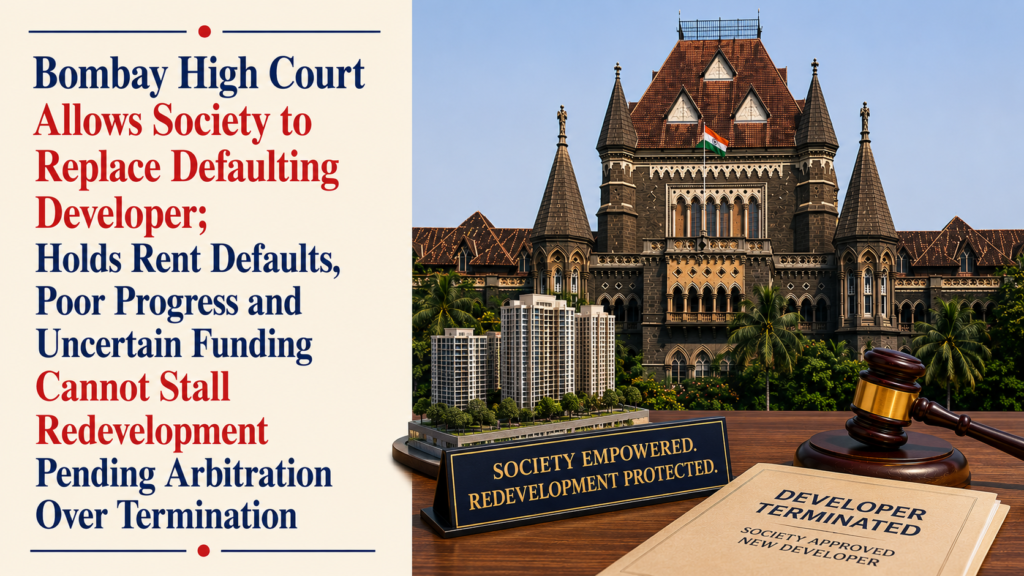
Bombay High Court Allows Society to Replace Defaulting Developer; Holds Rent Defaults, Poor Progress and Uncertain Funding Cannot Stall Redevelopment Pending Arbitration Over Termination

Bombay High Court Allows Society to Proceed With New Redeveloper; Holds Arbitral Challenge to Termination Cannot Keep Displaced Members and Redevelopment Project Indefinitely Stalled
Facts
The dispute concerned redevelopment of Om Vithal Cooperative Housing Society Limited’s property at Kasturi Park, Shimpoli Road, Borivali (West), Mumbai. The Society filed Arbitration Petition (L) No. 25010 of 2026 under Section 9 of the Arbitration and Conciliation Act, 1996 against its developer, Trilogy Infra Private Limited. The developer filed a cross-petition seeking to stay the Society’s termination notice and prevent its dispossession from the property.
The Society had originally appointed JKD Enterprises for redevelopment in January 2015. Following alleged defaults and abandonment, that arrangement was terminated in January 2023. After regaining possession through the Court Receiver, the Society conducted a fresh tender process and appointed Trilogy Infra. A registered Development Agreement dated 25 November 2023 and Power of Attorney dated 11 December 2023 were executed in its favour.
Under the Development Agreement, Trilogy was required to obtain necessary approvals, execute Permanent Alternate Accommodation Agreements, regularly pay rent to members and complete redevelopment within the stipulated period. The Society alleged that the developer failed to fulfil these obligations, obtain approvals, demonstrate financial readiness or make meaningful progress.
According to the Society, rent and rehabilitation compensation remained unpaid from around November 2025/January 2026, while not even a single RCC slab had been completed. The Society had nevertheless granted the developer a 24-month extension on 6 December 2025, with the original Development Agreement terms remaining unchanged and rent increasing by 10% from January 2026.
Relations subsequently deteriorated. On 30 January 2026, the developer gave the Society three options, including requiring payment of ₹10 crore with 18% interest if the Society wanted it to exit. In April 2026, the developer stated that an exit would require ₹10 crore plus an additional ₹10 crore as damages.
The Society ultimately issued a Termination Notice dated 18 May 2026, terminating the Development Agreement, Power of Attorney and connected documents. It sought protection under Section 9 so that it could proceed with redevelopment either through another developer or by self-development.
The developer challenged the termination and sought an injunction preventing the Society from acting upon it or appointing another developer.
Issues
The principal issues before the Court were:
- Whether the Society’s termination of the Development Agreement should remain operative pending arbitration.
- Whether the developer was entitled to an interim injunction preventing the Society from appointing another developer or undertaking self-redevelopment.
- Whether alleged delay, non-payment of rent, inadequate construction progress and uncertainty regarding funding created sufficient grounds to permit the Society to move ahead.
- Whether the developer’s explanation that the project was delayed because of a MahaRERA stay, parking construction and statutory approvals justified continuing the existing redevelopment arrangement.
- Whether Section 9 permitted the Court to finally declare either that the termination was valid or that it was illegal.
- How the Court should balance the members’ need for reconstructed homes against the developer’s contractual and commercial interests.
The Court formulated the immediate Section 9 question as whether redevelopment should continue with Trilogy until arbitration concluded or whether the Society should be allowed to proceed with redevelopment while adequately protecting the developer’s claims.
Petitioner’s Arguments
The Society argued that Trilogy had fundamentally failed to perform its redevelopment obligations.
Under the Development Agreement, redevelopment was to be completed within 18 months with a six-month grace period, and necessary approvals were required within six months. The developer was also required to provide a proper construction schedule or bar chart.
Despite these requirements:
- rent remained unpaid from November 2025;
- no proper construction schedule was supplied;
- not even one RCC slab had been completed;
- adequate approvals and progress were absent; and
- financial capacity to complete the project remained uncertain.
The Society emphasised that it had already shown accommodation by granting a 24-month extension, yet the developer allegedly failed to demonstrate meaningful progress even thereafter.
It further argued that the developer attempted to make continuation of redevelopment conditional upon acceptance of fresh commercial terms and execution of a Supplementary Development Agreement.
Accordingly, the Society maintained that its members had legitimately lost confidence in Trilogy and could not be compelled to remain tied to a stalled redevelopment project indefinitely.
It relied upon several Bombay High Court redevelopment decisions, including Pioneer Constructions, Yogeeta CHS Ltd., Punjab National Bank Workers CHS Ltd., Rajawadi Arunodaya CHSL, Mayurpankh CHSL, Swashray CHSL, Jal Ratan Deep CHSL and Goverdhangiri CHSL.
Respondent’s Arguments
The developer disputed that it alone was responsible for the delay.
It pointed out that MahaRERA had granted a stay on 16 April 2025 on a complaint by the earlier developer, affecting the redevelopment process.
It further submitted that demolition of the existing parking area and construction of a multi-storeyed parking building consumed substantial time. Municipal permission had been obtained on 1 February 2024, the necessary premium was paid on 11 August 2024, and parking-related construction continued from September 2024 until March 2025.
The developer also relied upon the Society’s 24-month extension granted on 6 December 2025, contending that this showed acceptance of the reasons for delay and modification of the redevelopment timeline.
It offered to deposit the outstanding corpus and additional funds in a joint escrow account or clear the arrears of rent, provided it was permitted to continue the project. It also stated that after the MahaRERA stay was lifted in December 2025, it approached lenders and investors to secure funding.
On jurisdiction, the developer argued that the Society’s request for a declaration that the Development Agreement stood terminated amounted to final relief, which could not ordinarily be granted under Section 9.
It therefore sought an injunction staying the termination and preventing the Society from proceeding with another developer.
Analysis of the Law
Scope of Section 9
The Court drew an important distinction between finally deciding contractual rights and creating an appropriate interim arrangement pending arbitration.
Justice Amit Borkar held that the validity of the termination notice ultimately had to be determined by the Arbitral Tribunal. A Section 9 Court could not conclusively declare either:
- that the termination was finally valid; or
- that the termination was illegal and the Development Agreement continued to subsist.
The Court was instead required to make a prima facie assessment and determine the interim arrangement necessary to protect the parties and prevent the redevelopment from remaining stalled indefinitely.
Society Members’ Housing Rights vs Developer’s Commercial Rights
A central principle applied by the Court was that in redevelopment disputes, the developer’s commercial interest in earning profits must ordinarily remain subservient to the Society members’ interest in obtaining reconstructed, safe and habitable homes.
The Court stressed, however, that this does not mean every termination by a society must automatically be upheld. A prima facie inquiry must still be undertaken into which party appears responsible for the breach.
Thus, redevelopment disputes require balancing:
Developer: contractual rights, investment and expected profits.
Society members: homes, alternate accommodation, rent, rehabilitation and timely completion.
Where the developer’s potential loss can ultimately be compensated monetarily but stopping redevelopment would leave members displaced indefinitely, the balance ordinarily weighs against an injunction.
Extension Does Not Give Unlimited Right to Delay
The Court held that the Society’s grant of a 24-month extension could be relevant in arbitration to determine whether earlier breaches had been waived or contractual timelines modified.
However, an extension does not confer an unrestricted right upon a developer to delay performance.
The developer remained obligated to demonstrate reasonable construction progress and fulfil continuing obligations, particularly payment of rent.
Payment of Rent Is a Significant Redevelopment Obligation
The Court placed particular emphasis on rent.
Members who vacate their existing homes depend upon the developer for alternate accommodation and monetary benefits. Failure to pay rent can therefore cause substantial hardship and cannot be treated as a minor contractual default.
The developer’s later offer to clear arrears did not automatically cure the broader issue of whether it possessed the financial and operational capacity to complete redevelopment within a definite timeframe.
Damages as an Adequate Remedy for Developer
The Court distinguished the prejudice suffered by the parties.
If the Society were restrained, members could remain without certainty regarding their homes until arbitration and subsequent proceedings concluded.
If the Society proceeded and the developer later established that termination was wrongful, the developer could pursue damages, compensation or other monetary relief before the Arbitral Tribunal.
The balance of convenience therefore favoured allowing redevelopment to continue.
Precedent Analysis
1. Pioneer Constructions v. Sahakarnagar Co-operative Housing Society Ltd., 2026 SCC OnLine Bom 2711
This was the principal precedent relied upon by the Court.
It established that in redevelopment disputes, a developer’s right to earn profits is ordinarily subordinate to residents’ rights to obtain reconstructed homes.
At the same time, the Court must undertake a prima facie assessment of the alleged breaches rather than mechanically favouring the Society.
The Court applied Pioneer Constructions to conclude that the consequence of granting the developer an injunction—potentially indefinite delay of redevelopment—was more serious than the developer’s loss of an opportunity to earn profits, which could potentially be compensated through an arbitral award.
2. Huges Real Estate Developers LLP
This Division Bench decision was referred to through Pioneer Constructions and supported the principle governing temporary injunctions in society redevelopment disputes.
3. Ison Builders LLP
The Court relied upon the principle that a developer whose termination is ultimately found wrongful can claim damages against the Society, but ordinarily cannot use that monetary dispute to stall redevelopment until final adjudication.
4. Swashray Co-operative Housing Society Ltd. v. Shanti Enterprises
This decision emphasised that a housing society cannot be kept indefinitely bound to a development agreement involving repeated defaults and no reasonable prospect of completion.
The Court applied that principle while examining the alleged rent defaults, absence of satisfactory progress and continuing uncertainty regarding project funding.
Court’s Reasoning
The Court acknowledged that the developer had offered plausible explanations for part of the delay. The MahaRERA stay, parking construction and statutory approval process were relevant factors and could not simply be ignored.
But those explanations did not resolve the subsequent problems.
The material indicated:
- alleged non-payment of rent;
- insufficient construction progress;
- uncertainty regarding financial closure;
- continuing attempts to secure investors and lenders;
- disputes over additional contractual conditions;
- deterioration of relations between the parties; and
- serious loss of confidence regarding the developer’s ability to finish within a reliable timeframe.
The developer’s offer to now clear arrears and arrange funds did not establish that completion within a definite period was realistically possible.
The Court held that granting Trilogy an injunction would effectively force the Society to remain tied to the existing developer until arbitration concluded. That could indefinitely stall the project.
Conversely, allowing the Society to move forward would not destroy Trilogy’s legal remedies. Its challenge to the termination and claims for damages or compensation could be fully adjudicated by the Arbitral Tribunal.
The Court therefore found that the balance of convenience favoured the Society. The likely prejudice from keeping redevelopment stopped was greater than the prejudice to Trilogy from allowing redevelopment to proceed while preserving its monetary and contractual claims.
Significantly, the Court did not finally uphold the legality of the termination. That issue remained expressly open for arbitration.
Conclusion
The Bombay High Court partly allowed the Society’s Section 9 petition and dismissed the developer’s Commercial Arbitration Petition.
Pending arbitration, the Court directed that the Termination Notice dated 18 May 2026 would remain operative and effective. Trilogy was consequently prohibited from claiming any right to continue redevelopment under the Development Agreement or Power of Attorney.
The Society was permitted to proceed with redevelopment either through self-development or by appointing another developer, contractor or agency. Trilogy was restrained from interfering with the Society’s possession or obstructing redevelopment and from creating third-party rights in the property.
The developer was also directed to hand over original project documents within two weeks and provide copies of approvals, sanctions, NOCs, drawings and other relevant redevelopment records.
The Court rejected Trilogy’s request that the Society be directed to deposit ₹10 crore as security for its alleged investment, leaving those monetary claims for determination in arbitration.
Crucially, all findings concerning termination and breach were expressly declared prima facie and were not to bind the Arbitral Tribunal.
The developer’s request to stay implementation of the judgment was also rejected.
The judgment therefore establishes that a developer cannot ordinarily use a pending arbitration over termination to indefinitely freeze a housing redevelopment project where substantial progress and funding remain uncertain and members face continuing hardship; the developer’s wrongful-termination and monetary claims can instead be preserved for arbitration.
Case Details
Case: Om Vithal Cooperative Housing Society Limited v. Trilogy Infra Private Limited with Trilogy Infra Private Limited v. Om Vithal Cooperative Housing Society Limited
Court: High Court of Judicature at Bombay, Ordinary Original Civil Jurisdiction
Case Number: Arbitration Petition (L) No. 25010 of 2026 with Commercial Arbitration Petition (L) No. 23586 of 2026
Judge: Justice Amit Borkar
Date: 20 August 2026 (Reserved: 19 August 2026)
Result: Society’s petition partly allowed; developer’s petition dismissed; termination kept operative pending arbitration; Society permitted to appoint another developer or self-redevelop; developer’s ₹10 crore security demand and stay request rejected; final validity of termination left to the Arbitral Tribunal.