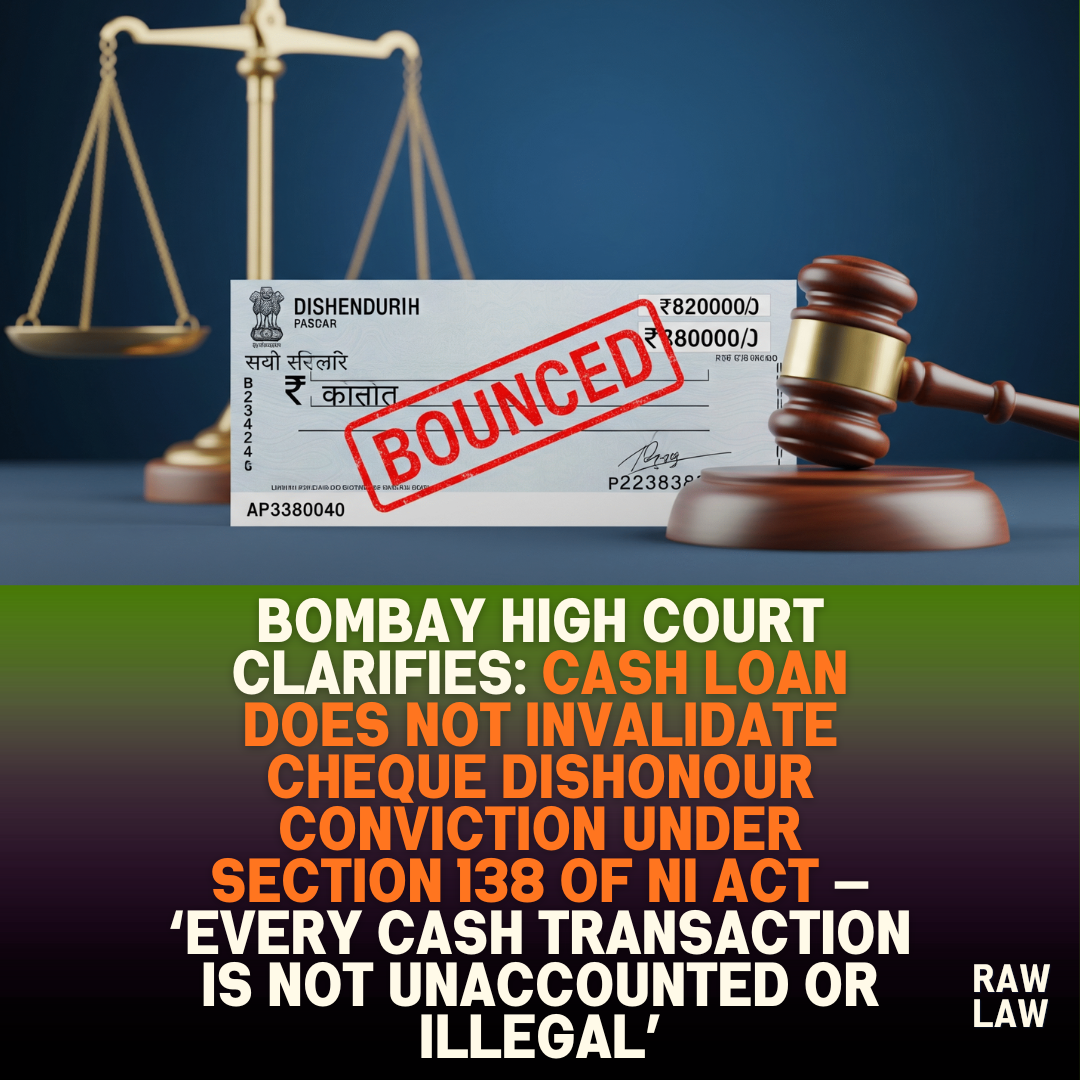
Bombay High Court Clarifies: Cash Loan Does Not Invalidate Cheque Dishonour Conviction under Section 138 of NI Act — ‘Every Cash Transaction Is Not Unaccounted or Illegal’

Court’s Decision
The Bombay High Court, per Justice N.J. Jamadar, dismissed a writ petition filed under Article 227 of the Constitution of India challenging the Sessions Court’s order directing the petitioner–accused to deposit 20% of the compensation as a condition for suspension of sentence in a cheque dishonour case under Section 138 of the Negotiable Instruments Act, 1881 (NI Act).
The Court upheld the lower court’s discretion, observing that the direction to deposit 20% under Section 148(1) of the NI Act was not mandatory but ordinarily required unless the case was “exceptional.” Justice Jamadar held that the mere fact that the underlying loan transaction was made in cash does not make it illegal or unenforceable, and thus no “exceptional circumstance” existed to waive the deposit.
The Court held:
“Every transaction in cash is not per se illegal or void. The presumption under Section 139 of the NI Act continues to operate unless duly rebutted.”
Accordingly, the writ petition was dismissed, and the Sessions Court’s direction to deposit 20% of the compensation was affirmed.
Facts
The respondent–complainant filed a complaint under Section 138 of the NI Act alleging that he had advanced a loan of ₹2.67 crore to the accused between April 2018 and February 2021 through multiple cash transactions. To acknowledge his liability, the accused executed Demand Promissory Notes and issued three cheques of ₹89.25 lakh each, all of which were dishonoured upon presentationordjud (27).
A legal notice dated 15 April 2021 demanding repayment was served, but the accused neither replied nor paid. The trial court convicted the accused, sentencing him to one year’s simple imprisonment and ordering compensation equal to the loan amount.
On appeal, the Sessions Court suspended the sentence but directed the accused to deposit 20% of the compensation in compliance with Section 148(1) of the NI Act. The accused then filed a writ petition before the High Court, claiming that the direction to deposit the amount rendered his right of appeal illusory since the transaction was in cash and therefore “illegal” under the Income Tax Act.
Issues
- Whether the Sessions Court’s direction to deposit 20% of the compensation under Section 148(1) of the NI Act was mandatory or discretionary.
- Whether a cash transaction, allegedly violating Section 269SS of the Income Tax Act, renders the underlying debt “unenforceable” under Section 138 of the NI Act.
- Whether the accused had made out an “exceptional case” justifying waiver of the deposit condition.
Petitioner’s Arguments
The petitioner contended that the Sessions Court failed to exercise discretion judiciously and treated the deposit requirement as mandatory. It was argued that the transaction was entirely in cash, amounting to an illegal and unaccounted transaction under the Income Tax Act, making the debt unenforceable.
Counsel emphasized that the Sessions Judge did not provide reasons for rejecting the plea for exemption. He cited G. Pankajakshi Amma v. Mathai Mathew [(2004) 12 SCC 83], where the Supreme Court held that courts cannot assist a party in enforcing unaccounted cash transactions, and Sanjay Mishra v. Kanishka Kapoor [2009 (4) Mh LJ 155], which held that repayment of unaccounted cash is not a legally enforceable liability under Section 138.
It was submitted that compelling deposit of 20% of ₹2.67 crore would make the right of appeal illusory, especially when the legality of the transaction itself was doubtful. The petitioner further argued that the Sessions Court ignored contentions regarding non-service of notice and that the petitioner was not the drawer of one of the cheques.
Respondent’s Arguments
The complainant argued that all cash advances were duly disclosed in income tax returns, supported by promissory notes acknowledging the liability. Therefore, the transactions were neither unaccounted nor illegal.
It was contended that Section 148(1) empowers the appellate court to direct a deposit, and such a condition can only be waived in truly exceptional circumstances, none of which were made out. The complainant further highlighted that the petitioner had sought extension of time to pay before invoking the High Court’s writ jurisdiction, thereby acting in bad faith.
The respondent relied on Dr. Jagannath Ganesh Hegde v. In Depth Entertaining Arts Pvt. Ltd. [2016 SCC OnLine Bom 10400], which clarified that cash transactions are not inherently void, and their enforceability depends on factual proof and acknowledgment of liability.
Analysis of the Law
The Court undertook a detailed examination of Section 148 of the NI Act, noting that the provision was inserted to curb misuse of the appellate process by convicted cheque drawers and to safeguard the payee’s right to compensation during appeals.
Justice Jamadar emphasized that the word “may” in Section 148(1) confers discretion on the appellate court, while the word “shall” denotes that the deposit amount, once directed, cannot be less than 20%. The provision, he said, strikes a balance between ensuring compensation to the complainant and preserving the accused’s right of appeal.
The Court further observed that cash transactions are not automatically void under the Income Tax Act. Violation of Section 269SS attracts only a penalty under Section 271D, and does not make the transaction unenforceable or void for the purposes of Section 138 of the NI Act.
Thus, the argument that the loan being in cash made the debt unenforceable was contrary to settled law.
Precedent Analysis
The Court referred extensively to precedent to settle the conflicting interpretations:
- Surinder Singh Deswal v. Virender Gandhi [(2019) 11 SCC 341] – The Supreme Court held that Section 148 must be interpreted purposively, allowing the appellate court to ordinarily require a 20% deposit, with waiver only in “exceptional cases.”
- Jamboo Bhandari v. MP State Industrial Development Corp. (2023) – Clarified that the appellate court has limited discretion to waive deposit, but only when imposing it would deprive the appellant of his substantive right of appeal.
- Muskan Enterprises v. State of Punjab [2025 SCC OnLine SC 4107] – The Supreme Court reconciled earlier decisions, holding that “may” confers discretion but waiver must be rare and reasoned.
- G. Pankajakshi Amma v. Mathai Mathew (2004) 12 SCC 83 – Cited by the petitioner to argue that courts cannot enforce illegal cash lending; however, distinguished on facts, since that case involved unaccounted, unlawful money lending without records.
- Prakash Madhukarrao Desai v. Dattatraya Sheshrao Desai [(2023) 5 Mah LJ 709] – The Division Bench overruled Sanjay Mishra, holding that transactions in cash do not invalidate a debt under Section 138, and the presumption of liability under Section 139 continues.
- Sanjabi Tari v. Kishore S. Borcar (Supreme Court, 25 Sept 2025) – The Court clarified that breach of Section 269SS only invites tax penalty and does not make the transaction void; hence, the debt remains legally enforceable under Section 138.
The High Court applied these rulings to conclude that the petitioner’s arguments were unsustainable.
Court’s Reasoning
Justice Jamadar reasoned that no exceptional circumstance justified waiving the statutory deposit. The petitioner’s reliance on the “cash transaction” argument was misconceived, given the Supreme Court’s clarification that such transactions do not invalidate liability.
He further held that every contentious or debatable issue in appeal does not amount to an “exceptional case.” Only where the conviction appears manifestly illegal, perverse, or contrary to law should the appellate court consider waiving the deposit.
“An exceptional circumstance is not every arguable point. It arises only when the conviction order is ex facie perverse or manifestly illegal.”
Since the complainant had duly reported the transactions in income tax filings, and the petitioner had admitted executing promissory notes, the Sessions Judge rightly ordered the deposit.
Conclusion
The Bombay High Court dismissed the writ petition, holding that the Sessions Court correctly exercised discretion under Section 148(1). It reaffirmed that:
- Cash transactions are not per se illegal or unenforceable.
- Deposit of 20% compensation is the norm, waiver being rare.
- The accused failed to establish any “exceptional circumstance” warranting deviation.
Justice Jamadar concluded:
“Violation of the Income Tax Act does not render a transaction unenforceable under Section 138 of the NI Act. Every cash transaction cannot be branded as unaccounted or illegal.”
The petition was dismissed with no order as to costs.
Implications
This ruling harmonizes conflicting High Court views and reinforces that Section 148(1) deposits are ordinarily mandatory. It safeguards the rights of complainants in cheque dishonour cases by preventing appellants from using appeals to delay payments.
Equally, it clarifies that cash-based transactions, if properly acknowledged, remain legally enforceable debts, restoring certainty in business dealings.
The decision is a major precedent for both criminal appellate procedure and financial compliance law, establishing that tax irregularities do not negate criminal liability under Section 138.