

1. Court’s decision
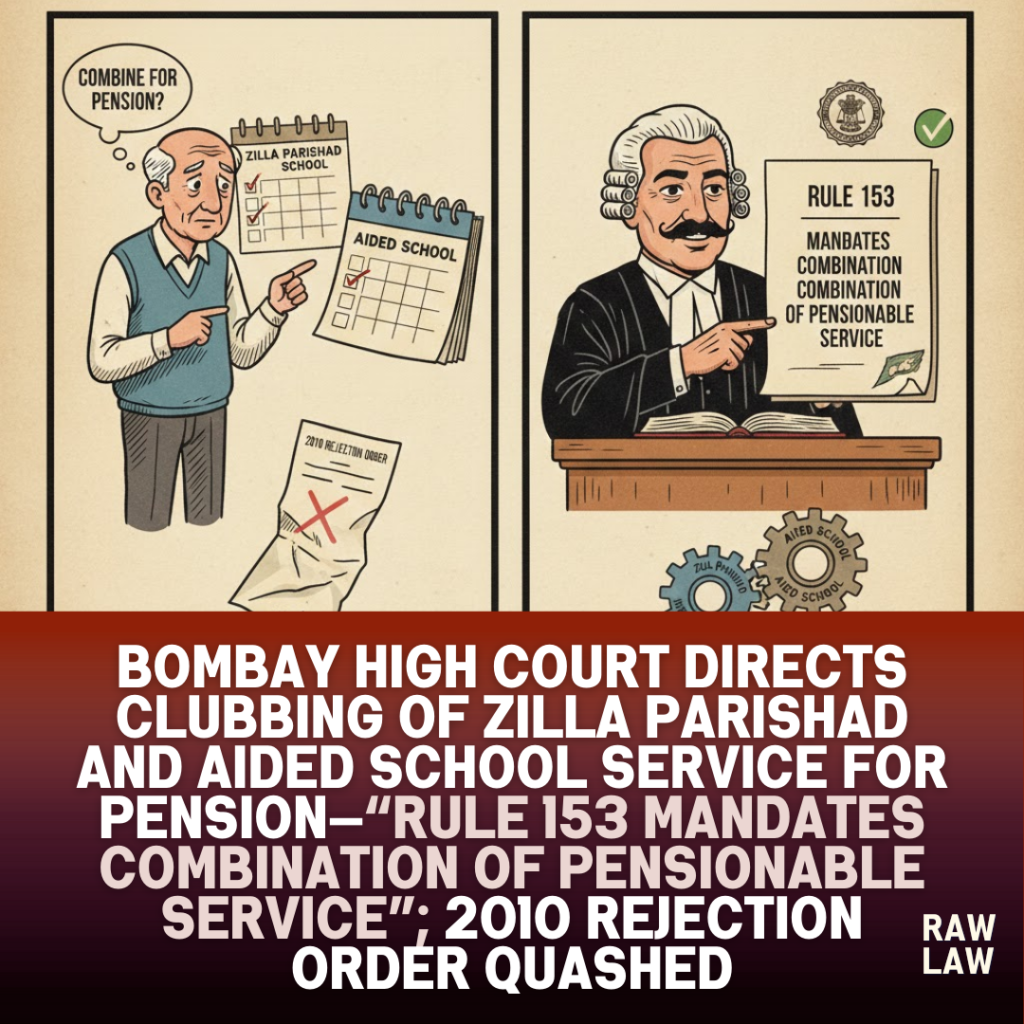
The Bombay High Court (Aurangabad Bench) allowed a writ petition filed by the legal heirs of a retired Head Master seeking clubbing of his Zilla Parishad service and subsequent grant-in-aid school service for pensionary benefits. The Court quashed the State Government’s order dated 15 March 2010 rejecting the claim and held that Rule 153 of the Maharashtra Civil Services (Pension) Rules, 1982 mandates combination of earlier and subsequent pensionable service.
The Court directed refixation of pension by treating service from 26 June 1959 to 30 April 1996 as one continuous qualifying service, with arrears payable within four months and 6% interest for delay.
2. Facts
The original petitioner served as Assistant Teacher in a Zilla Parishad High School, Parbhani, from 26 June 1959 to 31 July 1986, completing about 27 years of service. He opted for voluntary retirement on 31 July 1986 and immediately joined as Head Master in Prabhavati Vidyalaya, a grant-in-aid school run by a private management, where he served until 30 April 1996.
After superannuation, a proposal was forwarded to count both services for combined pension. The Accountant General returned the proposal citing Rules 39 and 153 of the Pension Rules, 1982, stating that new service after voluntary retirement cannot be counted. The Government rejected the claim on 15 March 2010.
3. Issues
The Court examined:
• Whether service rendered after voluntary retirement in another pensionable post can be clubbed with prior service under Rule 153.
• Whether Rules 66 and 66-A (governing voluntary retirement and weightage) bar counting subsequent pensionable service.
• Whether the petitioner’s claim amounted to “double benefit.”
4. Petitioner’s arguments
The petitioner contended that both posts—Assistant Teacher in Zilla Parishad and Head Master in a grant-in-aid school—were pensionable and governed by statutory pension rules. There was no break in service.
Relying on Rule 153, it was argued that when new service is pensionable, it must be combined with previous service and treated as one continuous service for pension.
The petitioner further relied on the Supreme Court judgment in Madhukar v. State of Maharashtra (2014) 15 SCC 565, which held that subsequent pensionable service after retirement is liable to be counted for determining pensionary benefits.
5. Respondents’ arguments
The State argued that the petitioner had taken voluntary retirement and received pension with addition of five years’ weightage under Rule 66-A. Since he had already been granted pension for 32 years’ qualifying service, counting further service would exceed permissible limits and result in double benefit.
It was contended that Rule 153 applied only in exceptional situations such as closure of institution or administrative compulsion, not voluntary retirement.
The State also alleged that the petitioner had enjoyed pay fixation without deduction of pension, thereby deriving dual advantage.
6. Analysis of the law
The Court undertook a textual analysis of Rule 153. It observed that the rule explicitly provides that where the new service is pensionable, it must be combined with previously rendered service and treated as one service for calculating pension.
The Court rejected the State’s restrictive interpretation that Rule 153 applies only in exceptional cases. No such limitation is found in the text of the rule.
Rules 66 and 66-A were held to operate in a different field. They govern voluntary retirement and weightage but do not bar counting subsequent pensionable service. The Court harmoniously construed the provisions to give effect to the scheme of the Pension Rules.
7. Precedent analysis
The Bench relied on the Supreme Court decision in Madhukar v. State of Maharashtra (2014) 15 SCC 565, which conclusively settled that subsequent pensionable service after retirement must be counted along with earlier service for pensionary benefits.
The Court observed that the issue was no longer res integra and the statutory mandate under Rule 153 could not be diluted by administrative interpretation.
8. Court’s reasoning
The Court noted that there was no break in service and both employments were pensionable. Once subsequent service qualifies for pension, it must be clubbed with earlier service.
The “double benefit” argument was rejected. The record showed that pension was taken into account while fixing pay in the aided school and excess amounts, if any, were recovered. The petitioner sought only a single consolidated pension based on total qualifying service.
The impugned order dated 15 March 2010 was held contrary to statutory rules and therefore unsustainable.
9. Conclusion
The writ petition was allowed. The rejection order dated 15 March 2010 was quashed.
The respondents were directed to club service from 26 June 1959 to 31 July 1986 (Zilla Parishad) and 01 August 1986 to 30 April 1996 (grant-in-aid school) as one continuous qualifying service under Rule 153. Pension is to be re-fixed based on average pensionable pay of the last ten months, with consequential benefits payable within four months.
Failure to comply will attract 6% interest per annum on arrears.
10. Implications
This judgment reinforces the binding nature of Rule 153 of the Maharashtra Civil Services (Pension) Rules, 1982. It clarifies that:
• Subsequent pensionable service after voluntary retirement must be counted.
• Rules 66 and 66-A do not bar such clubbing.
• Administrative interpretation cannot override statutory mandate.
• Pensioners cannot be denied rightful consolidation of qualifying service.
The ruling may significantly impact teachers and government servants who shift between Zilla Parishad and aided institutions after voluntary retirement.
Case Law References
Madhukar v. State of Maharashtra (2014) 15 SCC 565 – Subsequent pensionable service after retirement must be combined with earlier service for pension computation.
FAQs
1. Can service after voluntary retirement be counted for pension?
Yes, if the subsequent service is pensionable. Rule 153 mandates combination of earlier and new pensionable service.
2. Do Rules 66 and 66-A prohibit counting later service?
No. They govern voluntary retirement weightage but do not bar clubbing of subsequent pensionable service.
3. Does combining service amount to double pension?
No. The Court clarified that only one consolidated pension is payable after adjustment of earlier payments.


