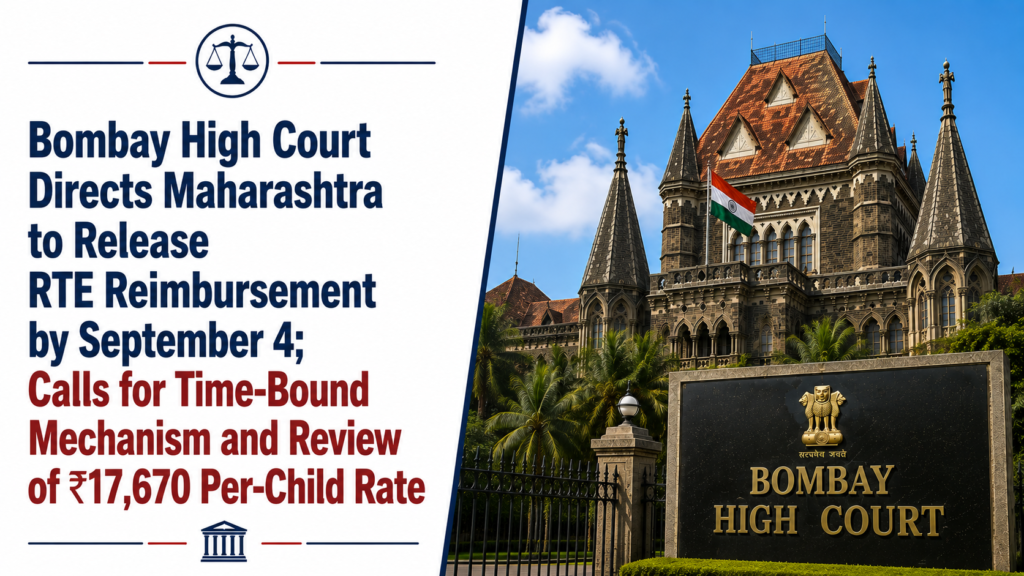
Bombay High Court Directs Maharashtra to Release RTE Reimbursement by September 4; Calls for Time-Bound Mechanism and Review of ₹17,670 Per-Child Rate

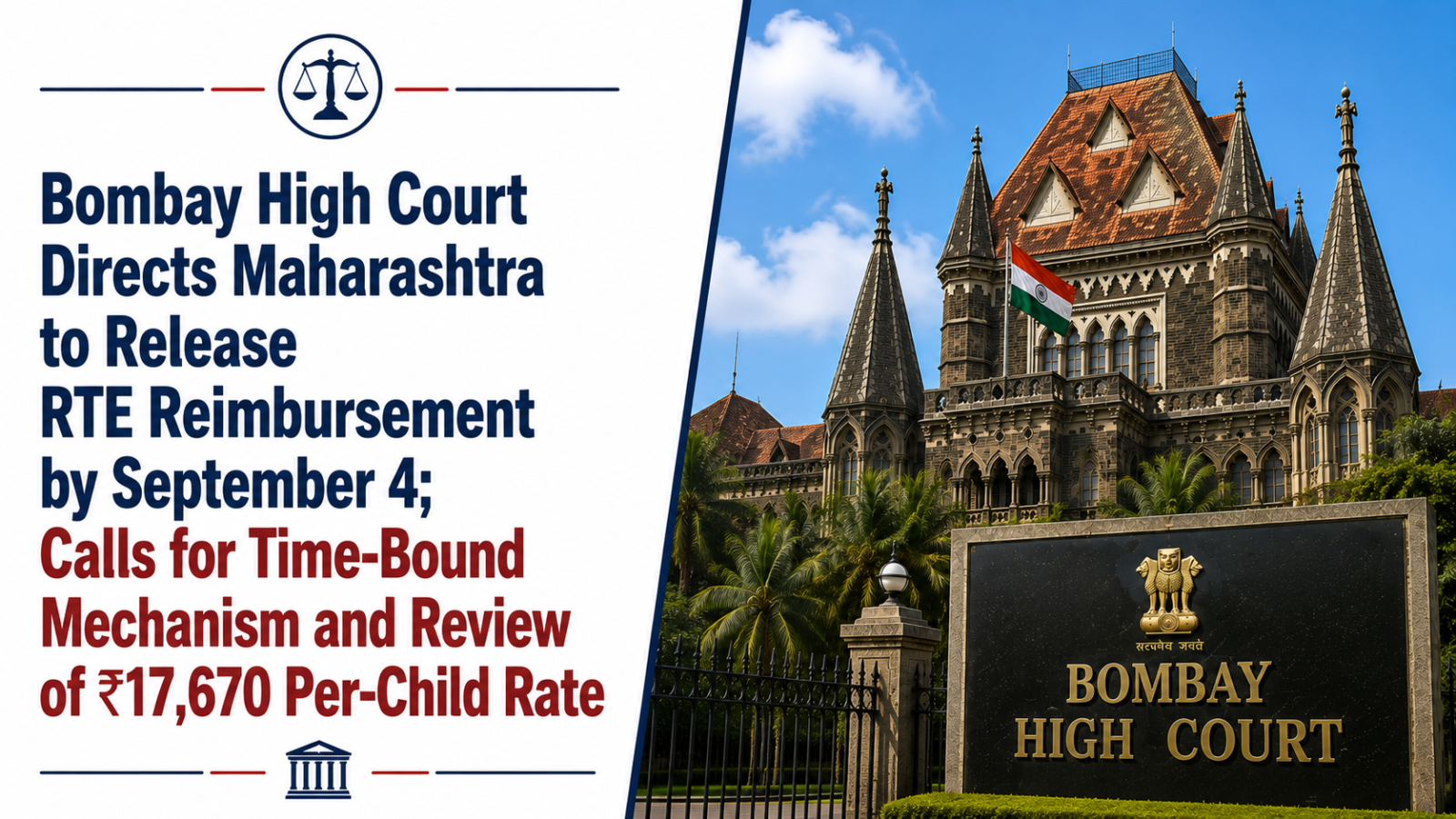
Bombay High Court Directs Maharashtra to Release Pending RTE Reimbursement by September 4; Calls for Comprehensive Review of Payment Mechanism
Facts
The petitioners, Om Education Society and other schools, instituted a contempt petition alleging wilful and deliberate breach of an earlier order dated 26 March 2026 passed by the Bombay High Court in relation to reimbursement dues under the Right of Children to Free and Compulsory Education Act, 2009.
In the earlier writ proceedings, the State had made a statement that it would reimburse Petitioner Nos. 3 to 5 their pending dues, to the extent found payable, within eight weeks from 1 April 2026, i.e. by 27 May 2026.
The schools had claimed reimbursement aggregating to Rs. 3,65,75,530 under the RTE Act.
When the contempt petition came up, the Additional Government Pleader, on instructions from the Under Secretary, School Education and Sports Department, who was personally present, stated that the State would comply with the earlier order and release the admissible amount within four weeks and, in any event, not later than 4 September 2026.
The High Court accepted this statement as an undertaking to the Court and listed the matter on 7 September 2026 for reporting compliance.
Although the immediate contempt dispute was thereby substantially resolved, the Division Bench used the proceeding to address the broader and recurring problem of delayed RTE reimbursements across Maharashtra.
Issues
- Whether the State had failed to comply with its earlier undertaking to release RTE reimbursement dues within the stipulated period.
- Whether delayed processing of reimbursement claims under Section 12(2) of the RTE Act was undermining the statutory scheme.
- Whether the absence of prescribed timelines after verification by the Education Officer was resulting in unreasonable administrative delay.
- Whether administrative scrutiny of reimbursement claims could justify keeping claims pending for years.
- Whether the State should establish a time-bound mechanism and monitoring framework for processing RTE reimbursements.
- Whether the existing reimbursement rate of Rs. 17,670 per child, stated to have remained unchanged since 2016-17, required reconsideration.
Petitioners’ Arguments
The petitioners approached the Court on the basis that the State had failed to honour its earlier assurance to release the schools’ admissible reimbursement dues by 27 May 2026.
Their underlying claim arose from their statutory obligation to admit children from weaker sections and disadvantaged groups under Section 12(1)(c) of the RTE Act and the corresponding right to reimbursement under Section 12(2).
The contempt petition therefore sought enforcement of the earlier High Court order and appropriate action against the State authorities for alleged wilful non-compliance.
Respondent’s Arguments
The State did not ultimately contest its obligation to comply.
On instructions from the Under Secretary of the School Education and Sports Department, the Additional Government Pleader stated that the admissible reimbursement amount would be released within four weeks and no later than 4 September 2026.
This statement was expressly accepted by the Court as an undertaking.
The order does not record any detailed substantive defence by the State regarding the earlier delay. The focus shifted instead to the systemic difficulties in processing RTE reimbursement claims.
Analysis of the Law
Section 12 of the RTE Act
The Court emphasised that the RTE Act is a beneficial social welfare legislation enacted to implement the fundamental right to education for children between six and fourteen years.
Under Section 12(1)(c), specified private unaided schools must admit at least 25% of Class I students from weaker sections and disadvantaged groups and provide them free elementary education.
Correspondingly, Section 12(2) imposes a statutory obligation upon the State to reimburse eligible schools to the extent of the State’s per-child expenditure or the actual amount charged from the child, whichever is lower.
The Court treated these two obligations as inseparably connected: private schools’ obligation to educate RTE students cannot realistically function unless the State performs its reciprocal reimbursement obligation.
Absence of Timelines
Under the State’s Rules and notifications, the concerned Education Officer must verify the school’s reimbursement claim and forward an eligible claim to the Director of Education within one month.
However, the Court noted that no prescribed timeline exists thereafter for the Director of Education or other departments to process the proposal and release funds.
This legislative and administrative gap had resulted in proposals remaining pending for years.
The Court accepted that the State has every right—and indeed a duty—to scrutinise claims before disbursing public funds. But it made the important observation that:
administrative verification cannot become a justification for indefinite inaction.
Recurring Litigation as Evidence of Systemic Failure
The Court relied upon information supplied by the Registry that between 1 January 2026 and 6 August 2026, at least 133 writ petitions had been filed seeking release of RTE reimbursement under Section 12(2).
Many had already resulted in directions requiring the State to process and release admissible amounts within specified periods. The present contempt petition itself arose because one such direction had not been complied with on time.
The Court therefore viewed the problem as systemic rather than isolated.
Precedent Analysis
The order does not cite or analyse any reported judicial precedent.
The Court’s reasoning is based directly upon:
- the statutory scheme under the RTE Act;
- the Maharashtra RTE Rules and Government Notifications;
- the State’s earlier and present undertakings;
- the recurring pattern of litigation concerning delayed reimbursements; and
- the practical effect of prolonged non-payment upon unaided schools.
Accordingly, the order is significant primarily for its administrative and structural observations concerning implementation of Section 12(2) rather than for interpreting earlier case law.
Court’s Reasoning
The High Court held that the RTE scheme places reciprocal statutory responsibilities on private unaided schools and the State.
Schools are legally required to reserve seats and provide free education to eligible children. The State, in turn, must reimburse the eligible expenditure.
The Court observed that prolonged delays in reimbursement can materially affect the financial viability of institutions that continue to discharge statutory obligations without receiving corresponding payments.
It held that the legislative objective of Section 12 could be seriously undermined unless the reimbursement mechanism is made time-bound.
The Court therefore recommended a comprehensive review of the existing system, specifically requiring consideration of:
- definite timelines at every stage of reimbursement processing;
- an appropriate monitoring mechanism to ensure adherence to those timelines; and
- adequacy of the current per-child reimbursement amount.
The Court was specifically informed that the reimbursement rate remained Rs. 17,670 per child since the academic year 2016-17, despite substantial escalation in educational expenditure. This was therefore identified as a matter requiring reconsideration.
The Bench further expected the Maharashtra Government to constitute an appropriate Committee comprising senior officers from the Finance Department and School Education and Sports Department, together with any other necessary officials.
The Committee could also seek representations from recognised associations of unaided schools and other stakeholders. The Court expressed the expectation that the exercise be completed preferably before the end of calendar year 2026.
Conclusion
The contempt petition was substantially resolved after the State gave a fresh undertaking to release the admissible reimbursement amount to the petitioner schools within four weeks and no later than 4 September 2026.
The matter was kept pending and directed to be listed on 7 September 2026 for reporting compliance.
Beyond the immediate dispute, the Bombay High Court called upon the Maharashtra Government to undertake a comprehensive review of its RTE reimbursement mechanism.
It expected the State to consider:
- fixed timelines for each processing stage;
- a monitoring mechanism;
- revision or reconsideration of the existing reimbursement rate; and
- constitution of a committee involving senior Finance and Education Department officials, with stakeholder consultation.
The exercise was expected to be undertaken expeditiously and preferably before the end of 2026.
Case Details
Case: Om Education Society & Ors. v. State of Maharashtra & Ors.
Court: Bombay High Court, Civil Appellate Jurisdiction
Case Number: Contempt Petition No. 408 of 2026 in Writ Petition No. 3834 of 2026
Judges: Justice R. I. Chagla and Justice Farhan P. Dubash
Date: 7 August 2026
Result: State undertaking to release admissible RTE dues by 4 September 2026 accepted; matter listed for compliance on 7 September 2026; State expected to comprehensively review reimbursement timelines, monitoring and per-child rates
Bombay High Court Directs Maharashtra to Release RTE Reimbursement by September 4; Calls for Time-Bound Mechanism and Review of ₹17,670 Per-Child Rate
Bombay High Court Directs Maharashtra to Release Pending RTE Reimbursement by September 4; Calls for Comprehensive Review of Payment Mechanism
Facts
The petitioners, Om Education Society and other schools, instituted a contempt petition alleging wilful and deliberate breach of an earlier order dated 26 March 2026 passed by the Bombay High Court in relation to reimbursement dues under the Right of Children to Free and Compulsory Education Act, 2009.
In the earlier writ proceedings, the State had made a statement that it would reimburse Petitioner Nos. 3 to 5 their pending dues, to the extent found payable, within eight weeks from 1 April 2026, i.e. by 27 May 2026.
The schools had claimed reimbursement aggregating to Rs. 3,65,75,530 under the RTE Act.
When the contempt petition came up, the Additional Government Pleader, on instructions from the Under Secretary, School Education and Sports Department, who was personally present, stated that the State would comply with the earlier order and release the admissible amount within four weeks and, in any event, not later than 4 September 2026.
The High Court accepted this statement as an undertaking to the Court and listed the matter on 7 September 2026 for reporting compliance.
Although the immediate contempt dispute was thereby substantially resolved, the Division Bench used the proceeding to address the broader and recurring problem of delayed RTE reimbursements across Maharashtra.
Issues
- Whether the State had failed to comply with its earlier undertaking to release RTE reimbursement dues within the stipulated period.
- Whether delayed processing of reimbursement claims under Section 12(2) of the RTE Act was undermining the statutory scheme.
- Whether the absence of prescribed timelines after verification by the Education Officer was resulting in unreasonable administrative delay.
- Whether administrative scrutiny of reimbursement claims could justify keeping claims pending for years.
- Whether the State should establish a time-bound mechanism and monitoring framework for processing RTE reimbursements.
- Whether the existing reimbursement rate of Rs. 17,670 per child, stated to have remained unchanged since 2016-17, required reconsideration.
Petitioners’ Arguments
The petitioners approached the Court on the basis that the State had failed to honour its earlier assurance to release the schools’ admissible reimbursement dues by 27 May 2026.
Their underlying claim arose from their statutory obligation to admit children from weaker sections and disadvantaged groups under Section 12(1)(c) of the RTE Act and the corresponding right to reimbursement under Section 12(2).
The contempt petition therefore sought enforcement of the earlier High Court order and appropriate action against the State authorities for alleged wilful non-compliance.
Respondent’s Arguments
The State did not ultimately contest its obligation to comply.
On instructions from the Under Secretary of the School Education and Sports Department, the Additional Government Pleader stated that the admissible reimbursement amount would be released within four weeks and no later than 4 September 2026.
This statement was expressly accepted by the Court as an undertaking.
The order does not record any detailed substantive defence by the State regarding the earlier delay. The focus shifted instead to the systemic difficulties in processing RTE reimbursement claims.
Analysis of the Law
Section 12 of the RTE Act
The Court emphasised that the RTE Act is a beneficial social welfare legislation enacted to implement the fundamental right to education for children between six and fourteen years.
Under Section 12(1)(c), specified private unaided schools must admit at least 25% of Class I students from weaker sections and disadvantaged groups and provide them free elementary education.
Correspondingly, Section 12(2) imposes a statutory obligation upon the State to reimburse eligible schools to the extent of the State’s per-child expenditure or the actual amount charged from the child, whichever is lower.
The Court treated these two obligations as inseparably connected: private schools’ obligation to educate RTE students cannot realistically function unless the State performs its reciprocal reimbursement obligation.
Absence of Timelines
Under the State’s Rules and notifications, the concerned Education Officer must verify the school’s reimbursement claim and forward an eligible claim to the Director of Education within one month.
However, the Court noted that no prescribed timeline exists thereafter for the Director of Education or other departments to process the proposal and release funds.
This legislative and administrative gap had resulted in proposals remaining pending for years.
The Court accepted that the State has every right—and indeed a duty—to scrutinise claims before disbursing public funds. But it made the important observation that:
administrative verification cannot become a justification for indefinite inaction.
Recurring Litigation as Evidence of Systemic Failure
The Court relied upon information supplied by the Registry that between 1 January 2026 and 6 August 2026, at least 133 writ petitions had been filed seeking release of RTE reimbursement under Section 12(2).
Many had already resulted in directions requiring the State to process and release admissible amounts within specified periods. The present contempt petition itself arose because one such direction had not been complied with on time.
The Court therefore viewed the problem as systemic rather than isolated.
Precedent Analysis
The order does not cite or analyse any reported judicial precedent.
The Court’s reasoning is based directly upon:
- the statutory scheme under the RTE Act;
- the Maharashtra RTE Rules and Government Notifications;
- the State’s earlier and present undertakings;
- the recurring pattern of litigation concerning delayed reimbursements; and
- the practical effect of prolonged non-payment upon unaided schools.
Accordingly, the order is significant primarily for its administrative and structural observations concerning implementation of Section 12(2) rather than for interpreting earlier case law.
Court’s Reasoning
The High Court held that the RTE scheme places reciprocal statutory responsibilities on private unaided schools and the State.
Schools are legally required to reserve seats and provide free education to eligible children. The State, in turn, must reimburse the eligible expenditure.
The Court observed that prolonged delays in reimbursement can materially affect the financial viability of institutions that continue to discharge statutory obligations without receiving corresponding payments.
It held that the legislative objective of Section 12 could be seriously undermined unless the reimbursement mechanism is made time-bound.
The Court therefore recommended a comprehensive review of the existing system, specifically requiring consideration of:
- definite timelines at every stage of reimbursement processing;
- an appropriate monitoring mechanism to ensure adherence to those timelines; and
- adequacy of the current per-child reimbursement amount.
The Court was specifically informed that the reimbursement rate remained Rs. 17,670 per child since the academic year 2016-17, despite substantial escalation in educational expenditure. This was therefore identified as a matter requiring reconsideration.
The Bench further expected the Maharashtra Government to constitute an appropriate Committee comprising senior officers from the Finance Department and School Education and Sports Department, together with any other necessary officials.
The Committee could also seek representations from recognised associations of unaided schools and other stakeholders. The Court expressed the expectation that the exercise be completed preferably before the end of calendar year 2026.
Conclusion
The contempt petition was substantially resolved after the State gave a fresh undertaking to release the admissible reimbursement amount to the petitioner schools within four weeks and no later than 4 September 2026.
The matter was kept pending and directed to be listed on 7 September 2026 for reporting compliance.
Beyond the immediate dispute, the Bombay High Court called upon the Maharashtra Government to undertake a comprehensive review of its RTE reimbursement mechanism.
It expected the State to consider:
- fixed timelines for each processing stage;
- a monitoring mechanism;
- revision or reconsideration of the existing reimbursement rate; and
- constitution of a committee involving senior Finance and Education Department officials, with stakeholder consultation.
The exercise was expected to be undertaken expeditiously and preferably before the end of 2026.
Case Details
Case: Om Education Society & Ors. v. State of Maharashtra & Ors.
Court: Bombay High Court, Civil Appellate Jurisdiction
Case Number: Contempt Petition No. 408 of 2026 in Writ Petition No. 3834 of 2026
Judges: Justice R. I. Chagla and Justice Farhan P. Dubash
Date: 7 August 2026
Result: State undertaking to release admissible RTE dues by 4 September 2026 accepted; matter listed for compliance on 7 September 2026; State expected to comprehensively review reimbursement timelines, monitoring and per-child rates