Bombay High Court Jails Insolvent Pallav Sheth for Concealing Bank Accounts and False Disclosures; Reopens Public Examination and Permits Recovery of Undisclosed Assets

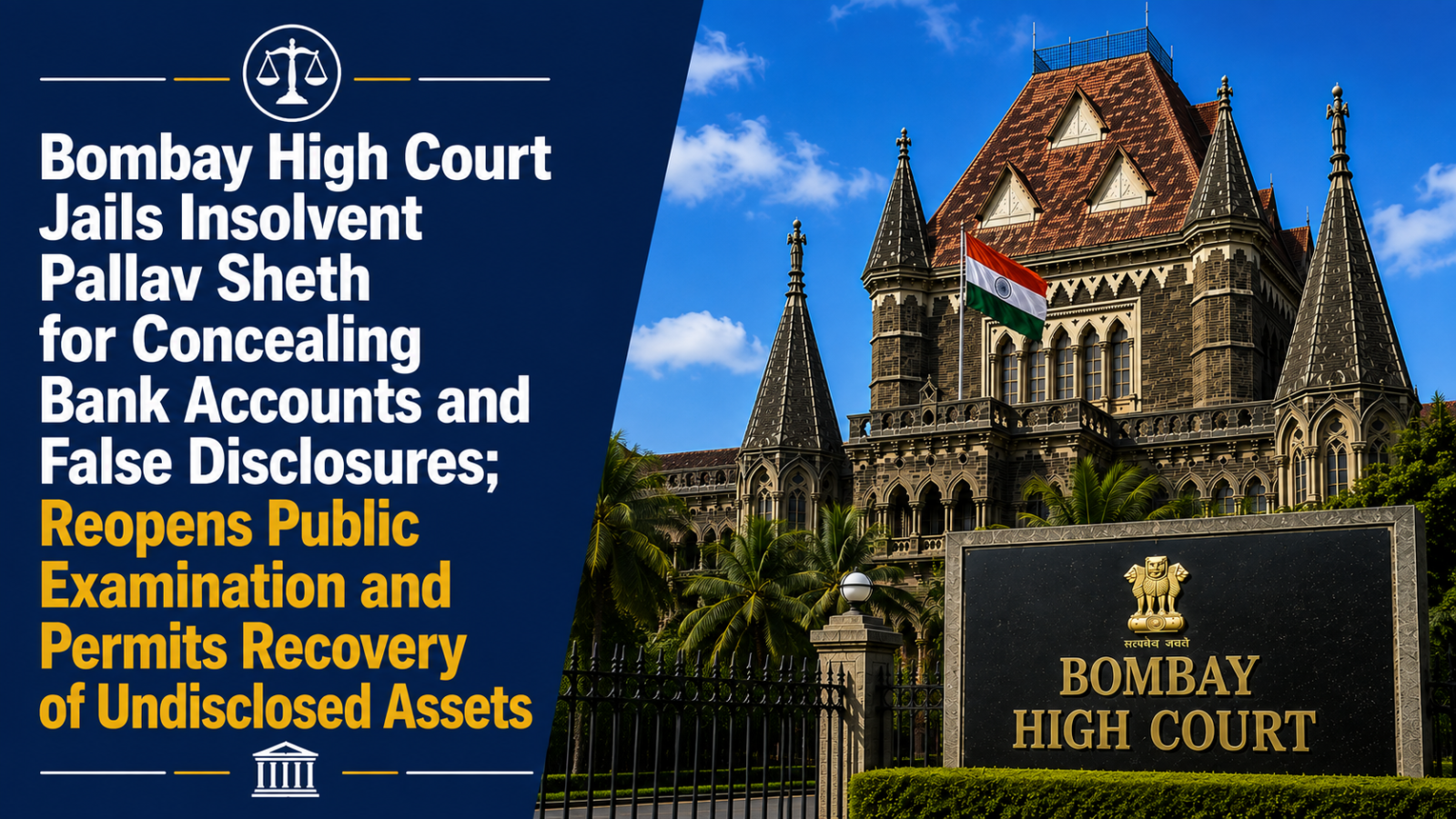
Bombay High Court Jails Insolvent for One Month After Finding Wilful Concealment of Accounts, False Affidavits and Undisclosed Transactions
Facts
The Bombay High Court decided Show Cause Notice No. 2 of 2025 in Official Assignee’s Report No. 9 of 2024 in Insolvency Petition No. 49 of 1996, along with a connected Notice of Motion filed by Canbank Financial Services Ltd., the petitioning creditor, against Pallav Sheth, the adjudged insolvent.
Pallav Sheth had been notified under the Special Court (Trial of Offences Relating to Transactions in Securities) Act, 1992 in October 2001, resulting in statutory attachment of his properties. He was thereafter adjudged insolvent in November 2003 under the Presidency Towns Insolvency Act, 1909. His schedule disclosed liabilities exceeding Rs. 249 crore, while his estate account had a balance of only Rs. 1,106.
The controversy arose when the petitioning creditor received information that the insolvent had been operating bank accounts and undertaking substantial financial transactions despite the pending insolvency proceedings.
The record eventually revealed accounts with ICICI Bank, HDFC Bank, Model Cooperative Bank and IDFC First Bank, several of which had never been disclosed during the insolvent’s schedule, private examination or public examination.
The ICICI account had received credits exceeding Rs. 10.50 crore, while the insolvent claimed that over Rs. 6.5 crore received from a woman identified as “L” was towards consultancy and legal assistance. The Court found this explanation implausible and unsupported by the account statements.
The matter assumed greater seriousness because on 28 September 2022, at the conclusion of his public examination, Pallav Sheth had sworn that he had made a full disclosure of all his assets and liabilities and had not concealed any part of his estate.
Issues
The principal issues before the Court were:
- Whether Pallav Sheth had wilfully failed to perform his statutory duties under Section 33 of the Presidency Towns Insolvency Act, 1909.
- Whether suppression of bank accounts, financial transactions and assets constituted contempt under Section 33(4).
- Whether contempt required breach of a specific judicial direction or whether wilful breach of statutory duties under Section 33 was independently sufficient.
- Whether the contempt action was barred by the one-year limitation under Section 20 of the Contempt of Courts Act, 1971.
- Whether Section 17 of the Limitation Act applied where the contemptuous acts were concealed through fraud.
- Whether Pallav Sheth’s unconditional apology was genuine and sufficient to avoid punishment.
- Whether his public examination should be reopened and undisclosed assets recovered for creditors.
Petitioning Creditor’s Arguments
Canbank Financial Services argued that the record demonstrated a persistent and deliberate pattern of concealment.
The insolvent had failed to disclose accounts with ICICI Bank, HDFC Bank and Model Cooperative Bank despite repeated obligations to disclose his assets, property and financial dealings.
The bank statements revealed transactions involving substantial sums, contradicting his sworn representations that he had made a full disclosure of his affairs.
The petitioning creditor further argued that Pallav Sheth repeatedly changed his explanation concerning the opening of the ICICI account, the HDFC account and the source of funds. His false statements in affidavits filed even during the contempt proceedings aggravated the misconduct.
On limitation, the creditor relied heavily on the Supreme Court’s earlier decision in Pallav Sheth v. Custodian, arguing that where fraud and concealment prevent discovery of contemptuous conduct, limitation begins only upon discovery.
It therefore sought punishment for contempt and reopening of the public examination.
Official Assignee and Custodian’s Arguments
The Official Assignee argued that by suppressing accounts while submitting the schedule of assets and participating in private and public examinations, Pallav Sheth had wilfully failed to discharge his statutory obligations under Section 33.
The Custodian similarly argued that the inconsistent explanations concerning the accounts established deliberate concealment.
It was further submitted that the undisclosed monies should be brought back into the insolvent’s estate for satisfaction of creditors.
Insolvent’s Arguments
Pallav Sheth resisted the proceedings on several grounds.
First, he tendered an unconditional apology and claimed that any omission had been bona fide and unintentional.
Second, he argued that no express Court order had directed him to perform or refrain from any specific act and therefore there could be no wilful disobedience amounting to civil contempt.
Third, he contended that the contempt action was barred by limitation, since many transactions occurred between September 2022 and March 2023 whereas the Official Assignee’s report was filed only in November 2024.
Fourth, he argued that receipt of money from family members or well-wishers did not necessarily constitute property requiring disclosure, and that certain post-insolvency assets would not automatically vest in the Official Assignee.
He also relied upon his age, medical condition and earlier apology to seek leniency.
Analysis of the Law
Duties of an Insolvent Under Section 33
The Court examined Sections 17, 24, 27 and 33 of the Presidency Towns Insolvency Act.
It held that Section 33 creates both negative and positive obligations.
An insolvent must disclose his property, creditors, debtors and financial affairs and must also actively assist the Official Assignee in realising the estate and distributing it amongst creditors.
The Court held that failure to make a true and faithful disclosure frustrates the very object of insolvency administration.
Under Section 33(4), where an insolvent wilfully fails to perform those duties or deliver property divisible amongst creditors, he “shall” be guilty of contempt and may be punished accordingly.
Meaning of “Wilful”
The Court held that mere failure is not enough. “Wilful” imports a conscious mental element.
Relying on Ashok Paper Kamgar Union v. Dharam Godha and Ram Kishan v. Tarun Bajaj, the Court explained that wilful conduct means a voluntary, intentional, calculated and deliberate act undertaken with knowledge of its consequences.
Casual, inadvertent, negligent or genuinely unavoidable conduct does not satisfy this threshold.
However, on the facts, the Court found the concealment unmistakably deliberate.
Specific Court Direction Not Essential Under Section 33(4)
The Court rejected the argument that contempt could arise only if a specific judicial direction had been violated.
Section 33 itself imposes statutory duties upon an insolvent. A wilful failure to perform those duties attracts the statutory consequence under Section 33(4).
In any event, the record also showed that on 15 January 2004 Pallav Sheth had been expressly called upon to lodge his schedule, cheque books and details of bank accounts and had been directed not to operate accounts or deal with his properties.
The Court therefore found both statutory and express obligations requiring disclosure.
Concealment of Bank Accounts
The Court found that Pallav Sheth had made sworn statements denying the existence of bank accounts even though the ICICI and Model Cooperative Bank accounts already existed.
The HDFC account had also been opened in February 2019 and operated extensively before closure of the public examination.
The Court recorded that the HDFC account reflected 192 credits and 639 debits, with approximately Rs. 4.67 crore credited and Rs. 4.67 crore debited during the relevant period.
The ICICI account reflected total credits exceeding Rs. 10.50 crore.
The Court found that these were not isolated or accidental transactions but repeated, continuous and substantial dealings.
Precedent Analysis
Pallav Sheth v. Custodian, (2001) 7 SCC 549
This was the most significant precedent—and notably involved the same contemnor.
In the earlier case, Pallav Sheth had concealed assets and operated benami companies despite orders requiring asset disclosure. The Special Court had found him guilty of contempt and sentenced him to one month’s imprisonment and a fine of Rs. 2,000.
The Bombay High Court found a striking resemblance between the earlier misconduct and the present case.
The precedent was also decisive on limitation.
The Supreme Court had held that Section 17 of the Limitation Act applies where contemptuous conduct or necessary documents have been fraudulently concealed. In such cases, the limitation period begins only upon discovery of the fraud.
The High Court therefore held that the Official Assignee’s action was timely because the concealed transactions came to light only after information was received from a third party, and the report was filed within one year thereafter.
S. Tirupathi Rao v. M. Lingamaiah
The insolvent relied on S. Tirupathi Rao to argue that the contempt proceedings were barred after one year.
The High Court distinguished that case because it dealt with whether the relevant act constituted a continuing wrong.
The present case instead involved fraudulent concealment, squarely attracting the three-Judge Bench ruling in Pallav Sheth.
Dhananjay Sharma v. State of Haryana
The Court relied upon Dhananjay Sharma while considering the false affidavits filed during the proceedings.
It reiterated that false affidavits in judicial proceedings have the tendency to obstruct and interfere with the administration of justice and may expose a deliberate attempt to pervert the judicial process.
Ashok Paper Kamgar Union v. Dharam Godha and Ram Kishan v. Tarun Bajaj
These authorities were relied upon to define “wilful” disobedience as conscious, intentional and calculated conduct rather than accidental or negligent breach.
M.Y. Shareef v. Judges of Nagpur High Court
The Court applied the principle that an apology cannot simultaneously operate as a justification.
An apology is not a weapon of defence or universal means of escaping punishment; it must demonstrate real contrition.
Priya Gupta v. Additional Secretary, Ministry of Health
The Supreme Court had held that whether an apology is bona fide must be assessed from the contemnor’s behaviour, remorse and attendant circumstances.
Where a person persistently attempts to overreach the Court, an unconditional apology may still be rejected.
Court’s Reasoning
The Court found a deliberate design to suppress accounts and assets.
Pallav Sheth had sworn that he possessed no undisclosed accounts and had made complete disclosure, while substantial transactions were simultaneously occurring through concealed accounts.
His explanations changed as contrary evidence emerged.
Initially, he claimed that the ICICI and HDFC accounts were opened only after his public examination ended. When bank records disproved that assertion, his defence shifted.
The Court held that such changing positions demonstrated not bona fide error but an attempt to mould the defence according to convenience.
Most significantly, the Court found that the insolvent continued filing false affidavits even after contempt proceedings commenced.
This led the Court to reject his apology as neither genuine nor remorseful. Instead, it was characterised as a subterfuge and disingenuous device to escape consequences.
The Court therefore concluded that the suppression of bank accounts, transactions and amounts standing to their credit amounted to wilful failure to discharge the duties imposed by Section 33.
Apology and Sentence
Although the Court found the apology insincere and the misconduct aggravated by Pallav Sheth’s previous contempt conviction, it nevertheless considered his advanced age of 70 years and medical ailments, including bariatric surgery and angioplasty.
On that limited basis, the Court took a lenient view while determining sentence.
Conclusion
The Bombay High Court held Pallav Sheth guilty of contempt under Section 33(4) of the Presidency Towns Insolvency Act, 1909.
He was sentenced to:
- one month’s simple imprisonment;
- a fine of Rs. 2,000; and
- in default of payment of fine, a further one week’s simple imprisonment.
The Court further:
- reopened his public examination;
- directed him to appear before the Official Assignee for recommencement of examination; and
- authorised the Official Assignee to take steps to recover his undisclosed assets.
Since Pallav Sheth had a statutory right of appeal, the Court stayed operation and execution of the judgment for eight weeks.
Case Details
Case: Canbank Financial Services Ltd. v. Pallav Sheth
Court: Bombay High Court, Insolvency Jurisdiction
Case Number: Show Cause Notice No. 2 of 2025 in Official Assignee’s Report No. 9 of 2024 in Insolvency Petition No. 49 of 1996, with Notice of Motion (L) No. 13070 of 2025
Judge: Justice N. J. Jamadar
Date: 7 August 2026
Result: Pallav Sheth held guilty of contempt; sentenced to one month’s simple imprisonment and Rs. 2,000 fine; public examination reopened; Official Assignee permitted to recover undisclosed assets; order stayed for eight weeks.