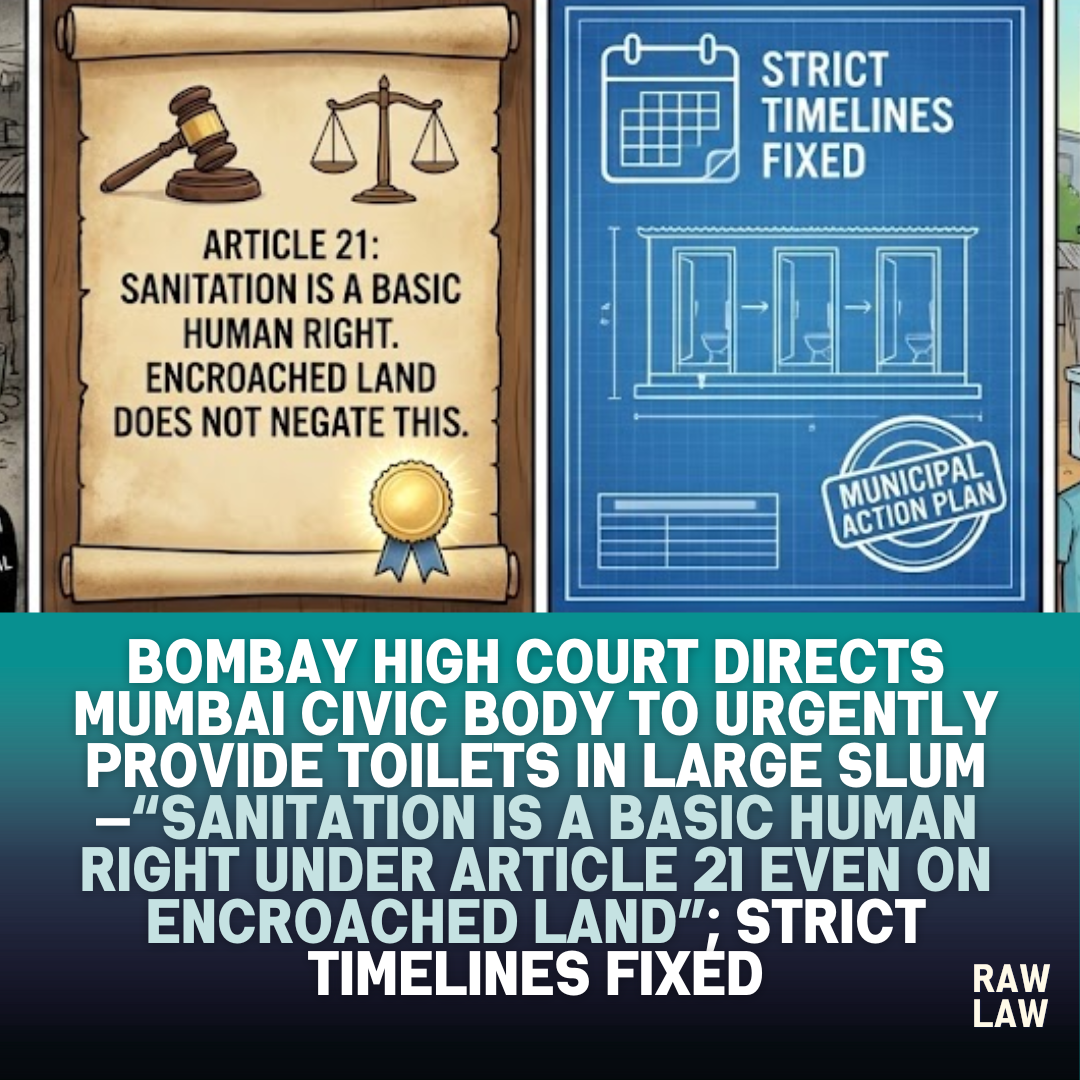
Bombay High Court directs Mumbai civic body to urgently provide toilets in large slum—“Sanitation is a basic human right under Article 21 even on encroached land”; strict timelines fixed

Court’s decision
The Bombay High Court held that access to adequate sanitation and properly maintained toilets is a non-negotiable facet of the right to life under Article 21 of the Constitution, even in slum areas created by encroachment on municipal land. Strongly criticising the Municipal Corporation of Greater Mumbai and the Slum Rehabilitation Authority for abdication of statutory duties, the Court directed immediate repair of existing toilet blocks and construction of additional toilets commensurate with the population of a massive slum cluster at Buddha Nagar, Govandi. The Court fixed strict timelines and emphasised that failure to provide sanitation facilities amounts to breach of fundamental rights.
Court’s decision
Disposing of the writ petition, the Division Bench issued sweeping directions to the Municipal Commissioner and subordinate officers to ensure availability, maintenance, and day-to-day supervision of sanitation facilities in slum areas across Mumbai. The Court held that the civic body cannot evade its obligations merely because the area is a slum or because a limited portion of land is covered by a slum rehabilitation scheme. Recognising sanitation as a core human right, the Court mandated immediate remedial measures and ongoing oversight.
Facts
The petition concerned an extraordinarily large slum cluster at Buddha Nagar, Govandi, situated entirely on land belonging to the Municipal Corporation of Greater Mumbai. The slum spans approximately 1,83,000 square metres and houses more than 4,000 residents living in hundreds of hutments, along with several commercial structures.
The petitioners highlighted that despite the scale of habitation, there were only 60 toilet seats available for the entire population. These toilets, constructed under the Slum Sanitation Programme pursuant to a work order issued in 2019, were stated to be in a ruinous and unhygienic condition, with no meaningful repairs or maintenance undertaken by the civic authorities. Photographs placed on record depicted the deplorable state of sanitation.
A portion of the land measuring about 1,449 square metres was covered by a slum rehabilitation scheme for a limited number of eligible slum dwellers pursuant to a Letter of Intent issued in 2020. The remaining vast area, however, was not covered by any rehabilitation project, resulting in neglect of basic civic amenities.
Issues
The principal issues before the Court were whether the Municipal Corporation could shirk its statutory and constitutional obligations to provide sanitation facilities in slum areas situated on municipal land, whether the existence of a slum rehabilitation scheme for a small portion of land justified neglect of the larger slum population, and whether access to toilets and sanitation forms part of enforceable fundamental rights under Article 21.
Petitioners’ arguments
The petitioners contended that the civic authorities had completely failed in their duty to provide even the bare minimum sanitation facilities to a slum population exceeding 4,000 residents. It was argued that only 60 toilet seats for such a population was grossly inadequate by any standard and posed a serious threat to public health, dignity, and safety.
They further submitted that the Municipal Corporation had stopped maintaining existing toilets on the pretext that part of the land was under a proposed slum rehabilitation scheme, even though the scheme covered only a fraction of the slum area and a small number of beneficiaries. The petitioners emphasised that residents were being forced to walk long distances or resort to open defecation, violating basic human dignity.
Respondents’ arguments
The Municipal Corporation and the Slum Rehabilitation Authority sought to justify the situation by referring to the ongoing and proposed slum rehabilitation process in a limited portion of the land. It was contended that redevelopment plans were in place and that issues relating to sanitation would be addressed in due course through redevelopment.
The developer appointed under the slum rehabilitation scheme argued that its obligations were confined to the specific land and limited number of slum dwellers covered by the Letter of Intent, and that it could not be saddled with responsibility for the entire slum area.
Analysis of the law
The High Court examined the statutory duties of the Municipal Corporation under the Mumbai Municipal Corporation Act, 1888, and reiterated that these duties extend even to areas declared as slums. The Court relied on settled jurisprudence holding that municipal authorities retain full authority and obligation to discharge public health functions in slum areas, irrespective of land ownership or encroachment status.
Crucially, the Court located the right to sanitation within the constitutional guarantee of life and dignity under Article 21. It observed that sanitation, hygiene, clean drinking water, and disease prevention are inseparable from the right to a healthy life and cannot be treated as discretionary welfare measures.
Precedent analysis
The Court relied on earlier Bombay High Court rulings recognising municipal responsibility in slum areas, as well as recent Supreme Court authority affirming that access to sanitation and hygienic living conditions is an integral component of the right to life and human dignity. The Supreme Court’s recognition of sanitation as a human right, grounded in constitutional principles and international human rights norms, was expressly applied to the facts of the case.
Court’s reasoning
The Court found the conduct of the Municipal Corporation deeply troubling. It noted that allowing encroachments on municipal land already results in irreversible loss of public land, and that neglecting sanitation in such areas compounds the harm by endangering health and dignity. The Court rejected any distinction between slum and non-slum areas when it comes to basic human needs.
It held that once a large population resides in an area categorised as a slum—irrespective of how it came into existence—the State and civic authorities are constitutionally bound to ensure access to toilets, sanitation, clean water, and basic healthcare. The Court described sanitation as a matter of basic human rights, not administrative convenience.
Conclusion
The Bombay High Court directed the Municipal Corporation to immediately repair and make functional all existing toilet blocks in the slum area. It further ordered identification of open spaces and construction of additional toilets within two months, in numbers proportionate to the resident population. The Municipal Commissioner was directed to ensure continuous supervision, maintenance, and cleanliness of toilets in slum areas across Mumbai.
The Court clarified that while the ongoing slum rehabilitation project for a limited area would not be disturbed, the authorities must ensure alternate sanitation arrangements if any toilets are demolished during redevelopment.
Implications
This judgment is a significant reaffirmation of sanitation as a justiciable fundamental right. It sends a clear message that civic bodies cannot hide behind technicalities of encroachment, redevelopment, or jurisdiction to deny basic human necessities. The ruling has wide ramifications for urban governance, slum administration, and public health policy, placing enforceable constitutional obligations on municipal authorities to uphold dignity and health for the most vulnerable sections of society.
Case law references
- High Court on its own motion in Jilani Building at Bhiwandi v. Municipal Corporation: Held that municipal bodies retain authority and obligation to discharge statutory duties even in slum areas.
- Rajeeb Kalita v. Union of India: Recognised access to sanitation, clean water, and hygienic living conditions as an essential component of the right to life under Article 21.
FAQs
1. Is access to toilets a fundamental right in slum areas?
Yes. Courts have held that sanitation and access to toilets are integral to the right to life and dignity under Article 21, even in slums on encroached land.
2. Can municipal corporations refuse sanitation facilities citing encroachment?
No. Municipal authorities are constitutionally and statutorily bound to provide basic civic amenities regardless of the encroached status of land.
3. What duties do civic bodies have towards slum dwellers?
They must provide and maintain sanitation, clean drinking water, and basic health facilities to ensure a dignified and healthy life.