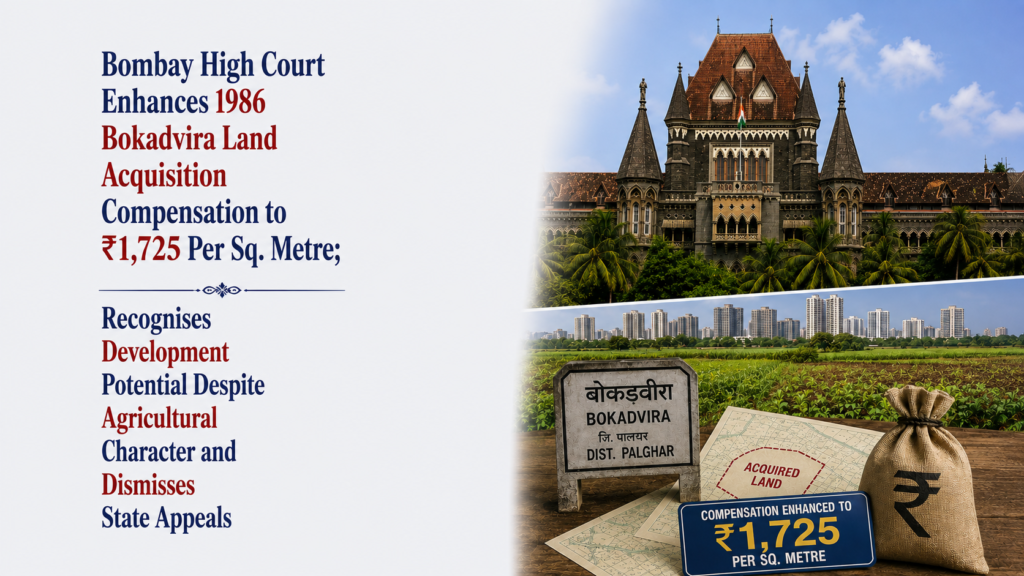
Bombay High Court Enhances 1986 Bokadvira Land Acquisition Compensation to ₹1,725 Per Sq. Metre; Recognises Development Potential Despite Agricultural Character and Dismisses State Appeals

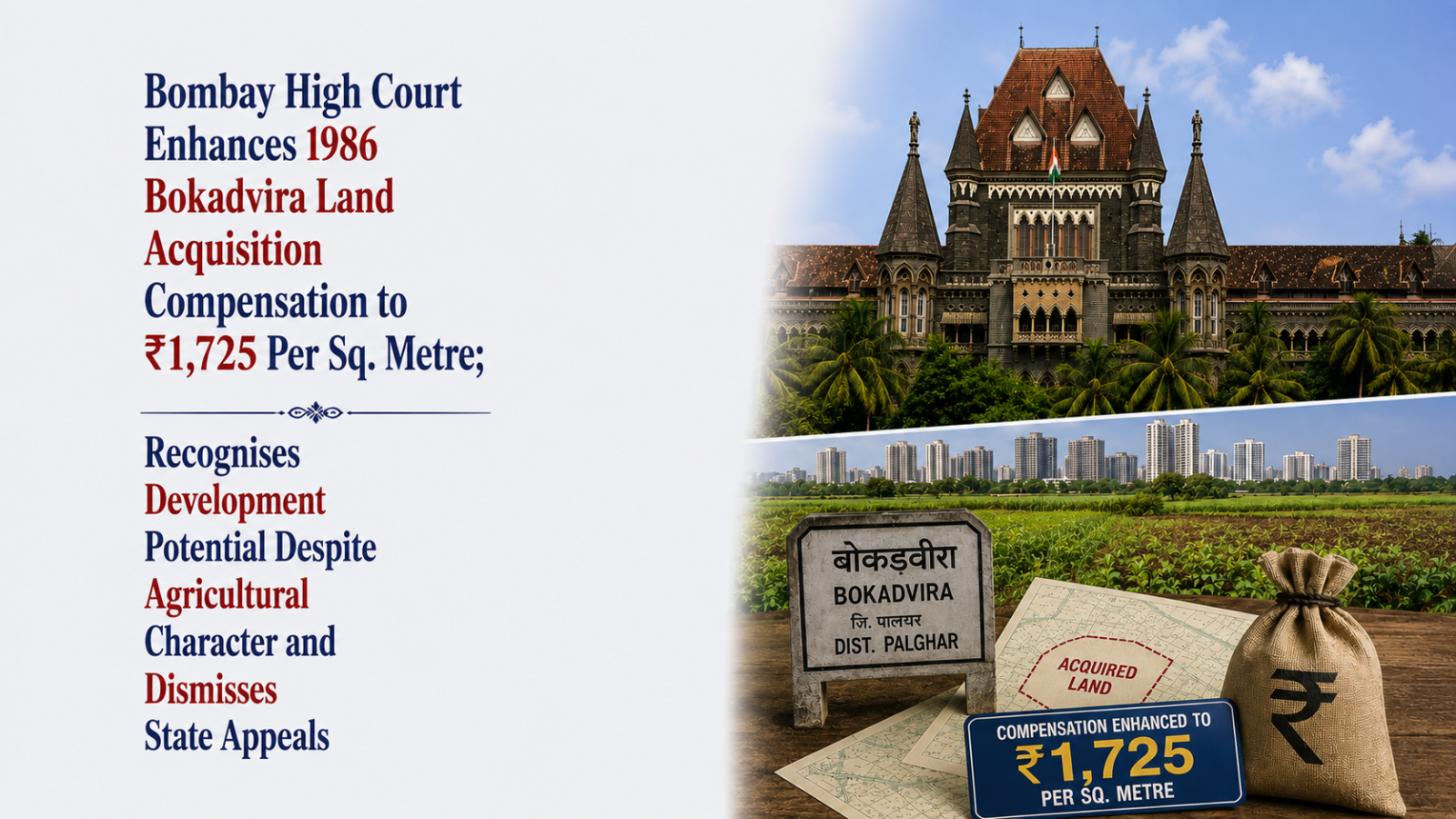
Bombay High Court Reassesses 1986 Bokadvira Land Value Using Development Potential and Comparable Awards; Enhances Compensation to ₹1,725 Per Sq. Metre
Facts
The connected proceedings arose from acquisition of lands situated at Village Bokadvira, Taluka Uran, District Raigad, for the development of New Bombay/Navi Mumbai. The lead proceedings included First Appeal Nos. 1983 and 1987 of 2025, along with several earlier First Appeals and cross-objections. The State of Maharashtra challenged compensation awarded to the landowners, while the claimants sought further enhancement.
The acquisition formed part of the larger New Bombay development project. Following recommendations of the Barve and Gadgil Committees, approximately 96 villages were notified for establishment of the new township, and CIDCO was constituted as the New Town Development Authority. Bokadvira subsequently formed part of this statutory planning framework.
For the Bokadvira lands involved in the lead appeals, the notification under Section 4 of the Land Acquisition Act, 1894 was published on 24 September 1986. In First Appeal No. 1983 of 2025, the land measured 3,690 square metres and the original compensation awarded was ₹25,903. In First Appeal No. 1987 of 2025, the acquired area was 5,110 square metres and the original award was ₹35,679.13.
After earlier proceedings under Section 28A, the matters reached the Reference Court under Section 28A(3). The claimants led oral and expert valuation evidence and relied upon allotment and lease transactions. The Reference Court noted that direct comparable sale instances were unavailable, considered the development around Bokadvira and ultimately determined market value at ₹1,124 per square metre.
The State challenged the enhancement, whereas the landowners filed cross-objections seeking a still higher valuation.
The dispute therefore required the Bombay High Court to determine the proper market value of the Bokadvira lands as on the date of the 1986 notification.
Issues
The principal issues before the Court were:
- What was the fair market value of the acquired Bokadvira lands as on 24 September 1986?
- Whether their agricultural character and absence of full civic development justified reducing the compensation awarded by the Reference Court.
- Whether the Court could take into account the lands’ development potential, including their inclusion in the New Bombay Development Plan and proximity to industrial, transport and port infrastructure.
- What evidentiary value should be attached to CIDCO’s lease transactions concerning developed commercial plots when determining the value of large undeveloped agricultural lands.
- Whether earlier judgments fixing compensation for lands in Roadpali, Padaghe and Bokadvira could be relied upon as comparable material.
- What was the effect of the Supreme Court’s observations in Babibai Babu Patil concerning the earlier Roadpali valuation of ₹1,725 per square metre.
- Whether the landowners’ entitlement under CIDCO’s 12.5% developed plot scheme could be treated as part of, or deducted from, statutory compensation under Section 23 of the Land Acquisition Act.
- Whether the Reference Court’s ₹1,124 rate should be reduced as sought by the State or enhanced to ₹2,000 as sought by the claimants.
Appellant-State/CIDCO’s Arguments
The State argued that the Reference Court had awarded excessive compensation.
According to it, Bokadvira remained an agricultural and substantially undeveloped village in 1986. The lands were used primarily for paddy cultivation and lacked several basic civic amenities.
The State contended that the earlier ₹1,725 valuation for Roadpali could not automatically govern Bokadvira merely because both acquisitions related to the Navi Mumbai project. Each village had to be evaluated according to its own location, development, advantages, disadvantages and potential.
It particularly attacked reliance on CIDCO lease transactions involving small, fully developed commercial plots. Such transactions, according to the State, could not legitimately determine the value of large tracts of undeveloped agricultural land.
The State relied on Supreme Court authorities requiring the Court to assume the position of a prudent purchaser and determine what the acquired land itself would realistically have fetched in the open market on the date of notification.
CIDCO additionally argued that the landowners had received or were entitled to 12.5% developed plots under the Government’s rehabilitation policy. According to CIDCO, that benefit should be taken into account while determining just compensation.
Claimants’ Arguments
The claimants argued that Bokadvira could not be valued merely by describing the acquired parcels as agricultural lands.
They pointed to extensive planning and infrastructure surrounding the village and argued that the lands possessed substantial non-agricultural and urban development potential by 1986.
Among the advantages relied upon were:
- proximity to Uran;
- the Uran-Panvel State Highway;
- railway connectivity;
- ONGC facilities;
- Bhendkhal Industrial Estate;
- the development of JNPT;
- Mora and Karanja ports/jetties;
- existing industries;
- residential colonies; and
- Bokadvira’s inclusion within the planned New Bombay development area.
The claimants contended that Bokadvira was, in several respects, better situated than Roadpali, for which compensation of ₹1,725 per square metre had previously been determined.
They further argued that the absence of ordinary sale transactions could not be held against them. Acquisition proceedings and restrictions over the lands had continued for years, thereby preventing normal private-market transactions from emerging.
The claimants therefore sought enhancement, in some of the proceedings, to ₹2,000 per square metre.
Analysis of the Law
Market Value Must Reflect the Land’s Real Potential
The High Court held that the fact that land was being used for agriculture on the date of notification was undoubtedly relevant, but was not by itself conclusive of market value.
Market valuation under the Land Acquisition Act required consideration of the land’s location, existing circumstances, surrounding development and reasonably ascertainable potential.
The evidence established that Bokadvira had not become a fully developed urban area in 1986 and continued to have an agricultural character. Nevertheless, it could not be characterised as land having no development potential.
The planning of New Bombay had commenced before the relevant notification; Bokadvira was incorporated into the new town; CIDCO had been appointed the statutory development authority; and acquisition itself formed part of the larger development scheme.
Developed CIDCO Lease Plots Required Caution
The Court accepted the State’s objection that developed commercial lease plots could not simply be equated with undeveloped agricultural lands.
Relying upon Lal Chand v. Union of India and other authorities, the Court observed that allotment or auction rates of developed plots by development authorities may reflect policy considerations, infrastructure and commercial demand that do not necessarily represent the open-market value of raw agricultural land.
Accordingly, such transactions were relevant only with appropriate caution and adjustments.
The Court nevertheless declined to discard the broader evidentiary picture merely because individual lease transactions were imperfect comparables.
Absence of Sale Transactions Could Not Be Used Against Landowners
A significant feature was the absence of contemporaneous private sale transactions.
The Court found that this absence had to be understood against the history of acquisition. The Land Acquisition Officer himself had recorded that sale transactions were unavailable because the lands had remained under acquisition since 1970.
Therefore, the absence of sales could not rationally be treated as evidence that the land lacked substantial value. The Court was entitled to consider earlier judgments, planning documents, expert evidence and lease transactions, while subjecting each to appropriate scrutiny.
Claimants Retained the Burden of Proving Market Value
The State and CIDCO had not produced an independent valuation exercise establishing a lower rate.
The Court clarified that this did not shift the legal burden. The burden of proving proper market value remained on the claimants.
However, once the claimants produced oral, documentary and expert evidence, the Court had to evaluate that material on its merits. A lower valuation could not simply be presumed because parts of the claimants’ evidence were open to criticism.
Precedent Analysis
Chimanlal Hargovinddas v. Special Land Acquisition Officer
The judgment applied the established framework in Chimanlal Hargovinddas governing determination of market value.
The valuation exercise must approximate what a willing purchaser would reasonably pay to a willing seller on the relevant date, having regard to comparable material and the positive and negative features of the acquired property.
The Court used this principle to balance Bokadvira’s agricultural condition against its demonstrated development potential.
Trimbak Joma Thakur — Roadpali Valuation
In State of Maharashtra v. Trimbak Joma Thakur, the Bombay High Court had fixed compensation for Roadpali at ₹1,725 per square metre after considering CIDCO lease transactions and making a 25% development deduction.
The State argued that this rate had lost its reliability following the Supreme Court’s observations in Babibai Babu Patil.
The present Court, however, refused either to treat the Roadpali rate as automatically binding or to discard it altogether.
Babibai Babu Patil v. State of Maharashtra
The High Court carefully analysed the Supreme Court’s observations in Babibai.
The Supreme Court had questioned whether appropriate deductions had been made when developed commercial/industrial lease plots—including a weighbridge plot and a 60-year lease—were used for determining compensation.
Crucially, however, the Supreme Court did not itself hold that ₹1,725 was impermissible or substitute a lower market value. It required fresh examination of the valuation methodology and deductions.
The High Court therefore held that Babibai required a fresh and careful appraisal, not automatic rejection of the ₹1,725 figure.
Subsequent Padaghe Decision
The Court also considered significant the Bombay High Court’s judgment dated 17 April 2026 concerning Village Padaghe.
That decision was rendered after the Supreme Court’s observations in Babibai were already available. Despite considering those objections, the Court again fixed market value at ₹1,725 per square metre.
CIDCO challenged that judgment before the Supreme Court, but the SLP was dismissed. The present Court correctly clarified that dismissal of the SLP was not itself a declaration of law, though the continued operation of the valuation added to its persuasive value.
Comparable Villages
The Court acknowledged the principle that compensation awarded for one village cannot mechanically govern another.
However, the present case involved villages forming part of a common development plan, acquired under the same notification for a common public purpose and governed by the same planning authority.
Therefore, earlier awards relating to comparable lands could legitimately form part of the valuation material, provided their factual comparability was independently examined.
Court’s Reasoning
1. Bokadvira Was Agricultural, But Not Merely Agricultural
The Court accepted the State’s factual submission that the lands remained agricultural in 1986 and that several civic facilities were absent.
However, it simultaneously found that Bokadvira had important locational, infrastructural and planning advantages.
Its development potential was supported by the statutory New Bombay planning process, surrounding industries, transport facilities, proximity to Uran and port-related development.
The Court therefore rejected both extremes: treating the land as fully developed urban property or treating it as ordinary agricultural land with negligible future potential.
2. ₹1,725 Was Independently Justified
Importantly, the Court did not adopt ₹1,725 merely because earlier judgments had reached that figure.
Justice Amit Borkar expressly recorded that the Court had independently considered:
- oral evidence;
- documentary evidence;
- planning documents;
- valuation reports;
- lease transactions; and
- surrounding circumstances.
The earlier Bokadvira judgment was therefore corroborative rather than mechanically binding.
After evaluating the evidence as a whole, the Court concluded that ₹1,725 per square metre came nearest to the true market value and represented reasonable and just compensation both for the landowners and the public exchequer.
3. ₹2,000 Claim Rejected
Although the Court accepted that Bokadvira had significant development potential, it refused the claimants’ demand for ₹2,000 per square metre.
The lands remained agricultural on the relevant date, full development had not occurred and several civic facilities were unavailable.
Further adjustments were also necessary when comparing developed commercial or leasehold plots with large compulsorily acquired agricultural parcels.
Accordingly, the evidence did not justify going beyond ₹1,725.
4. CIDCO’s 12.5% Developed Plot Argument Rejected
The Court separately rejected CIDCO’s attempt to treat the 12.5% developed plot scheme as a component deductible from statutory compensation.
The scheme arose from an independent executive policy and Government Resolutions. By contrast, compensation under Section 23 represented statutory compensation for compulsory acquisition of proprietary rights.
No statutory provision or policy had been shown permitting the 12.5% benefit to be adjusted against compensation under the Land Acquisition Act.
The Court therefore held that an independent executive benefit cannot be treated as part of statutory compensation unless the Act or applicable policy specifically permits such adjustment.
5. State’s Appeals Failed; Landowners Secured Enhancement
The Court ultimately found no justification for reducing the valuation as sought by the State.
Conversely, it also rejected the landowners’ attempt to obtain ₹2,000 per square metre.
The appropriate market value was fixed at ₹1,725 per square metre.
Conclusion
The Bombay High Court dismissed all the State’s connected First Appeals and partly allowed the landowners’ cross-objections.
The Reference Court awards were modified by increasing the market value of the Bokadvira lands acquired pursuant to the 24 September 1986 notification from ₹1,124 per square metre to ₹1,725 per square metre.
The claimants were also held entitled to solatium, additional amount and interest under the applicable provisions of the Land Acquisition Act, 1894 on the enhanced compensation. Amounts already deposited or paid were directed to be adjusted.
The Court prescribed a time-bound mechanism for payment. An authenticated copy was to reach the SLAO within two weeks; the SLAO was to prepare claimant-wise calculations within three weeks of receipt; the Reference Court was to decide those calculations within four weeks; and the enhanced amount was thereafter to be released within 12 weeks.
Case Details
Case: State of Maharashtra through Deputy Collector (Land Acquisition), Metro Center No. 1, Uran v. Narayan Gosavi Patil (Deceased) Through Legal Heirs & Connected Matters
Court: High Court of Judicature at Bombay, Civil Appellate Jurisdiction
Lead Case Number: First Appeal No. 1983 of 2025 with Cross Objection (St.) No. 19862 of 2026
Connected Matters: First Appeal Nos. 1987 of 2025, 706 of 2017, 1324 of 2017, 207 of 2022 and 798 of 2018, with connected cross-objections/applications.
Judge: Hon’ble Mr. Justice Amit Borkar
Reserved On: 4 August 2026
Date: 11 August 2026
Result: State appeals dismissed; landowners’ cross-objections partly allowed; market value enhanced from ₹1,124 to ₹1,725 per square metre, with statutory solatium, additional amount and interest.