Bombay High Court Quashes Bank Employee’s Dismissal Without Fresh Disciplinary Inquiry; Holds Closed Proceedings Cannot Be Reopened and Awards ₹40 Lakh Compensation After Retirement

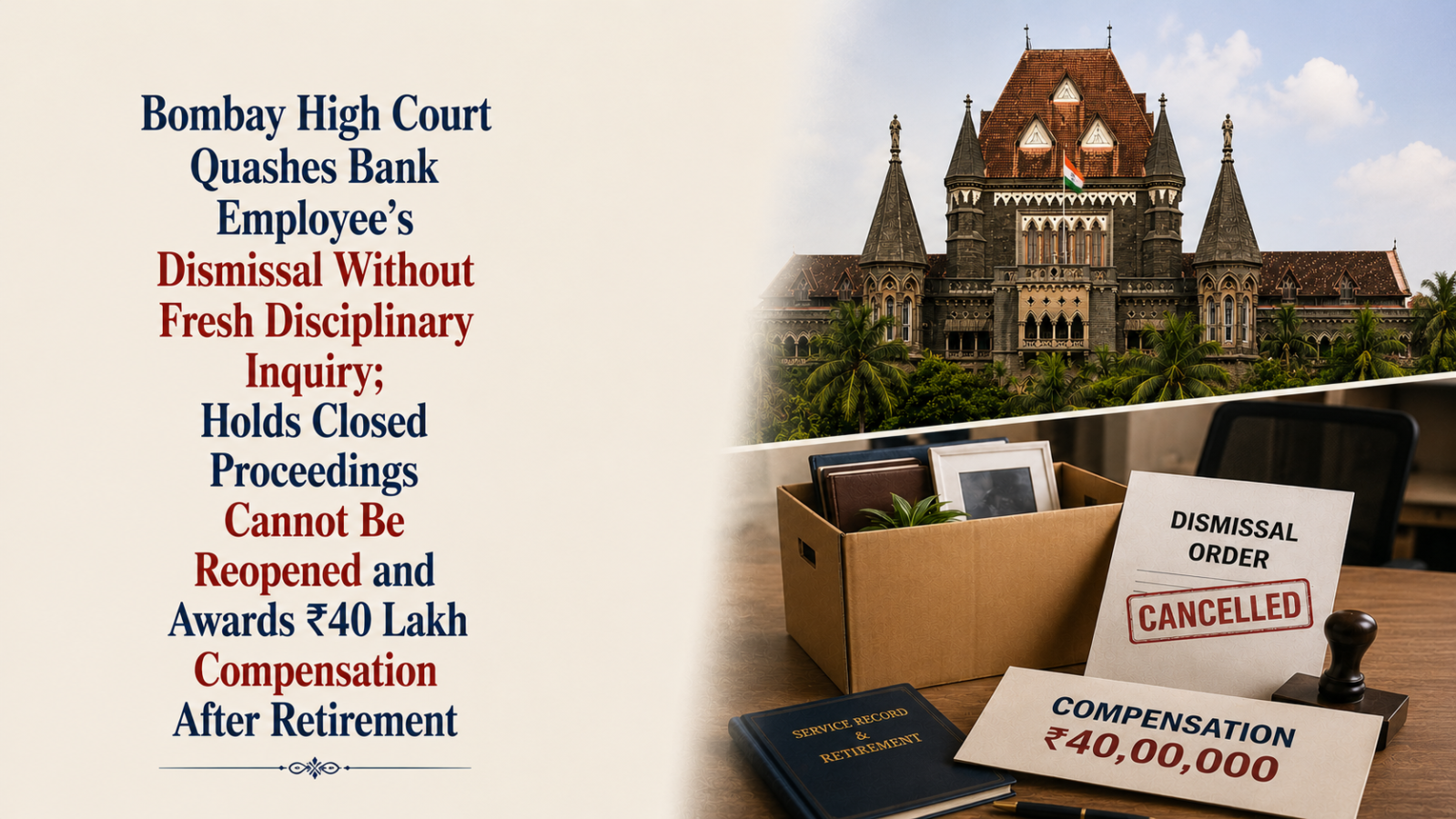
Bombay High Court Awards ₹40 Lakh to Retired Bank Employee After Finding His 2018 Dismissal Illegal for Want of Fresh Disciplinary Proceedings
Facts
The petitioner, Laxman Krishna Kesare, had been employed with Mumbai District Central Co-operative Bank Ltd. since 1991 and was working as a Junior Officer at its Lalbaug Branch in 2014.
The Bank issued a chargesheet dated 27/28 October 2014 alleging that Royal Co-operative Credit Society Ltd. had been granted credit facilities of ₹126 lakh on the basis of an inspection report prepared by the petitioner. The Bank alleged that the borrower had defaulted on instalments under earlier loans but that this fact had not been properly disclosed in the petitioner’s inspection report, causing loss to the Bank.
Following a departmental inquiry, the Enquiry Officer held the charge proved. The Board of Directors initially resolved on 2 May 2016 to dismiss the petitioner, and he was dismissed with effect from 10 May 2016.
However, after the petitioner made a representation through his Union, the Board took a lenient view and substituted dismissal with the lesser punishment of reversion from Junior Officer to Bank Assistant, retrospectively from 10 May 2016.
The petitioner thereafter continued working for more than two years.
In 2018, the Bank reconsidered the matter on the ground that the petitioner had failed to assist in recovering outstanding loans amounting to approximately ₹201.89 lakh. The Board passed another resolution on 31 July 2018, and by order dated 11 September 2018, the petitioner was again dismissed from service.
The petitioner challenged this second dismissal before the Labour Court. The Labour Court dismissed his unfair labour practice complaint on 24 August 2022. The Industrial Court dismissed his revision on 3 February 2024.
He therefore approached the Bombay High Court challenging the Labour Court and Industrial Court orders as well as his dismissal.
Issues
The principal issues before the High Court were:
- Whether the Bank could reopen concluded disciplinary proceedings after having substituted the original dismissal with the punishment of reversion.
- Whether the Bank’s Board of Directors became functus officio concerning the 2014 disciplinary proceedings after the punishment of reversion attained finality.
- Whether the petitioner’s alleged subsequent failure to assist in recovery of the outstanding loan constituted fresh misconduct requiring separate disciplinary proceedings.
- Whether dismissal without issuing a fresh chargesheet and conducting a disciplinary inquiry violated the principles of natural justice.
- Whether the case actually involved the principle of double jeopardy, as argued before the Labour and Industrial Courts.
- What relief should be granted when the dismissal was illegal but the petitioner had already crossed the age of superannuation.
Petitioner’s Arguments
The petitioner argued that the original charge itself had been wrongly held proved. According to him, he had specifically highlighted the borrower’s defaults and recommended sanction of the fresh loan only after recovery of the outstanding instalments.
He further argued that he was merely responsible for inspection and was not the authority which sanctioned the loan. The ultimate decision to grant credit facilities had been taken by the Bank’s senior management.
His principal argument, however, was that he had effectively been punished twice for the same misconduct.
Once the Bank substituted the punishment of dismissal with reversion in May 2016, the disciplinary proceedings had concluded. The Bank could not reopen the same proceedings two years later and again impose dismissal.
Accordingly, he sought setting aside of the orders passed by the Labour and Industrial Courts.
Respondents’ Arguments
The Bank alleged that the petitioner had committed serious misconduct and that his erroneous inspection report had resulted in undue credit facilities being granted to the borrower, thereby causing financial loss.
It argued that reinstatement and reversion had been granted to provide the petitioner an opportunity to assist the Bank in recovering the loan amount. Since he failed to do so, the Bank was justified in subsequently dismissing him.
The Bank further relied upon the concurrent findings of the Labour Court and Industrial Court and argued that there was no justification for interference under Article 227 of the Constitution.
It also contended that the misconduct was serious and that the Bank had suffered substantial financial loss.
Analysis of the Law
Disciplinary Proceedings Cannot Remain Open-Ended
The High Court held that disciplinary proceedings are not open-ended. Once punishment is imposed, the proceedings attain finality.
A limited statutory or regulatory power of review or revision may exist, but such power must be exercised on the basis of material forming part of the disciplinary inquiry. It cannot ordinarily be invoked later on the basis of subsequent events.
In the present case, the Bank had already exercised its power of review when it reconsidered the initial punishment of dismissal and reduced it to reversion.
Once the order dated 25 May 2016 was passed reverting the petitioner from Junior Officer to Bank Assistant, the disciplinary proceedings arising from the 2014 chargesheet came to an end.
The Board consequently became functus officio concerning those proceedings.
Subsequent Misconduct Required Fresh Proceedings
The High Court drew an important distinction between the misconduct forming the subject matter of the original chargesheet and the petitioner’s conduct after his reinstatement.
If the petitioner’s subsequent failure to recover or assist in recovering the loan constituted misconduct, the Bank was entitled to proceed against him.
But it had to initiate fresh disciplinary proceedings.
The Bank could not revive the already concluded 2014 disciplinary proceedings and impose another punishment by relying upon conduct occurring after those proceedings had ended.
Natural Justice
The High Court held that the second dismissal was also in gross violation of the principles of natural justice.
The petitioner was never afforded an opportunity to defend himself against the fresh allegation that he had failed to take steps to recover the outstanding loan.
Instead, the Bank directly relied upon that alleged misconduct to impose the extreme punishment of dismissal.
Precedent Analysis
The judgment primarily turned on the application of settled principles governing finality of disciplinary proceedings, jurisdiction of the disciplinary authority and natural justice, rather than on an extensive analysis of Supreme Court precedents.
The Industrial Court had relied upon Rohidas Premchand Bhagat v. Divisional Controller, MSRTC and Janatha Bazar (South Kanara) Central Co-operative Wholesale Stores Ltd. v. Secretary, Sahakari Noukarana Sangh, (2000) 7 SCC 517, for the proposition that leniency ordinarily cannot be shown in cases involving misappropriation.
The High Court, however, found this reasoning misplaced because the real controversy was not the seriousness of the original misconduct or proportionality of punishment.
The decisive question was whether the Bank could lawfully dismiss the petitioner in 2018 for alleged subsequent conduct without conducting any fresh disciplinary inquiry.
Thus, authorities concerning proportionality or leniency in cases of misappropriation did not answer the jurisdictional and natural-justice defect affecting the second dismissal.
Court’s Reasoning
1. Original Chargesheet Was Vague
At the outset, the Court observed that the 2014 chargesheet did not precisely disclose the alleged misconduct.
After examining it, the Court found that the identifiable allegation was essentially that the petitioner had failed to disclose non-payment of three instalments by the borrower in his inspection report. The Court described the chargesheet as “totally vague” regarding the exact misconduct alleged.
2. Reversion Brought the First Disciplinary Proceedings to an End
The Bank initially dismissed the petitioner but subsequently reconsidered the punishment on his representation and substituted dismissal with reversion.
The petitioner accepted the reversion, resumed service as Bank Assistant and continued working for more than two years.
The High Court therefore held that the disciplinary proceedings had conclusively ended with the punishment of reversion.
3. Industrial Court’s “Interim Measure” Finding Was Unsustainable
The Industrial Court had characterised the 2016 reversion as merely an “interim measure”, thereby permitting the Bank to reconsider the matter later.
Justice Sandeep V. Marne described this conclusion as “preposterous to say the least.”
The 2016 order was a completed exercise of disciplinary power. The Bank had first imposed dismissal and then, after considering the employee’s representation, deliberately substituted it with the lesser punishment of reversion.
The Board could not subsequently treat that final order as provisional merely because the petitioner allegedly failed to recover the loan.
4. Board Had Become Functus Officio
Once reversion was imposed, the Board became functus officio in relation to the disciplinary proceedings arising from the October 2014 chargesheet.
Therefore, the 2018 decision to review the same proceedings on the basis of subsequent events was without jurisdiction.
5. Double Jeopardy Was Not Strictly the Correct Principle
Importantly, the High Court clarified that the case was not strictly one of double jeopardy.
The 2018 dismissal was based not precisely upon the original misconduct but upon the petitioner’s alleged subsequent failure to assist in recovering the outstanding loan.
Therefore, technically, the second punishment related to different misconduct.
But that distinction did not save the dismissal.
Because the alleged failure to recover the loan constituted fresh misconduct, the Bank was required to issue a fresh charge, give the petitioner an opportunity to defend himself and conduct a proper disciplinary inquiry.
No such inquiry was conducted.
The dismissal was therefore void for violation of natural justice, even though the strict doctrine of double jeopardy did not apply.
6. Labour Court Examined the Wrong Question
The High Court strongly criticised the Labour Court’s approach as “clearly perfunctory.”
Since the petitioner had never challenged the earlier punishment of reversion, the real question was whether the second dismissal was legally permissible.
Instead, the Labour Court went back into the seriousness and proof of the original misconduct while failing to meaningfully decide whether the Bank could impose the later dismissal in the manner it did.
The Industrial Court similarly failed to properly exercise its revisional jurisdiction under Section 44 of the MRTU & PULP Act.
7. Compensation Instead of Reinstatement
By the time the writ petition was decided, the petitioner had crossed the age of 60 and had retired on 6 June 2025. Reinstatement was therefore impossible.
Although an illegal dismissal could ordinarily justify back wages until superannuation, the Court considered several factors while determining relief.
The petitioner had admitted that he had not made efforts to recover the outstanding loan. The Bank could legitimately have instituted fresh disciplinary proceedings regarding that conduct but had failed to do so.
The Court therefore considered lump-sum compensation, rather than full back wages, to be appropriate. It also took into account that the petitioner was earning approximately ₹65,000 per month at the time of dismissal and had lost more than seven years of service.
The Court fixed compensation at ₹40 lakh, inclusive of all retirement benefits except Provident Fund.
Conclusion
The Bombay High Court partly allowed the writ petition and set aside:
- the Labour Court’s preliminary order dated 18 November 2019;
- the Labour Court’s final judgment dated 24 August 2022; and
- the Industrial Court’s judgment dated 3 February 2024.
The Court declared the dismissal order dated 11 September 2018 illegal and set it aside.
Since the petitioner had already attained superannuation, reinstatement was not ordered. Instead, Mumbai District Central Co-operative Bank was directed to pay him ₹40 lakh as lump-sum compensation in lieu of reinstatement and back wages.
The amount includes all retirement benefits except Provident Fund and must be paid within two months. In case of default, it will carry 8% interest per annum after expiry of that period.
The judgment thus establishes an important service-law distinction: even where the strict principle of double jeopardy is unavailable because the later punishment concerns subsequent misconduct, an employer cannot punish that fresh misconduct without initiating fresh disciplinary proceedings and complying with natural justice.
Case Details
Case: Shri Laxman Krishna Kesare v. Mumbai District Central Co-operative Bank Ltd. & Anr.
Court: High Court of Judicature at Bombay, Ordinary Original Civil Jurisdiction
Case Number: Writ Petition No. 4124 of 2024
Judge: Hon’ble Mr. Justice Sandeep V. Marne
Reserved On: 31 July 2026
Date: 11 August 2026
Result: Petition partly allowed; 2018 dismissal and Labour/Industrial Court orders set aside; ₹40 lakh lump-sum compensation awarded in lieu of reinstatement and back wages, excluding Provident Fund, with 8% interest for delayed payment.