

Court’s decision
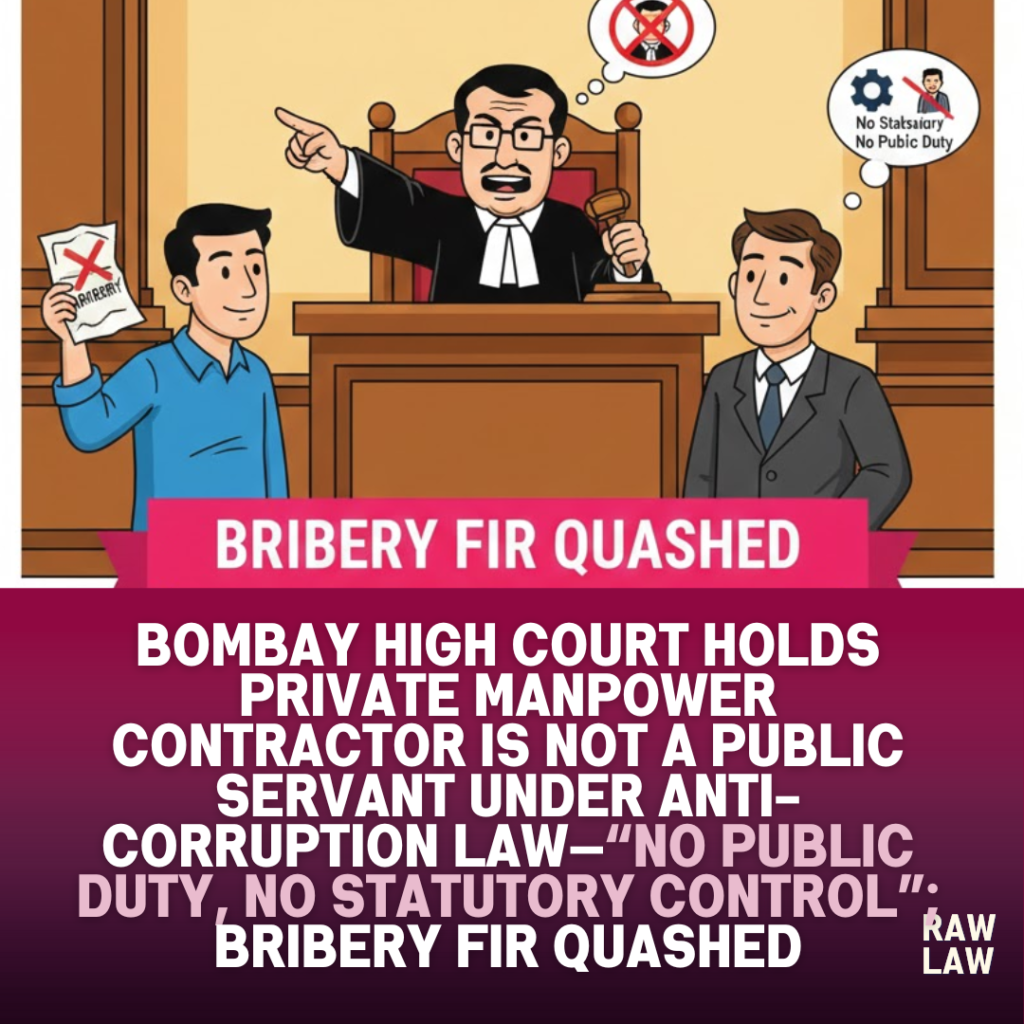
The Bombay High Court (Nagpur Bench) quashed an FIR registered under Section 7 of the Prevention of Corruption Act, 1988 against a private security and labour supply contractor, holding that he did not fall within the statutory definition of a “public servant”. The Court ruled that merely supplying manpower to government institutions on a contractual basis does not amount to discharging a “public duty” so as to attract the rigours of the anti-corruption law. Concluding that the foundational requirement of the offence was absent, the Court set aside the FIR to the extent of the applicant.
Facts
The applicant was the proprietor of a private firm engaged in providing security and labour services to various government and semi-government establishments through a tender process. The prosecution case arose from a complaint alleging that the applicant demanded and accepted illegal gratification for facilitating contractual appointments of individuals to positions such as sweeper and craft instructor at a government industrial training institute.
Acting on the complaint, the Anti-Corruption Bureau conducted verification proceedings, followed by a trap, during which the applicant was allegedly caught accepting money. Based on these allegations, an FIR was registered against him for an offence under Section 7 of the Prevention of Corruption Act.
The applicant approached the High Court seeking quashing of the FIR, contending that he was neither a government servant nor a “public servant” within the meaning of the Prevention of Corruption Act or the Bharatiya Nyaya Sanhita, and therefore the anti-corruption provisions were wholly inapplicable.
Issues
The central issue before the High Court was whether a private contractor supplying manpower to government institutions on a contractual basis could be treated as a “public servant” under Section 2(c) of the Prevention of Corruption Act and the corresponding definition under the Bharatiya Nyaya Sanhita. Ancillary to this was the question of whether the nature of the applicant’s activities could be characterised as performance of a “public duty” so as to justify prosecution under anti-corruption law.
Petitioner’s arguments
The applicant argued that he was a private individual running a proprietary concern and was not appointed by, employed by, or under the control of the Government. His relationship with government institutions was purely contractual, governed by tender terms, and did not confer any statutory authority or public office upon him. It was contended that persons working on contract through external agencies cannot be equated with public servants merely because they render services to government bodies.
Relying on Supreme Court precedents, the applicant submitted that employment under the Government is a matter of status regulated by statutory rules, whereas his engagement was purely contractual. He further argued that the Prevention of Corruption Act, despite its wide definition, does not extend to every private individual who has commercial dealings with the Government, and stretching the definition in such a manner would lead to serious abuse of criminal law.
Respondent’s arguments
The State opposed the application, asserting that the applicant was remunerated by the Government for supplying manpower to public institutions and was thus performing a public duty. Emphasis was placed on the expanded definition of “public servant” under Section 2(c)(i) of the Prevention of Corruption Act, which includes persons remunerated by the Government for the performance of any public duty.
The prosecution argued that the nature of the services provided by the applicant directly affected public institutions and public employment, and therefore his conduct squarely attracted the anti-corruption framework. It was further submitted that the allegations of demand and acceptance of bribe were supported by verification and trap proceedings, warranting continuation of the prosecution.
Analysis of the law
The High Court undertook an extensive analysis of the statutory definitions of “public servant” and “public duty” under the Prevention of Corruption Act and the Bharatiya Nyaya Sanhita. The Court reiterated that the emphasis under anti-corruption law is not merely on the source of remuneration but on the nature of duty performed and the existence of a public office or statutory function.
Referring to authoritative Supreme Court decisions, the Court noted that while the scope of “public servant” has been deliberately widened to combat corruption, it cannot be stretched to include every private contractor who has business dealings with the Government. The key determinant is whether the person holds an office or is entrusted with a duty in which the State or the public at large has a direct and substantial interest.
Precedent analysis
The Court relied on landmark judgments clarifying that contractual employees or private contractors do not automatically become public servants. It emphasised precedents holding that where workers are engaged through a contractor, the discretion of appointment, control, and supervision lies with the contractor and not with the Government, negating the relationship necessary to constitute public service.
The Court also referred to recent Supreme Court authority stressing that while anti-corruption legislation must be interpreted purposively, courts must guard against over-criminalisation by drawing a clear line between public duties and private commercial activities.
Court’s reasoning
Applying these principles, the High Court held that the applicant was merely a supplier of manpower under a commercial contract and did not hold any statutory office nor perform any sovereign or public function. The recruitment or placement of contractual workers through a private agency did not amount to discharge of public duty as contemplated under the Prevention of Corruption Act.
The Court observed that accepting the prosecution’s argument would mean that every contractor, vendor, or service provider dealing with the Government could be prosecuted as a public servant, which was never the legislative intent. Since the applicant did not satisfy the essential condition of being a public servant, the very foundation of the offence under Section 7 of the Prevention of Corruption Act collapsed.
Conclusion
The Bombay High Court concluded that the applicant was not a public servant and was not discharging any public duty within the meaning of the Prevention of Corruption Act. Consequently, the FIR registered against him for the offence of bribery was held to be legally unsustainable and was quashed to the extent of the applicant.
Implications
This judgment draws an important boundary between public servants and private contractors in the context of anti-corruption law. It provides significant protection to private individuals and entities engaged in contractual dealings with the Government, ensuring that anti-corruption statutes are not misused beyond their intended scope. At the same time, it underscores that criminal liability under the Prevention of Corruption Act hinges on the nature of duty performed, not merely on association with government institutions.
Case law references
- Union Public Service Commission v. Girish Jayantilal Vaghela: Distinguished government service as a matter of statutory status rather than contract.
- Municipal Council, Nandyal v. K. Jayaram: Held that workers engaged through contractors remain under the control of the contractor, not the principal employer.
- State of Gujarat v. Mansukhbhai Kanjibhai Shah: Emphasised purposive interpretation of “public servant” with focus on public duty.
- Aman Bhatia v. State (GNCT of Delhi): Clarified that remuneration alone is insufficient; the nature of public duty is decisive.
FAQs
1. Can a private contractor be prosecuted under the Prevention of Corruption Act?
Only if the contractor qualifies as a “public servant” by performing a public duty or holding a statutory office. Mere contractual dealings with the Government are insufficient.
2. Does supplying manpower to a government institution amount to public duty?
No. Supplying manpower through a private agency on a contractual basis does not, by itself, constitute discharge of public duty under anti-corruption law.
3. What is the key test for deciding who is a public servant under the PC Act?
The decisive test is the nature of duty performed—whether it is a public duty in which the State or public at large has a direct interest—not the mode of payment or contractual association.


