

Court’s decision
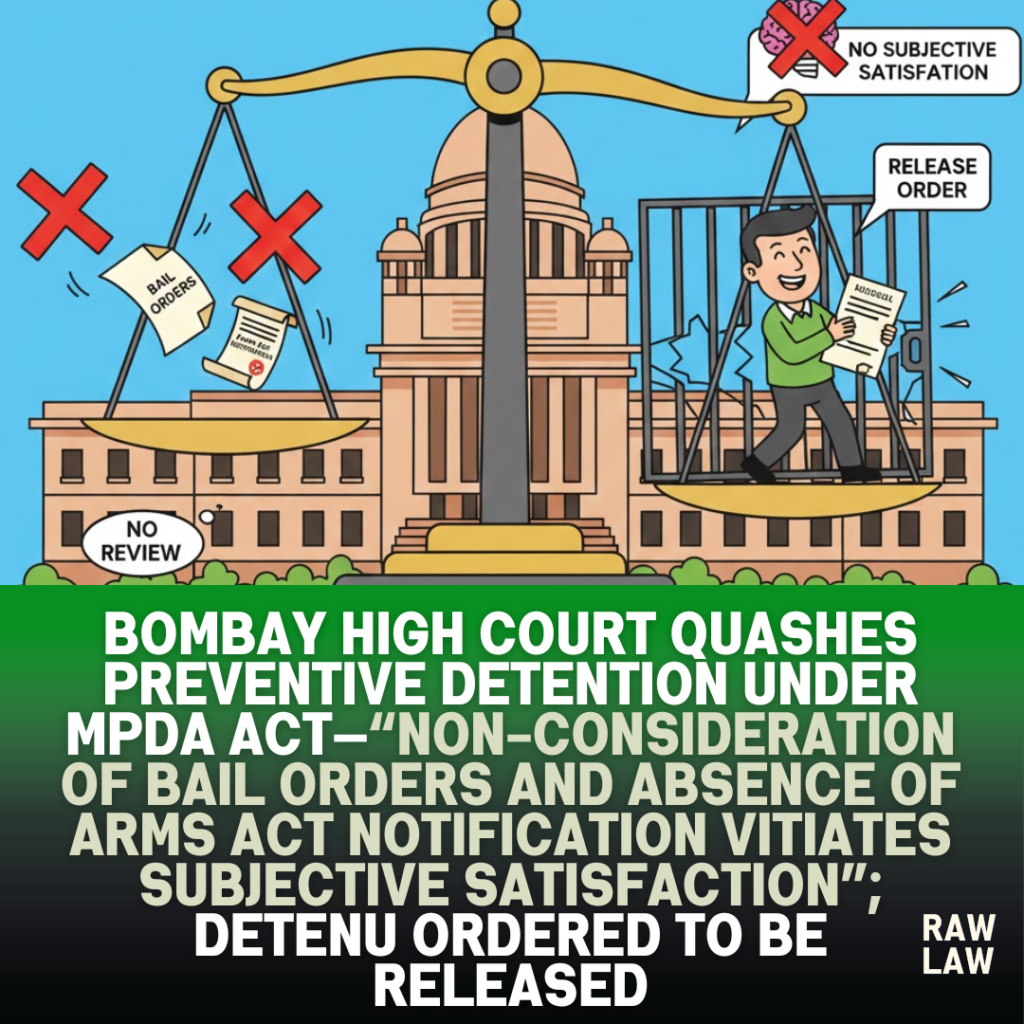
The Bombay High Court (Aurangabad Bench) set aside a preventive detention order passed under the Maharashtra Prevention of Dangerous Activities Act, holding that the detaining authority failed to apply its mind to vital materials, including bail orders, and relied on legally unsustainable grounds. The Court ruled that preventive detention, being an exceptional measure curtailing personal liberty, must strictly comply with constitutional safeguards. Finding serious infirmities in the decision-making process, the Court quashed both the detention and confirmation orders and directed the immediate release of the detenu.
Facts
The petitioner, a young labourer from Nanded, was detained for twelve months by an order of the District Magistrate, invoking powers under Section 3(1) of the MPDA Act. The detention was premised on the allegation that the petitioner was a “dangerous person” whose activities were prejudicial to the maintenance of public order. Though the proposal for detention referred to multiple past criminal cases and chapter proceedings, the actual detention order relied only on two recent offences registered under Sections 4 and 25 of the Arms Act, along with two in-camera statements of anonymous witnesses.
The State Government subsequently confirmed the detention. Challenging both orders, the petitioner approached the High Court, contending that the detention suffered from non-application of mind, reliance on vague material, and violation of constitutional safeguards under Article 22.
Issues
The principal issues before the High Court were whether the detaining authority validly arrived at subjective satisfaction as required under the MPDA Act, whether non-consideration of bail orders in respect of the very offences relied upon vitiated the detention, whether offences under the Arms Act could be relied upon without proof of a mandatory notification under Section 4, and whether vague and unverified in-camera statements could sustain a preventive detention order.
Petitioner’s arguments
The petitioner argued that although the detention order recorded that he had been released on bail in the pending criminal cases, neither the bail applications nor the bail orders were placed before or considered by the detaining authority. This omission, it was submitted, struck at the root of subjective satisfaction, as the authority failed to assess whether bail conditions were sufficient to prevent future prejudicial activities.
It was further contended that the two Arms Act cases could not form the basis of detention in the absence of a notification under Section 4 of the Arms Act regulating possession of arms in the concerned area. The petitioner also challenged the in-camera statements as vague, cyclostyled, lacking particulars of time and place, and improperly verified, thereby depriving him of the right to make an effective representation.
Respondent’s arguments
The State supported the detention, asserting that the petitioner was a habitual offender whose activities created terror in the locality and adversely affected public order. It was submitted that the District Magistrate had carefully examined the material and arrived at subjective satisfaction that preventive detention was necessary to avert future harm.
The State further argued that even if some grounds were found defective, Section 5A of the MPDA Act permitted severability, allowing the detention order to survive on the remaining grounds.
Analysis of the law
The High Court reiterated that preventive detention laws, though constitutionally permitted, are a “hard law” that must be strictly construed. Any curtailment of personal liberty without trial must adhere scrupulously to the procedure established by law and the safeguards under Article 22 of the Constitution.
The Court emphasised that when a detention order proceeds on the premise that the detenu is on bail, the detaining authority must examine the bail orders themselves. This is essential to assess the nature of allegations, the conditions imposed, and whether there exists a real likelihood of the detenu indulging in similar activities despite those conditions. Failure to do so amounts to denial of the right to make an effective representation.
Precedent analysis
The Court relied extensively on recent Supreme Court jurisprudence holding that preventive detention cannot be used as a substitute for seeking cancellation of bail. The apex court has repeatedly cautioned that when bail has been granted by a competent court, the detaining authority must consider the efficacy of bail conditions before resorting to preventive detention.
The High Court also relied on its own earlier decisions holding that offences under Section 4 of the Arms Act cannot be sustained without a specific notification issued by the Central Government regulating possession of arms in the concerned area. Absence of such notification is fatal not only to prosecution but also to preventive action based on such offences.
Court’s reasoning
On facts, the Court found that although the detention order noted the petitioner’s release on bail, the record did not contain a single bail order or application. This demonstrated clear non-application of mind and deprived the petitioner of his constitutional right under Article 22(5).
The Court further held that reliance on the Arms Act offences was legally untenable, as no notification under Section 4 was placed on record or shown to exist. Consequently, the very foundation of the detention order collapsed. The in-camera statements were also found to be vague, general, and inadequately verified, rendering them incapable of sustaining preventive detention.
The Court rejected the State’s reliance on severability, holding that where the detention order is fundamentally based on invalid grounds, the subjective satisfaction itself stands vitiated.
Conclusion
The Bombay High Court concluded that the impugned detention order suffered from serious legal infirmities, including non-consideration of bail orders, reliance on invalid Arms Act offences, and vague in-camera statements. The detention and its confirmation were accordingly quashed, and the petitioner was directed to be released forthwith, unless required in any other case.
Implications
This judgment reinforces strict judicial scrutiny over preventive detention orders and reiterates that such extraordinary powers cannot be exercised mechanically. Authorities must demonstrate careful application of mind, especially when the detenu is already on bail. The ruling also underscores that preventive detention cannot rest on legally defective criminal cases or vague material, thereby strengthening constitutional protections against arbitrary deprivation of liberty.
Case law references
- Joyi Kitty Joseph v. Union of India (2025): Held that failure to consider bail conditions while ordering preventive detention vitiates subjective satisfaction.
- Shaik Nazneen v. State of Telangana (2023): Clarified that the proper remedy against a dangerous accused on bail is to seek cancellation of bail, not preventive detention.
- Abdul @ Aslam Salim Shaikh v. State of Maharashtra: Held that absence of a Section 4 Arms Act notification is fatal to prosecution and preventive action.
- Dilip Asaram Zagade v. State of Maharashtra: Reiterated that Arms Act offences cannot be sustained without the requisite notification.
FAQs
1. Can preventive detention be ordered when an accused is already on bail?
Yes, but only if the detaining authority examines the bail orders and records satisfaction that bail conditions are insufficient to prevent future prejudicial activities.
2. Is a Section 4 notification mandatory for Arms Act offences?
Yes. Without a Central Government notification regulating possession of arms in a specific area, offences under Section 4 cannot be sustained.
3. Can vague in-camera statements justify preventive detention?
No. In-camera statements must be specific, credible, and properly verified; vague statements cannot form the basis of detention.


