

1. Court’s decision
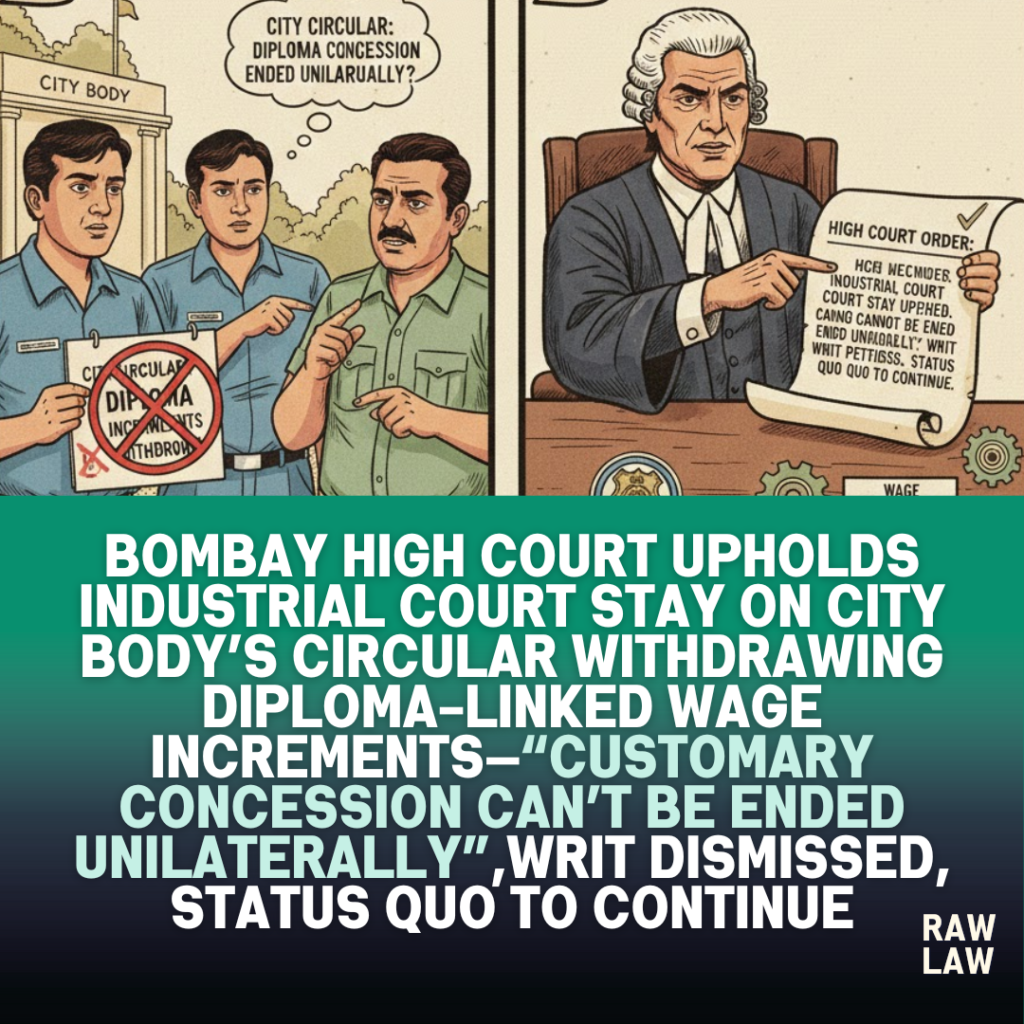
The Bombay High Court dismissed two writ petitions filed by the municipal corporation challenging an Industrial Court’s interim order that had stayed a circular dated 5 September 2025. The circular had prospectively discontinued the practice of granting one or two additional wage increments to municipal employees who obtained diplomas in Local Self Government. The High Court held that the Industrial Court’s interim protection was legally sustainable because the union established a strong prima facie case that the circular effected a “change in conditions of service” requiring a notice of change under Section 9A of the Industrial Disputes Act, 1947, particularly in view of Item 8 of the Fourth Schedule dealing with withdrawal of customary concessions.
2. Facts
The dispute traces back to long-standing municipal resolutions and circulars that rewarded clerical staff and other eligible cadres with additional increments upon acquiring specific diplomas. The record showed that in February 1967, a decision was taken to grant one additional increment to clerical employees on acquisition of a diploma in Local Self Government. In 1968, the Standing Committee approved a similar benefit for possession of another Local Government diploma, followed by a corporate resolution in September 1968. Later, in 1975, two increments were sanctioned for eligible employees acquiring the diploma, subject to pay-ceiling conditions, and the corporation gave effect to this through a March 1975 resolution. A 1984 circular refined the scheme in the context of pay revision, retaining the principle of two additional increments within a defined ceiling.
Decades later, the policy was again modified by a circular in September 2009 following corporation approval. In August 2025, the corporation initiated a proposal to discontinue the additional increments. Since the Standing Committee was dissolved at the time, the proposal was placed before the Administrator and approved on 25 August 2025. A resolution on 29 August 2025 clarified that additional increments would be governed by specified conditions, and after completing approvals the corporation issued the circular dated 5 September 2025, which effectively discontinued future entitlement while saving increments already granted. This circular triggered a complaint alleging unfair labour practice before the Industrial Court.
3. Issues
The High Court’s core questions were narrow but significant for service jurisprudence. First, whether a prospective discontinuance of a long-running increment-linked incentive is a “change in conditions of service” under Section 9A even if it does not reduce wages already drawn. Second, whether the decades-long practice had crystallised into a “customary concession or privilege” or “usage” under Item 8 of the Fourth Schedule, thereby making notice of change mandatory. Third, whether the Industrial Court, by staying the circular and directing continuation of the prior practice pending final adjudication, had impermissibly granted “final relief” at an interim stage.
4. Petitioner’s arguments
The municipal corporation argued that the Industrial Court’s interim order effectively granted the union the final relief at the interlocutory stage, which courts should avoid. It contended that additional increments were a voluntary, policy-based incentive designed to encourage employees to obtain higher qualifications and were not a benefit akin to passing a departmental examination. According to the corporation, withdrawal of future increments did not reduce any employee’s existing basic pay because the circular protected increments already granted and continued eligibility for those who obtained diplomas on or before 29 August 2025. It further contended that the Industrial Court wrongly treated the discontinuance as alteration of wage structure and incorrectly invoked notions of unfair labour practice, particularly where the union had not pinpointed a specific item of the Fourth Schedule in the manner suggested by the corporation.
5. Respondent’s arguments
The unions opposed the petitions by stressing continuity: one additional increment for the first diploma and two increments for the other had been granted consistently for decades, making it a recognised service condition and a customary concession. They argued that any unilateral withdrawal of such an established benefit attracted Section 9A of the Industrial Disputes Act and Item 8 of the Fourth Schedule, which expressly covers withdrawal of customary concessions or change in usage. The unions asserted that no statutory notice of change was issued before implementing the 5 September 2025 circular. This non-compliance, they said, furnished a strong prima facie case of unfair labour practice and justified interim protection to preserve the status quo. They relied on Supreme Court authority for the proposition that statutory obligations cannot be bypassed and that notice under Section 9A is mandatory when service conditions covered by the Fourth Schedule are altered.
6. Analysis of the law
The judgment proceeds by foregrounding the statutory scheme of Section 9A. The Court reproduced the text of Section 9A, emphasising that an employer proposing to effect any change in conditions of service regarding matters in the Fourth Schedule cannot implement such change without giving notice in the prescribed manner and waiting twenty-one days. The Court highlighted the legislative purpose: a cooling-off period to allow workmen to consider, object, and invoke conciliation if needed. The Court then analysed the relevant Fourth Schedule items, focusing especially on Item 8—withdrawal of any customary concession or privilege or change in usage—and explained that “customary concession” is not confined to contractual or statutory entitlements. A consistent benefit, acted upon over time, can acquire the character of a customary concession forming part of service conditions.
A crucial move in the Court’s reasoning is its rejection of the employer’s narrow framing of “change” as only immediate wage reduction. Section 9A speaks of “change in conditions of service,” which the Court treated as wider in amplitude, capable of covering prospective withdrawal of entitlements that have become embedded in service structure. That interpretation aligns with industrial relations logic: employees who pursue qualifications do so with legitimate expectations shaped by long-standing policy, and abrupt withdrawal alters the service regime even if previously granted increments are preserved.
7. Precedent analysis
The unions cited three Supreme Court decisions. The High Court recorded reliance on S.G. Chemicals and Dyes Trading Employees’ Union for the proposition that statutory obligations operate irrespective of their incorporation in employment contracts and actions contrary to law are invalid. The unions also relied on Paradeep Phosphates Ltd. to contend that issuance of notice under Section 9A is mandatory and cannot be dispensed with. Additionally, they invoked the Annamalai University line of authority for the broader principle that where a statute prescribes a particular procedure, it must be strictly followed. The High Court used these citations principally to reinforce the mandatory nature of Section 9A compliance at least at the prima facie stage, and to support the Industrial Court’s approach that non-compliance itself strengthens a case for interim protection.
8. Court’s reasoning
On the nature of the benefit, the Court examined the historical record from 1967 onwards and concluded that the concession was repeatedly sanctioned through formal resolutions and circulars, implemented uniformly, and continued without interruption for decades. Such continuity, the Court reasoned, indicates the benefit was not temporary or ad hoc and could assume the character of a “regular feature of service.” The Court explicitly held that when a concession is repeatedly approved, published by circular, and acted upon for a long duration, it can acquire sanctity and convert into a customary concession or established usage within the establishment, bringing it within Item 8.
The Court then addressed whether the 5 September 2025 circular “effects a change.” Although the circular was prospective and saved increments already granted, it “closed the door” for employees acquiring diplomas after the effective date. The Court held that prospective stoppage still alters the service regime because it removes an entitlement that a defined category could previously obtain upon fulfilment of conditions. The Court noted that Section 9A is concerned with the nature of the alteration rather than its temporal reach. It also pointed out that creating a differentiation between employees based solely on acquisition date flows directly from the circular and constitutes an alteration within Item 8.
On interim relief, the Court upheld the Industrial Court’s application of the standard triad: prima facie case, balance of convenience, and irreparable injury. It reasoned that if the circular operated during pendency, employees acquiring diplomas would lose benefits and later restoration might not be simple. Maintaining status quo was therefore justified. Crucially, the High Court rejected the corporation’s argument that the Industrial Court granted final relief, holding that a stay and direction to continue earlier practice only preserves the pre-circular position and does not conclusively decide legality. The order was held “protective” and expressly temporary, with final issues left open for adjudication on evidence.
9. Conclusion
The High Court concluded that the Industrial Court did not exceed jurisdiction in staying the circular and directing continuation of the earlier practice pending final adjudication of the unfair labour practice complaint. The union had shown a strong prima facie case that a long-standing concession was withdrawn without complying with Section 9A and that Item 8 of the Fourth Schedule was plainly engaged. The writ petitions were dismissed, the interim order upheld, and earlier ad-interim protection was continued for four weeks on the corporation’s request.
10. Implications
This ruling is a significant reminder that public employers and large municipal bodies cannot treat long-standing pay-linked incentives as purely discretionary once they have been repeatedly approved, implemented, and relied upon for decades. For labour law and service condition litigation, the judgment strengthens the proposition that “customary concession” under Item 8 can include monetary incentives that have become a settled part of the service pattern. It also underlines that prospective withdrawal is not immune from Section 9A: even without immediate wage reduction, removing an established pathway to increments can amount to a change in conditions of service, requiring notice and a waiting period. At a practical level, unions challenging unilateral changes may cite this reasoning to secure interim status quo orders where statutory notice is absent, while employers may need to build compliance-first strategies before policy reversals.
Case-law references (as discussed in the judgment)
- S.G. Chemicals and Dyes Trading Employees’ Union v. S.G. Chemicals and Dyes Trading Ltd. (1986): Cited for the principle that statutory obligations operate independently of contract terms and actions contrary to statute are invalid. Applied to argue that Section 9A compliance is mandatory irrespective of policy framing.
- Paradeep Phosphates Ltd. v. State of Orissa and Others (2018): Cited to emphasise that notice of change under Section 9A is mandatory and cannot be dispensed with when service conditions covered by the Fourth Schedule are altered. Used to support the prima facie case for interim relief.
- Annamalai University line of authority: Cited for the broader rule that when a statute prescribes a procedure, it must be strictly followed. Invoked to reinforce the mandatory nature of Section 9A’s notice-and-wait requirement.
FAQs
Q1. Is a notice under Section 9A required if an employer stops a benefit only for future employees or future events?
Yes. A prospective discontinuance can still be a “change in conditions of service” if it withdraws an established entitlement or customary concession forming part of the service regime, attracting Section 9A read with the Fourth Schedule.
Q2. What is a “customary concession” under Item 8 of the Fourth Schedule of the Industrial Disputes Act?
A benefit consistently granted over time, acted upon, and accepted as part of service conditions can acquire the character of a customary concession or established usage, even if it originated as a policy decision. Withdrawal then requires Section 9A compliance.
Q3. Can the Industrial Court stay an employer’s circular and direct continuation of an earlier practice at the interim stage?
Yes, to preserve the status quo where a strong prima facie case is shown and failure to grant interim relief may cause irreparable prejudice. Such a protective order does not amount to final adjudication on legality.


