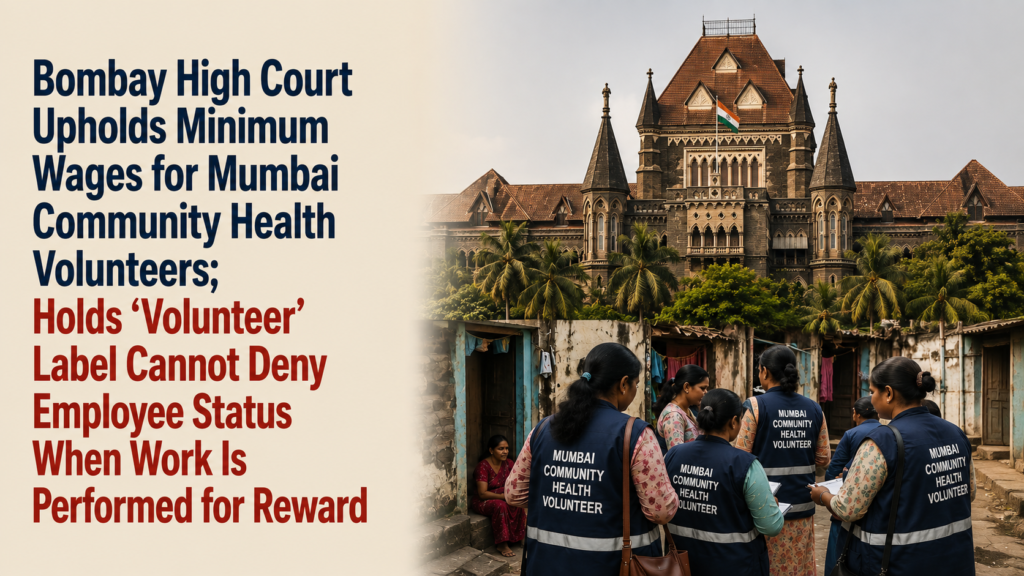
Bombay High Court Upholds Minimum Wages for Mumbai Community Health Volunteers; Holds ‘Volunteer’ Label Cannot Deny Employee Status When Work Is Performed for Reward

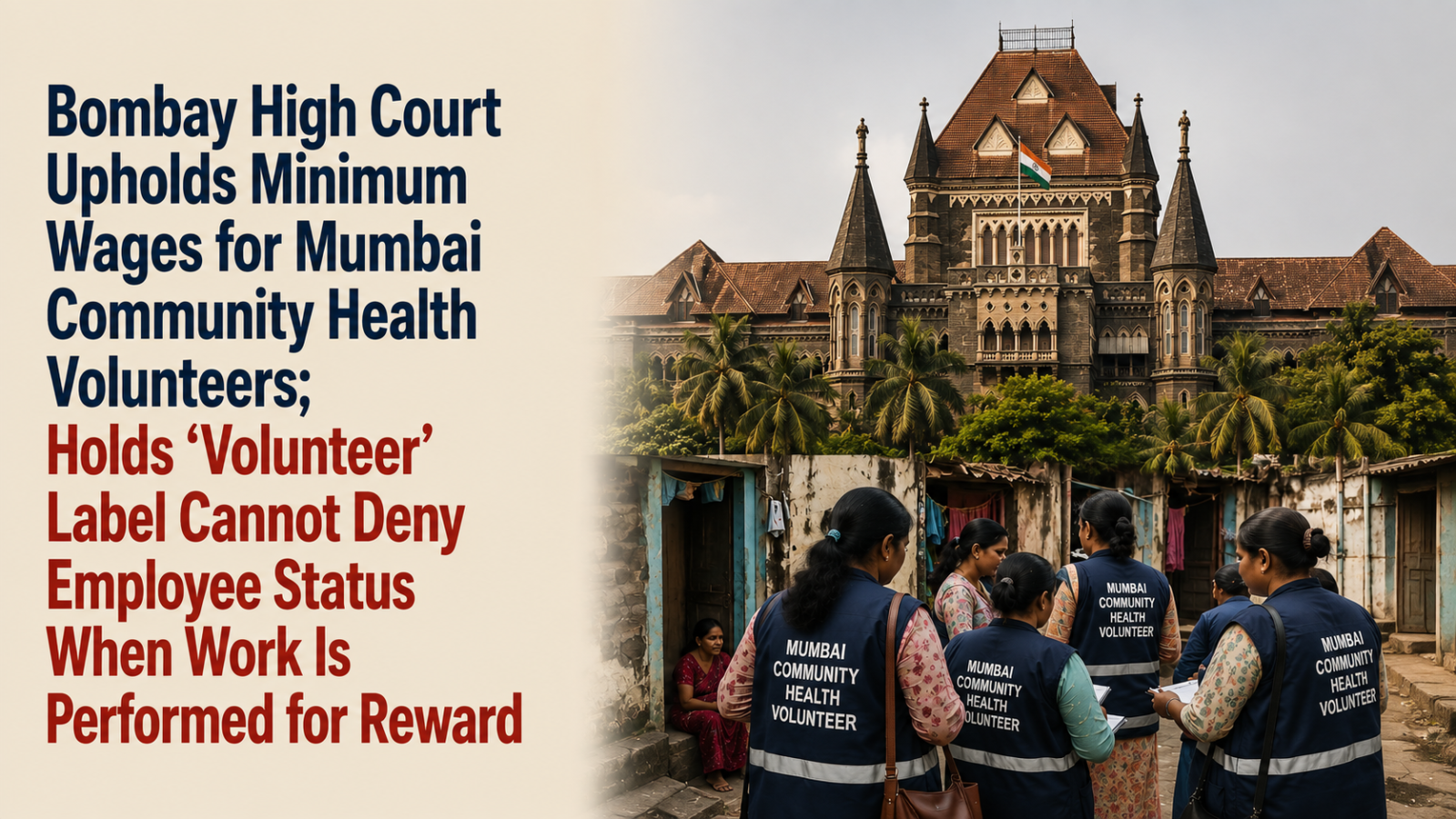
Bombay High Court Refuses Stay After Upholding Minimum Wages for Community Health Volunteers; Rejects MCGM’s Challenge to 2020 Labour Authority Order
Facts
The batch of petitions was filed by the Municipal Corporation of Greater Mumbai (MCGM) challenging a common order dated 7 September 2020 passed by the Authority under the Minimum Wages Act, 1948 and Assistant Commissioner of Labour, Mumbai City. The Authority had allowed applications filed by Community Health Volunteers (CHVs) and their unions and held them entitled to the difference between notified minimum wages, special allowance and the honorarium already paid to them.
The CHV scheme traces its origin to India Population Project V, implemented by MCGM in 1988 with World Bank assistance. The project created health posts throughout Mumbai to provide family planning, maternal and child healthcare, immunisation and disease-control services, particularly in slum communities. Women from local communities were engaged as part-time health workers to assist in implementation of these programmes.
Although World Bank assistance ended in 1996, MCGM continued the programme from its own budget. Over time, CHVs became an important link between municipal health posts and local communities.
The CHVs worked for fixed hours—at present approximately five hours daily—under the supervision of doctors and nurses at health posts. Their muster rolls were maintained and they were paid fixed monthly remuneration described as an “honorarium.” The Court noted that many CHVs continued for years, in some instances until crossing retirement age.
An earlier industrial dispute concerning CHVs had resulted in the Industrial Tribunal holding them to be “workmen” under the Industrial Disputes Act, although their demand for absorption into regular municipal service was rejected. Appeals concerning that question were pending before the Supreme Court.
Separately, CHVs instituted applications under Section 20(2) of the Minimum Wages Act claiming the difference between remuneration actually paid and minimum wages notified by the Government. Those claims were accepted by the Authority, prompting MCGM’s writ petitions.
Issues
The principal issues before the Bombay High Court were:
- Whether Community Health Volunteers engaged by MCGM qualify as “employees” under Section 2(i) of the Minimum Wages Act, 1948.
- Whether describing the payment made to them as an “honorarium” rather than wages excludes them from the Minimum Wages Act.
- Whether CHVs could claim minimum wages despite not being regularly appointed to the municipal establishment.
- Whether the earlier rejection of their claim for absorption or regularisation prevented them from separately claiming statutory minimum wages.
- Whether the pending Supreme Court proceedings concerning their status as “workmen” under the Industrial Disputes Act barred adjudication of their minimum-wage claims.
- Whether part-time CHVs were entitled to minimum wages proportionate to the number of hours actually worked.
Petitioner’s Arguments
MCGM contended that CHVs were merely volunteers and that no employer-employee relationship existed.
It argued that CHVs were not appointed through any regular recruitment process, their services were engaged according to requirements of particular health projects, and they were never treated as part of the municipal establishment.
According to MCGM, CHVs therefore did not satisfy the definition of “employee” under Section 2(i) of the Minimum Wages Act.
MCGM further argued that the status of CHVs as “workmen” was already pending before the Supreme Court in proceedings arising from the earlier Industrial Tribunal award and that the Minimum Wages Authority could not effectively re-adjudicate their employment status while that controversy remained sub judice.
It also raised objections concerning limitation, framing of issues, the evidence having been given by an advocate rather than individual CHVs, and the fact that CHVs presently received approximately ₹14,000 per month for five hours of work daily.
Respondent’s Arguments
The CHVs contended that regularisation and entitlement to minimum wages are legally distinct questions.
They argued that rejection of their demand for absorption into permanent municipal service could not deprive them of statutory minimum wages for work actually performed.
According to the respondents, MCGM had for years utilised their services to implement essential public-health programmes while describing their remuneration as an honorarium to avoid corresponding labour-law obligations.
They emphasised that minimum wages were paid to other categories of temporary municipal workers and submitted that CHVs could not be singled out merely because they were called volunteers.
Analysis of the Law
1. Regular Appointment and Employment Are Different Concepts
A central part of the judgment is the distinction between being “appointed” to municipal service and being “employed for hire or reward” within the Minimum Wages Act.
The Court held that the word “employed” in Section 2(i) cannot be equated with formal appointment to a sanctioned municipal post.
A person may be permanent, temporary, casual, contractual, ad hoc, badli or otherwise described. What matters for the Minimum Wages Act is whether the person renders services for hire or reward.
Thus, lack of formal recruitment or regular municipal status did not itself remove CHVs from statutory wage protection.
2. “Honorarium” Can Constitute Wages
The Court rejected MCGM’s attempt to distinguish the fixed remuneration paid to CHVs merely because it was described as an “honorarium.”
Under Section 2(h), “wages” broadly includes remuneration capable of being expressed in monetary terms and payable for employment or work performed.
The Court reasoned that if nomenclature alone were decisive, employers could simply rename wages as “honorarium” and thereby avoid statutory minimum-wage obligations.
Accordingly, the fixed remuneration paid to CHVs constituted wages for purposes of minimum-wage protection.
3. CHVs Were Not Volunteers in the Ordinary Sense
The High Court scrutinised the actual nature of the relationship rather than its label.
CHVs were required to:
- report for work;
- discharge assigned duties for approximately five hours;
- obey directions of municipal doctors and nurses;
- have their attendance reflected in muster rolls; and
- receive fixed monthly remuneration.
The Court therefore concluded that they were not “volunteers” in the ordinary sense of persons freely offering unpaid assistance.
Their work was also not occasional or transitory. The health programme had operated for approximately 38 years, and CHVs played a continuing role connecting local communities with municipal health infrastructure.
Minimum Wages and Regularisation Are Separate
The Court expressly rejected MCGM’s contention that the earlier dispute concerning regularisation barred the present proceedings.
The demand for absorption into municipal service was fundamentally different from a demand for minimum wages.
Even a person who has no right to permanent employment or regularisation can still possess a statutory right to minimum wages for services actually rendered.
The Court also held that the definition of “employee” under Section 2(i) of the Minimum Wages Act is materially different from the definition of “workman” under Section 2(s) of the Industrial Disputes Act. Therefore, the pending Supreme Court proceedings concerning “workman” status did not prevent adjudication under the Minimum Wages Act.
This was a critical distinction in the judgment.
Precedent Analysis
State of Punjab v. Jagjit Singh
The High Court treated Jagjit Singh as an important statement of the constitutional policy against exploitation of temporary and casual labour.
The Supreme Court in that case recognised that workers performing comparable duties cannot be arbitrarily paid less merely because of their temporary status and connected wage equality with human dignity.
Justice Sandeep V. Marne clarified, however, that the strict ratio of Jagjit Singh did not directly apply because CHVs were not shown to perform the same duties as permanent municipal employees.
Nevertheless, its underlying principle was relevant: once Government or its instrumentalities hire persons for reward, they cannot exploit those workers through undignified remuneration.
Sabha Shanker Dube v. Divisional Forest Officer
This decision reaffirmed Jagjit Singh and recognised minimum pay protection for temporary workers, independently of questions concerning regularisation.
The High Court relied upon it to reinforce the separation between employment security and wage entitlement.
Gujarat High Court — Anganwadi Workers
The Court also considered the Gujarat High Court’s decision in State of Gujarat v. Adarsh Gujarat Anganwadi Union, which distinguished claims to regular civil-post status from claims to appropriate or living wages.
The Bombay High Court did not extend its ruling to Anganwadi workers or ASHA workers generally; it expressly confined the present adjudication to MCGM’s Community Health Volunteers.
Decisions Concerning Part-Time Workers
The judgment further considered decisions recognising that part-time status does not itself defeat minimum-wage protection where the employment falls within a scheduled employment.
The principle emerging from those authorities was that statutory minimum-wage notifications prevail, and part-time workers may receive notified wages corresponding to the work performed.
Court’s Reasoning
The Court placed considerable weight upon the substance of MCGM’s arrangement with CHVs.
For nearly four decades, MCGM had relied upon local women to carry health programmes into Mumbai’s communities. CHVs acted as the bridge between municipal doctors and nurses and residents, particularly in slum areas.
Calling these women “volunteers” did not change the reality that they:
- performed prescribed duties;
- worked under municipal supervision;
- reported for fixed hours;
- received fixed remuneration; and
- served continuing municipal health functions.
The Court therefore held that, for the limited purpose of minimum wages, CHVs had to be treated as employees.
It expressly avoided holding that CHVs were regular or permanent municipal employees. Indeed, they had no automatic entitlement to:
- absorption;
- permanency;
- increments;
- promotion;
- leave wages;
- pension; or
- continued engagement indefinitely.
Nevertheless, so long as MCGM continued utilising their services for reward, statutory minimum wages had to be paid.
The Court rejected financial burden as an answer to statutory wage rights. While payment of minimum wages might increase MCGM’s expenditure, financial consequences could not justify denial of dignified and living wages to workers performing mainstream municipal functions.
Part-Time Work and Quantum of Wages
The Court recognised that CHVs do not work full-time.
They presently perform approximately five hours of work daily. Consequently, the Court did not hold that they must receive wages equivalent to a full eight-hour working day.
Instead, they were held entitled to the minimum rates prescribed under the applicable notification corresponding to the number of hours actually worked.
The judgment therefore protects the statutory rate while proportionately accounting for part-time working hours.
Conclusion
The Bombay High Court held that Community Health Volunteers utilised by MCGM are employees for the limited purpose of the Minimum Wages Act, notwithstanding their description as “volunteers” and the payment being labelled “honorarium.”
Their engagement was neither casual nor genuinely voluntary. They performed vital municipal health duties under supervision and for fixed remuneration over an extraordinarily long-running programme.
The Court therefore upheld their entitlement to minimum wages and refused to interfere with the order of the Minimum Wages Authority.
Importantly, it clarified that receiving minimum wages does not create any corresponding right to absorption, permanency or other municipal service benefits. CHVs are entitled only to notified minimum wages proportionate to the hours they work.
All the writ petitions filed by MCGM were consequently dismissed without costs. MCGM then sought a six-week stay of the judgment, but the Court rejected that request because the underlying 2020 order had not been stayed during pendency of the writ petitions.
Case Details
Case: Municipal Corporation of Greater Mumbai v. Sangeeta Devdas Salvi & Ors. and connected matters
Court: Bombay High Court, Civil Appellate Jurisdiction
Case Number: Writ Petition No. 1156 of 2021 with connected Writ Petitions
Judge: Justice Sandeep V. Marne
Date: 13 August 2026
Result: MCGM’s writ petitions dismissed; CHVs held entitled to notified minimum wages proportionate to hours worked; no right to regularisation or permanency created; six-week stay refused.