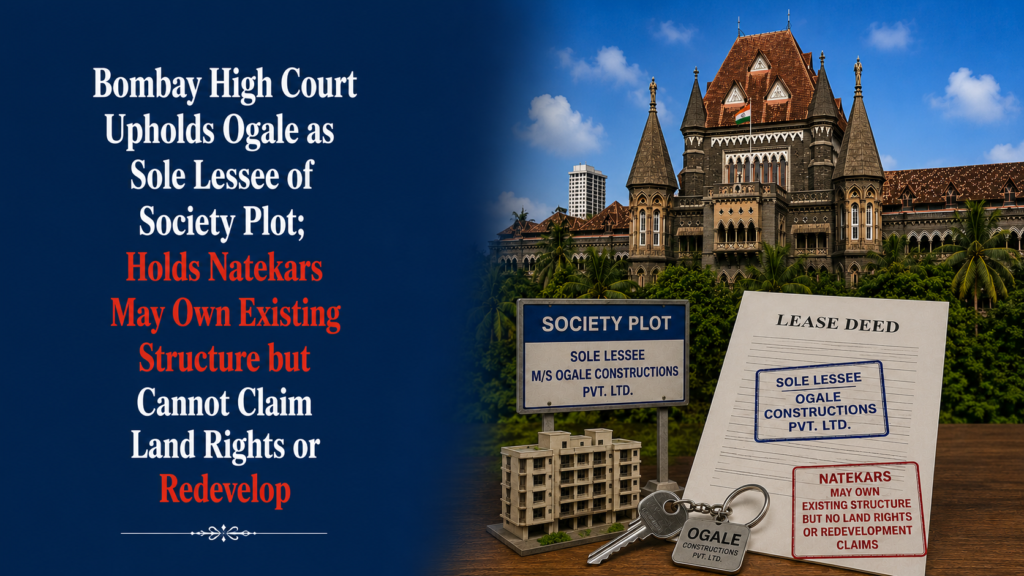
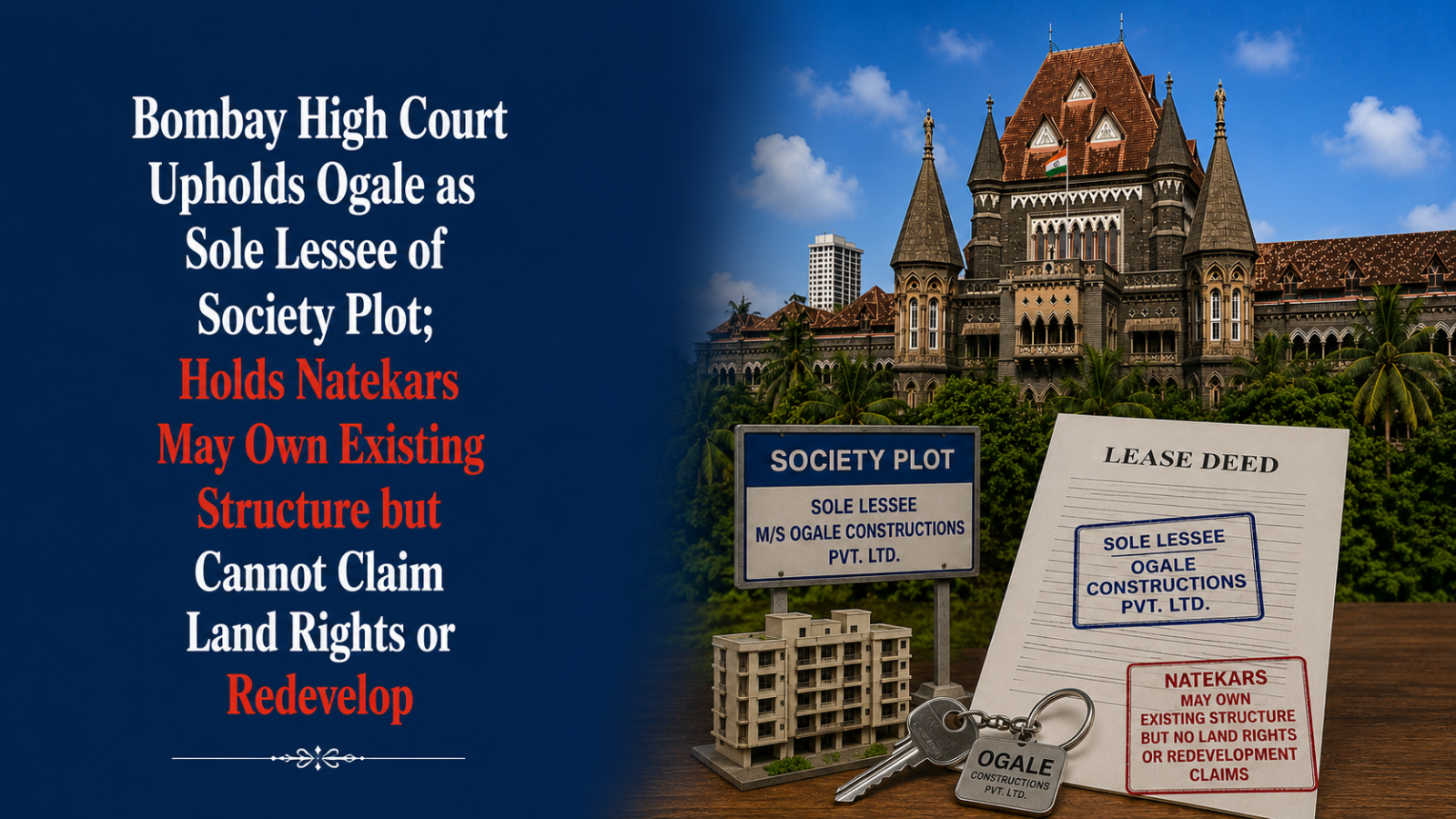
Bombay High Court Upholds Ogale as Sole Lessee of Society Plot; Holds Natekars May Own Existing Structure but Cannot Claim Land Rights or Redevelop

Bombay High Court Rejects Ogales’ Possession Claim After Four-Year Delay; Says Prior Civil Suit Failure Also Bars Eviction Relief in Cooperative Proceedings
Facts
The dispute concerned Plot No. 23 at Erandawane, Pune, forming part of the Deccan Gymkhana Co-operative Housing Society Ltd., a Tenant Ownership Housing Society. The Society owns the land and leases individual plots to its members, while structures constructed on such plots are ordinarily owned by the members. Plot No. 23 admeasured 10,302 sq. ft.
The plot was originally leased to Shivram Datar in 1947 and later transferred through various members until the leasehold rights came to be held by the Kales. In 1973, the Kales purported to sell the southern portion of the plot admeasuring 4,300 sq. ft., together with a structure admeasuring 2,300 sq. ft., to the Bagals. The Society objected because the transaction had been entered into without its permission.
A compromise followed. By a Reconveyance Deed dated 3 July 1976, the Bagals reconveyed the leasehold rights in the 4,300 sq. ft. land to the Kales but retained ownership of the 2,300 sq. ft. structure and possessory rights over the 4,300 sq. ft. area.
In 1985, Manjusha Ogale acquired the leasehold rights in the entire Plot No. 23 from the Kales, and the Society executed a lease in her favour in respect of the entire plot. The transaction expressly acknowledged the existing rights and possession of the Bagals over the southern structure and surrounding area.
In 1991, the Bagals sold the 2,300 sq. ft. southern structure and their claimed possessory rights over 4,300 sq. ft. to M/s Natekar Construction LLP. Multiple civil proceedings followed. Both sides ultimately failed in various civil actions, and Second Appeals remained pending.
Manjusha Ogale then filed Dispute No. 47 of 2004 under Section 91 of the Maharashtra Co-operative Societies Act, 1960 (“MCS Act”) before the Co-operative Court seeking, inter alia, declaration of sole leasehold rights, declaration that Natekars had acquired no rights, injunction and possession.
The Co-operative Court dismissed the dispute for want of jurisdiction. The Co-operative Appellate Court reversed that finding, declared Manjusha Ogale the sole lessee of the entire plot, restrained Natekars from dealing with the property without consent of Ogale and the Society, but refused eviction/possession against Natekars.
Both sides approached the Bombay High Court.
Issues
The principal issues were:
- Whether the Co-operative Court had jurisdiction under Section 91(1) of the MCS Act over a dispute between a member and Natekars, who were not members of the Society.
- Whether Natekars qualified as “persons claiming through a member” under Section 91(1)(b).
- Whether a dispute concerning transfer of interests in Society property without permission under Section 29(2) touched the business or management of a tenant-ownership society.
- Whether Manjusha Ogale was the sole lessee of the entire 10,302 sq. ft. plot, despite Bagals/Natekars owning the southern structure and occupying 4,300 sq. ft.
- Whether Natekars’ ownership of the 2,300 sq. ft. structure conferred any right to redevelop or construct afresh over the 4,300 sq. ft. land.
- Whether Ogales were entitled to evict Natekars and recover possession of the southern structure.
- Whether the Ogales’ 2026 writ petition seeking possession was barred by delay and laches and by the outcome of earlier civil proceedings.
Natekars’ Arguments
Natekars argued that the Co-operative Court had no jurisdiction because they were neither members nor persons falling within the categories enumerated in Section 91(1).
They contended that the Society was a tenant-ownership society, where the Society owns the land but has no concern with the member-owned structures. Therefore, disputes regarding ownership of a bungalow or structure did not touch the business of the Society.
They relied on Sanjaykumar Amrutlal Shah v. Uttamlal Ratilal Shah to argue that disputes concerning independently owned structures in a tenant-ownership society belong before the ordinary civil or rent court rather than the Co-operative Court.
Natekars further argued that the Society had accepted the 1976 arrangement between Kales and Bagals and that the Bagals validly retained ownership of the southern structure and rights of occupation.
They contended that the Appellate Court’s injunction went too far by preventing them from dealing with or reconstructing the portion purchased from Bagals.
They also opposed the Ogales’ possession petition on the ground of nearly four years’ delay and because the Ogales’ earlier civil challenge to the sale in favour of Natekars had already failed.
Ogales’ Arguments
Ogales argued that Section 91 was squarely attracted because Natekars derived their rights through Bagals, who themselves derived their rights through the Kales, former members of the Society.
Thus, Natekars were persons claiming through past members under Section 91(1)(b).
They further argued that the dispute involved enforcement of Section 29(2) MCS Act, the Society’s lease covenants and its bye-laws, thereby directly touching the Society’s business and management.
They relied upon N. Jethani v. Shri Shivaji Co-operative Housing Society Ltd. to contend that unauthorised alienation without Society permission falls within Section 91 jurisdiction.
Ogales also contended that the Bagals had no transferable rights in the land after the reconveyance and that Natekars could not acquire any better title.
They sought possession of the 2,300 sq. ft. southern structure and 4,300 sq. ft. portion of the plot.
Analysis of the Law
Section 91 Has Two Independent Requirements
The High Court reiterated that Section 91(1) has two components:
- the subject matter must touch the constitution, management or business of the Society; and
- the parties must fall within one of the statutory categories specified in Section 91(1)(a) to (e).
Both conditions must be satisfied.
The Court held that they were satisfied here.
Natekars Were “Persons Claiming Through a Member”
The Court found that Bagals did not enter the Society property independently.
Their ownership of the structure and occupation of part of the plot originated from their transaction with Kales, who were members and lessees of the Society.
Since Natekars purchased those rights from Bagals, they stepped into Bagals’ shoes.
Accordingly, if Bagals claimed through Kales, Natekars likewise claimed through a member and fell within Section 91(1)(b).
Dispute Touched Society’s Business
The Court emphasised that Natekars’ claim was not confined to ownership of the structure.
They were also asserting possession and rights over 4,300 sq. ft. of land belonging to the Society and questioning the extent of Ogale’s leasehold rights.
Since the Society existed for the purpose of leasing plots to its members, a dispute concerning rights over its land and an alleged transfer without permission clearly touched its business.
Further, disputes concerning violation of Section 29(2) were squarely within Co-operative Court jurisdiction.
Precedent Analysis
Sanjaykumar Amrutlal Shah v. Uttamlal Ratilal Shah
The Court distinguished this decision.
In Sanjaykumar Shah, the dispute concerned a landlord-tenant relationship in a bungalow owned by a member of a tenant-ownership society, and the Society had no existing proprietary concern in the bungalow itself.
Here, however, Natekars were asserting rights not merely in a structure but also in Society-owned land, while their claim arose through a member and implicated Section 29(2). The precedent therefore did not govern the present controversy.
O.N. Bhatnagar v. Rukibai Narsindas
The Court noted that O.N. Bhatnagar involved a tenant co-partnership society and was factually distinct.
Nevertheless, it remained relevant in recognising that where the Society itself stands transposed as a disputant, the Co-operative Court may exercise jurisdiction over claims concerning occupation of Society property.
N. Jethani v. Shri Shivaji Co-operative Housing Society Ltd.
This precedent was found directly relevant.
It established that alienation or attempted alienation of Society property without permission, particularly in violation of Section 29(2) and bye-laws, falls within Section 91 jurisdiction. The High Court held that its ratio applied squarely.
Anita Enterprises v. Belfer Co-operative Housing Society Ltd.
The case was relied upon for the mandatory nature of Section 29(2). However, the present Court ultimately clarified that while Section 29(2) supported jurisdiction, it did not automatically entitle Ogales to evict Natekars from the structure in the peculiar factual arrangement.
Court’s Reasoning
1. Manjusha Ogale Was Sole Lessee of Entire Plot
The Court held that the 1976 Reconveyance Deed extinguished the Bagals’ leasehold rights in the 4,300 sq. ft. land and restored them to the Kales.
The Bagals may have retained ownership of the 2,300 sq. ft. structure and a right of occupation, but they ceased to be lessees of any part of the land.
When Manjusha Ogale purchased the Kales’ rights in 1985, the entire 10,302 sq. ft. leasehold interest passed to her.
The Court therefore held that the Co-operative Appellate Court correctly declared her sole lessee of the whole plot.
2. Ownership of Structure Did Not Create Rights in Land
The High Court sharply distinguished between ownership of the superstructure and leasehold rights in the land beneath it.
Natekars may have acquired ownership of the existing 2,300 sq. ft. structure from Bagals, together with a possible right to occupy the surrounding 4,300 sq. ft. land.
But that did not give them leasehold rights in the land.
3. Natekars Cannot Redevelop or Reconstruct
The 1976 deed permitted Bagals to make alterations and additional construction connected with better enjoyment of the existing structure.
The Court held that those clauses did not authorise demolition and complete redevelopment or construction of an altogether new building.
To interpret them otherwise would recreate an interest in the land that the Reconveyance Deed was specifically intended to extinguish.
Thus, Natekars can occupy the existing structure but cannot redevelop or reconstruct it without the permission of Ogales as lessee and the Society as landowner.
4. Ogales Could Not Evict Natekars
Although Ogales were sole lessees, the Court refused to order possession against Natekars.
The 1985 sale deed under which Ogales acquired the leasehold rights expressly recognised the Bagals’ ownership of the southern structure and possessory rights. Ogales therefore purchased with full knowledge of that encumbrance.
Bagals had paid substantial consideration for the structure, and Natekars later purchased those rights for value. The Court therefore held that Ogales could not now insist that Natekars vacate merely because they held the leasehold interest in the underlying land.
Section 29(2) assisted Ogales on the issue of jurisdiction, but it was insufficient by itself to direct eviction.
5. Prior Civil Proceedings Also Defeated Possession Claim
Ogales had already filed a civil suit challenging the sale deed in favour of Natekars and seeking removal of the southern structure.
That suit and the appeal were dismissed. The High Court held that the possession issue could appropriately be pursued in the pending Second Appeal, but could not be resurrected through the present writ proceedings.
6. Ogales’ Writ Petition Was Also Hit by Delay
The Co-operative Appellate Court’s order was dated 19 March 2022, while Ogales filed their writ petition only in March 2026.
The Court found the nearly four-year delay gross and unexplained and held that the petition seeking possession was independently liable to dismissal on delay and laches.
Conclusion
The Bombay High Court upheld the Co-operative Appellate Court’s decision.
It held that:
- Manjusha Ogale is the sole lessee of the entire 10,302 sq. ft. Plot No. 23;
- Natekars may continue to own and possess the existing 2,300 sq. ft. southern structure, subject to the pending Second Appeal;
- Natekars have no leasehold rights in the land;
- they cannot demolish, reconstruct or redevelop the property without the consent of Ogales and the Society; and
- Ogales are not presently entitled to evict Natekars from the southern structure.
The Court described the arrangement as one where both sides had knowingly taken risks: Natekars bought a structure without rights in the land, while Ogales purchased the entire leasehold interest with knowledge that Bagals owned and occupied part of the structure. Both therefore had to live with the resulting limitations.
All three writ petitions were accordingly dismissed with no order as to costs.
Case Details
Case: M/s Natekar Construction LLP & Anr. v. Manjusha Dattatray Ogale & Ors. with connected petitions
Court: High Court of Judicature at Bombay, Civil Appellate Jurisdiction
Case Numbers: Writ Petition Nos. 5347 of 2024 and 5354 of 2024 with Writ Petition (Stamp) No. 9683 of 2026
Judge: Hon’ble Mr. Justice Sandeep V. Marne
Reserved On: 4 August 2026
Date: 11 August 2026
Result: All writ petitions dismissed; Co-operative Appellate Court order upheld; Ogale confirmed as sole lessee of entire plot, while Natekars retain limited ownership/possession of existing structure without redevelopment rights.