Bombay High Court Denies Full Back Wages Despite Reinstatement; Holds Employee’s Absence, Criminal Custody and Missing Plea of Unemployment Justified Refusal of Ten-Year Salary

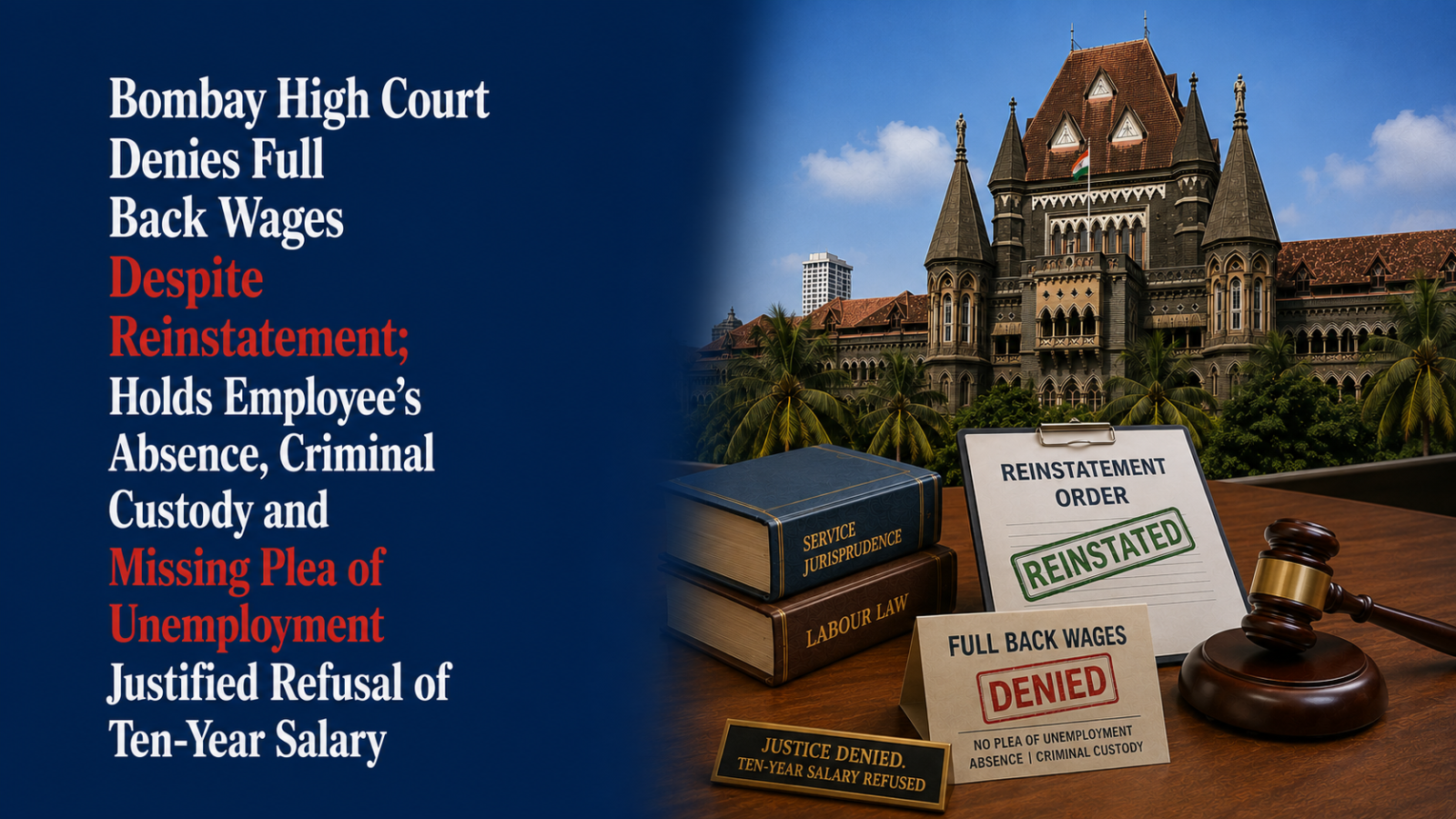
Bombay High Court Balances Illegal Termination Against Employee Conduct; Denies Decade-Long Back Wages but Compensates Two-Year Delay in Reinstatement
Facts
Vitthal Dilip Mhaske was employed with Nord Drive Systems Pvt. Ltd. from 20 August 2007. He initially worked in the Painting Department and was later assigned work in the Logistics Department.
In 2014, he became implicated as Accused No. 2 in a serious criminal case involving, among other provisions, Sections 366-A, 376(2)(i), 420 and 506 IPC and Sections 3 and 4 of the POCSO Act. The main allegations were against Accused No. 1, and the employee was apparently implicated because his car had allegedly been used in connection with the offence.
He applied for leave between 29 March and 19 April 2014 while attempting to obtain anticipatory bail. After his anticipatory bail plea failed, he was arrested and remained in custody from 21 May to 21 June 2014. He consequently remained absent from work without intimation between 20 May and 21 June 2014. The employer terminated his services by letter dated 23 July 2014, retrospectively with effect from 20 May 2014, on the ground of absence from duty.
The Labour Court, by judgment dated 2 May 2024, set aside the termination and directed reinstatement with continuity of service and full back wages from 20 May 2014.
The Industrial Court, in revision, upheld reinstatement and continuity but set aside the direction for full back wages. The employee challenged denial of back wages, while the employer challenged reinstatement itself.
By the time the writ petitions were heard, however, the employee had already been reinstated in May 2026. The employer’s petition challenging reinstatement therefore became infructuous, leaving only the employee’s claim for back wages to be decided.
Issues
The principal issues before the Court were:
- Whether an employee whose termination has been declared illegal is automatically entitled to full back wages upon reinstatement.
- Whether a claim for back wages can succeed where the workman failed to plead in the complaint that he remained unemployed and not gainfully employed after termination.
- Whether evidence regarding absence of gainful employment can be considered when no foundational pleading to that effect exists.
- Whether the employee’s own conduct—his absence, criminal prosecution, custody and alleged false pretext for leave—could justify denial of full back wages even though termination was procedurally illegal.
- Whether the employer was liable to pay wages for the period between the Labour Court’s reinstatement order in May 2024 and the employee’s actual reinstatement in May 2026.
Employee’s Arguments
The employee argued that the Industrial Court had wrongly denied back wages merely because the complaint did not contain an express pleading that he had remained unemployed.
He explained that the interval between termination and institution of the labour proceedings was relatively short and therefore the specific pleading was omitted. He nevertheless led evidence in 2017 that he had attempted to secure alternative employment but remained unemployed.
He contended that strict rules of pleadings should not govern labour disputes and that courts could consider evidence where parties understood the controversy.
He further argued that because the termination had been found illegal and reinstatement ordered, back wages should ordinarily follow as a natural consequence.
Reliance was placed upon Bhagwati Prasad v. Chandramaul, Taranjitsingh I. Bagga v. Maharashtra State Road Transport and Bal Vidhya Prakashan v. Prakash Baliram Hiwse.
Employer’s Arguments
The employer argued that the Industrial Court correctly denied back wages.
It submitted that there was no foundational pleading regarding absence of gainful employment and that evidence cannot be led beyond the pleadings.
It further contended that the employee’s own conduct had caused the situation leading to termination. He had become involved in a serious criminal prosecution, remained absent, failed to inform the employer regarding his arrest and custody, and allegedly gave a false explanation for his leave.
According to the employer, awarding ten years of back wages would effectively reward the employee for circumstances substantially attributable to him.
Analysis of the Law
Back Wages Are Not Automatic
The High Court held that reinstatement following illegal termination does not mechanically or invariably result in an award of full back wages.
Entitlement to back wages depends upon the facts and circumstances of each case, including the employee’s conduct, the reason for termination and whether he remained gainfully employed during the relevant period.
Pleading of Non-Gainful Employment
The Court accepted the general principle that evidence ordinarily cannot travel beyond pleadings.
The employee had made no allegation in his complaint that he remained unemployed after termination. He directly introduced that assertion in his evidence several years later.
The Court held that even though labour litigation is not governed by rigid technical pleading rules, there must still be some basic factual foundation in the pleadings before evidence on a material issue can be relied upon.
The Court relied on Shrinivas Raghavendrarao Desai v. Kumar Vamanrao and K.L. Kumar v. V.P. Patil for the principle that no amount of evidence can substitute for an absent foundational pleading.
Limited Exception Under Bhagwati Prasad
The Court considered Bhagwati Prasad, where the Supreme Court held that an issue not expressly pleaded may sometimes be considered if it was clearly understood by both parties to be part of the trial and both sides led evidence upon it.
However, that principle did not assist the employee here because absence of gainful employment had not been treated by implication as an issue understood and contested by both sides.
Precedent Analysis
Taranjitsingh I. Bagga v. Maharashtra State Road Transport
The Division Bench in Taranjitsingh had cautioned against rigidly insisting upon technical pleadings from dismissed employees and recognised that a wrongfully dismissed employee may struggle to obtain alternate livelihood.
The present Court, however, held that this judgment could not be read as laying down an absolute rule that back wages must always be granted even where there is no pleading or evidence properly founded on pleadings.
Bal Vidhya Prakashan v. Prakash Baliram Hiwse
That decision had reiterated, relying on Deepali Gundu Surwase, that reinstatement with continuity and back wages is ordinarily the normal rule in wrongful termination cases and that the employer bears the burden of proving gainful employment once the employee asserts unemployment.
The High Court distinguished it on the basis that the proposition did not eliminate the need for at least a basic pleading of non-gainful employment.
Court’s Reasoning
1. No Foundational Pleading for Back Wages
The Court found that the complaint was completely silent regarding unemployment after termination.
The employee had more than two months between termination and filing the complaint and could also have amended the complaint later. Therefore, the Court rejected the explanation that there was insufficient opportunity to include the relevant plea.
Accordingly, the evidence later introduced regarding his inability to find work could not by itself justify full back wages.
2. Employee’s Own Conduct Was Material
Even apart from the pleading defect, the Court held that the facts did not justify full back wages.
The employee had become embroiled in a criminal case involving grave allegations. He remained absent for a substantial period and was in custody for approximately one month.
Although the termination was illegal because the employer had failed to follow proper procedure, that procedural defect justified reinstatement, not necessarily a decade of salary.
The Court observed that the employer could not be treated as wholly blameworthy when the employee’s own private conduct had created the circumstances leading to prolonged absence.
3. False Leave Pretext and Failure to Inform Employer
The Court also noted that the employee had admitted in a representation dated 15 April 2014 that he had cited a false pretext of sickness.
There was also material showing that the employer was not informed by the employee of his arrest and instead learnt of it through the police.
These facts were considered relevant while determining equitable monetary relief.
The Court memorably observed that the employee was, to an extent, the “architect of his own termination”, and that making the employer pay ten years of back wages would amount to rewarding him for his own conduct.
4. Employer Liable for Delay After Reinstatement Order
The Court nevertheless found that a different position prevailed after the Labour Court ordered reinstatement on 2 May 2024.
Despite that order, the employer actually reinstated the employee only in May 2026.
For this period, the delay could no longer be attributed to the employee. The employer was therefore directed to pay full wages at ₹40,000 per month from 2 May 2024 to 11 May 2026.
Conclusion
The Bombay High Court upheld the Industrial Court’s refusal to award full back wages from 20 May 2014.
It held that the employee’s termination was indeed illegal and reinstatement had properly been granted, but full back wages were not warranted in view of the absence of a foundational pleading of non-gainful employment and, independently, the employee’s own conduct involving prolonged absence, criminal custody and misleading leave explanation.
The employer’s writ petition challenging reinstatement was dismissed as infructuous because the employee had already been reinstated. The employee’s writ petition seeking full back wages was also dismissed.
However, the employer was directed to pay full wages at ₹40,000 per month for the period from 2 May 2024 to 11 May 2026, within two months. In case of default, the amount would carry 8% interest per annum after expiry of the two-month period.
Case Details
Case: Vitthal Dilip Mhaske v. Chief Executive Officer, Nord Drive Systems Pvt. Ltd. & Anr. with connected employer petition
Court: High Court of Judicature at Bombay, Civil Appellate Jurisdiction
Case Numbers: Writ Petition No. 8740 of 2026 with Writ Petition (Stamp) No. 21261 of 2026
Judge: Hon’ble Mr. Justice Sandeep V. Marne
Reserved On: 5 August 2026
Date: 11 August 2026
Result: Employee’s claim for full back wages dismissed; employer’s challenge to reinstatement dismissed as infructuous; employer directed to pay ₹40,000 per month from 2 May 2024 to 11 May 2026, with 8% interest on delayed payment.