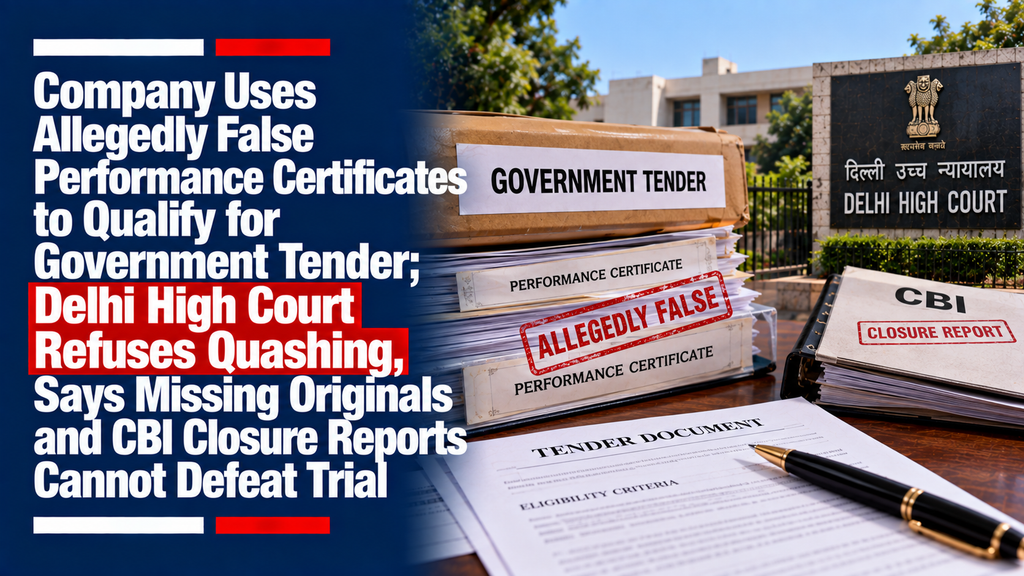
Company Uses Allegedly False Performance Certificates to Qualify for Government Tender; Delhi High Court Refuses Quashing, Says Missing Originals and CBI Closure Reports Cannot Defeat Trial

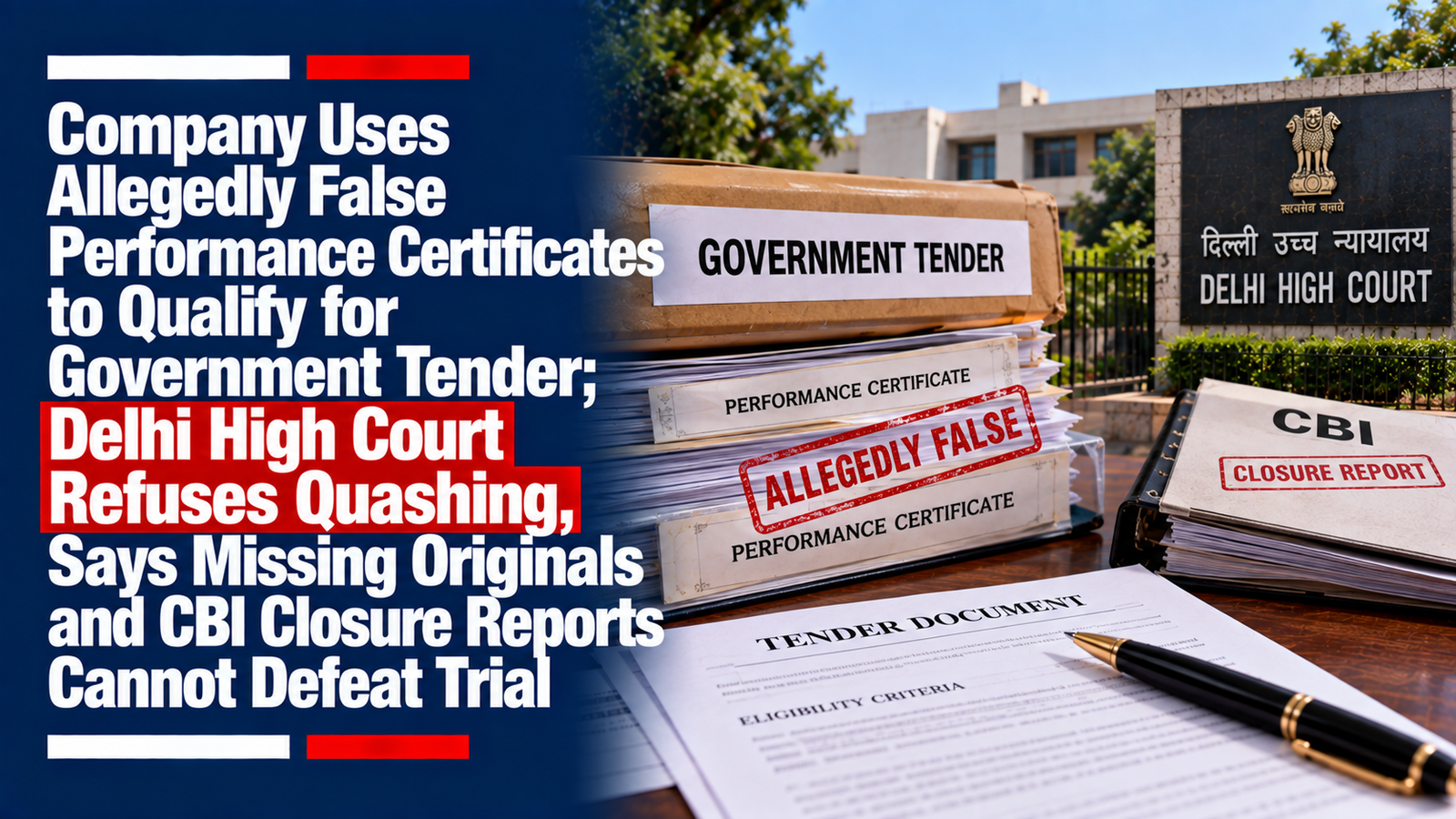
CBI Says Evidence Insufficient and Files Closure Reports Twice; Delhi High Court Says Court Is Not Bound by Investigating Agency’s Opinion
Facts
The case concerns two connected petitions filed by Vikas Bhardwaj and Madhukeshwar Manunath Hegde (M.M. Hegde) challenging criminal proceedings arising from a CBI case concerning a tender for the supply of six Flame Photometers under the Food and Drugs Capacity Building Project. The FIR/RC was registered on 1 April 2010.
The prosecution’s case was that M/s Ambalal Sarabhai Enterprises Ltd., also known as M/s Systronics, had submitted eight false/forged performance certificates in its bid to establish its past performance and qualify for the tender. The respective purchasers acknowledged purchasing Flame Photometers from Systronics but denied issuing the certificates attributed to them.
M.M. Hegde was the Delhi Branch Manager of Systronics during the relevant period and was alleged to have signed/verified the eight certificates. Vikas Bhardwaj was engaged as a liaison agent and was alleged to have participated in preparing the certificates immediately before the tender submission.
Significantly, the original eight certificates were never recovered. The handwriting expert could not conclusively identify Hegde’s signatures. Forensic examination of the computer hard disk did not reveal the five certificates allegedly prepared on that computer. Regarding three others, examination indicated that a certificate appeared to have been typed on Systronics’ typewriter, but the person who typed it could not be identified.
The CBI initially found no concrete evidence connecting the petitioners with preparation of the certificates or conspiracy and found no monetary loss, short supply or malfunctioning of the equipment. The Trial Court rejected the closure report and directed further investigation.
Even after further investigation, the CBI recorded that Systronics was the lowest bidder, all six Flame Photometers were supplied, there was no complaint about their functioning, the actual forger could not be identified, and the factual contents regarding earlier supply of equipment were otherwise true.
The CBI ultimately filed another closure report. Nevertheless, cognizance was taken and the Trial Court subsequently found a prima facie case under Sections 120-B, 420 and 471 IPC, while discharging both accused under Section 468 IPC.
Issues
The principal issue was whether the material collected during investigation was sufficient to proceed against the petitioners for criminal conspiracy, cheating and using forged documents as genuine, or whether continuation of the prosecution amounted to an abuse of process warranting interference under Section 482 Cr.P.C.
The Court also had to consider the effect of the CBI filing closure reports, non-recovery of the original certificates, inconclusive forensic evidence, subsequent satisfactory performance of the supply contract, and certain witnesses refusing to give Section 164 Cr.P.C. statements.
Petitioners’ Arguments
The petitioners strongly relied upon the fact that the CBI itself had filed closure reports twice and had been unable to gather concrete evidence identifying the actual person who forged the certificates.
They emphasised that the originals were never recovered, Hegde’s signatures could not conclusively be established, the hard disk examination did not reveal the certificates, and the typewriter evidence did not identify their author.
They further argued that Systronics was the lowest bidder, actually supplied the six machines and there was no allegation of defective, spurious or short supply. Consequently, according to them, there was no financial loss to the Government.
Hegde separately argued that merely being the Branch Manager and allegedly attesting documents could not establish either knowledge of forgery or participation in a conspiracy.
Respondent/CBI’s Arguments
The CBI contended that the certificates had not been issued by the purchasers whose names appeared on them and that statements of Systronics employees indicated that certificates were prepared and signed at the office under the petitioners’ directions.
The CBI further argued that the certificates were not irrelevant documents: past performance was an eligibility requirement. Their alleged use therefore enabled Systronics to qualify for the tender and potentially deprived other technically and commercially responsive bidders of a fair opportunity.
Analysis of the Law
The High Court reiterated that at the stage of framing charge, the Court does not conduct a mini-trial or meticulously determine whether the evidence will ultimately result in conviction.
The relevant inquiry is whether the prosecution material, taken at face value, discloses the ingredients of the alleged offences and creates a prima facie case or grave suspicion. Section 482 jurisdiction remains available where even accepting the prosecution case at face value no offence is disclosed or continuation amounts to abuse of process.
A particularly important proposition from the judgment is that an investigating agency’s closure report does not bind the criminal court. The Court must independently examine the material before it. Therefore, the fact that the CBI had itself sought closure could not automatically result in quashing where the underlying material otherwise disclosed a prima facie case.
Precedent Analysis
The Trial Court had relied upon State of Bihar v. Ramesh Singh and State of Tamil Nadu v. N. Suresh Rajan for the principle that at the charge stage the question is whether there exists sufficient ground for presuming commission of an offence—not whether the prosecution has already established a case sufficient for conviction. A mini-trial is impermissible at that stage.
The Trial Court had also relied upon Sheila Sebastian v. R. Jawaharaj while discharging the petitioners under Section 468 IPC, reasoning that liability for making a false document attaches to its maker and that the prosecution’s allegation was essentially that the petitioners got the documents prepared rather than themselves being their makers.
Court’s Reasoning
The Court found specific allegations against Vikas Bhardwaj. Witnesses stated that he received tender documents, prepared performance certificates, supplied photocopied letterheads for typing, dictated contents and dates, and allegedly caused an employee to make a false signature. These were not merely allegations of his general presence as a liaison agent.
As regards M.M. Hegde, witnesses placed him in an active role as Branch Manager. One witness specifically stated that Hegde signed all eight certificates on 6 December 2005 before their submission to HSCC. The inconclusive handwriting opinion did not eliminate this witness account at the charge stage.
The Court held that non-recovery of the originals was not by itself sufficient to quash the case, because the prosecution was not dependent exclusively upon scientific evidence identifying the physical maker. There were witness statements concerning preparation, signing and submission of the documents. Their ultimate admissibility and credibility were matters for trial.
Importantly, the fact that Systronics was the lowest bidder and subsequently supplied properly functioning equipment did not destroy the prosecution’s case. The alleged deception concerned eligibility at the tender stage, not the quality of the equipment ultimately supplied.
Similarly, the fact that originals were not required under the tender conditions did not make genuineness irrelevant. A photocopy purporting to be a genuine certificate could still form the basis of the allegation if the purported issuing entity denied issuing it.
The Court also held that the refusal of certain witnesses to subsequently give Section 164 Cr.P.C. statements could affect their credibility at trial, but did not automatically erase their Section 161 statements for the limited purpose of deciding whether sufficient grounds existed to proceed.
On conspiracy, the allegations presented a connected sequence: Hegde allegedly facilitated the tender work and signed the certificates, while Bhardwaj allegedly participated in preparing them and getting employees to type/sign them. At the charge stage, this was sufficient to raise a grave suspicion of concerted action.
Conclusion
The Delhi High Court held that the missing originals, inconclusive forensic evidence, two CBI closure reports and refusal of witnesses to give Section 164 statements were all matters capable of being tested during trial. They did not make the prosecution case inherently improbable or legally untenable at the threshold.
Accordingly, the Court upheld the prima facie case under Sections 120-B, 420 and 471 IPC, while leaving undisturbed the discharge under Section 468 IPC. Both petitions were dismissed and the Trial Court was directed to proceed with the trial without delay. The High Court expressly clarified that its observations were confined to the charge stage and were not findings on guilt.
Case: Vikas Bhardwaj v. CBI & Madhukeshwar Manunath Hegde v. CBI
Court: Delhi High Court
Case Nos.: CRL.M.C. 5490/2023 & CRL.M.C. 8489/2023
Judge: Justice Madhu Jain
Date: 22 September 2026
Result: Both petitions dismissed; charges under Sections 120-B, 420 and 471 IPC sustained; trial directed to proceed without delay.