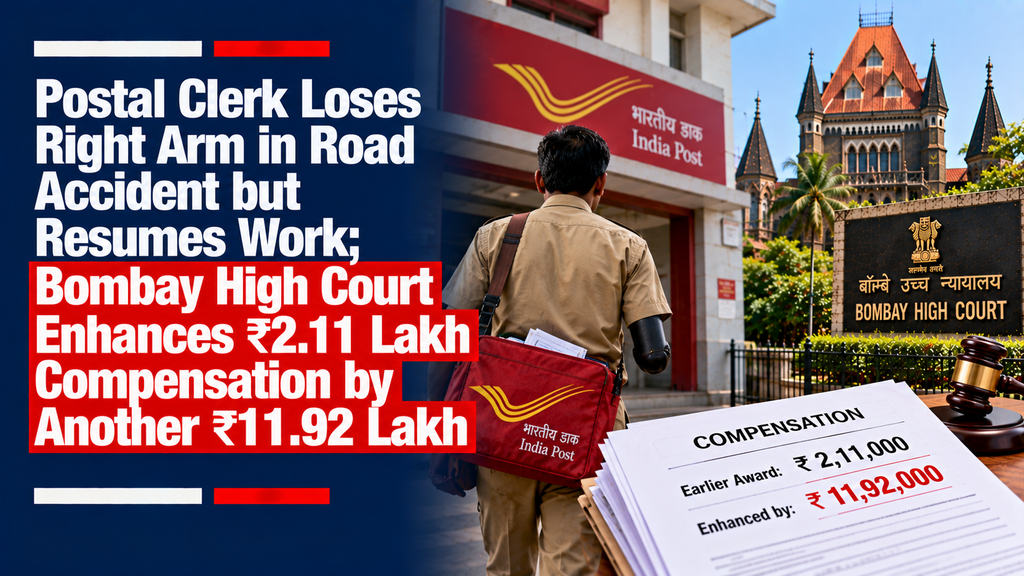
Postal Clerk Loses Right Arm in Road Accident but Resumes Work; Bombay High Court Enhances ₹2.11 Lakh Compensation by Another ₹11.92 Lakh

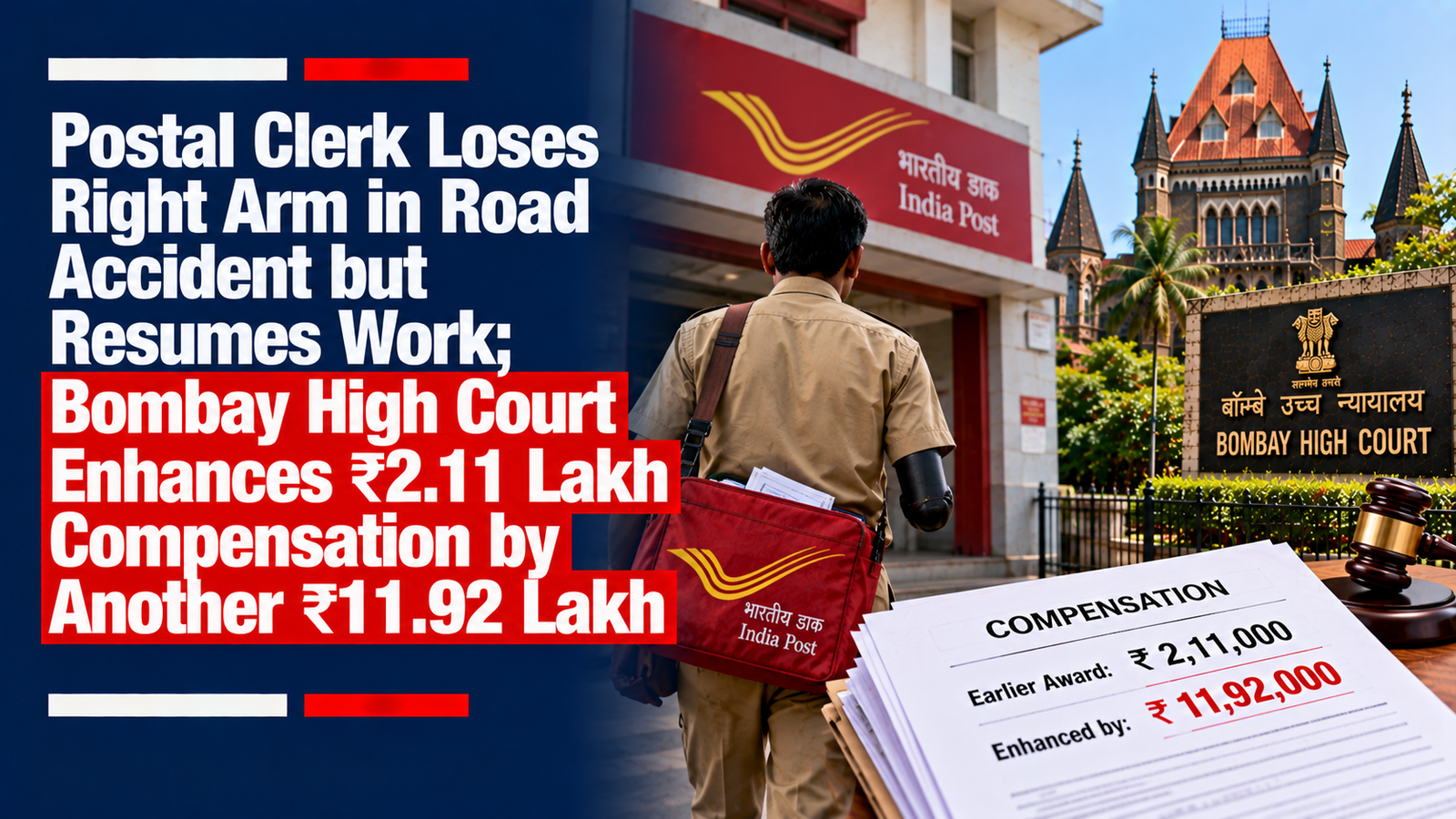
Motorcyclist Suffers 65% Permanent Disability After Arm Amputation; Bombay High Court Says Physical Disability and Functional Disability Are Different
Facts
The appellant, Martand Sakharam Gholap, challenged the compensation awarded by the Motor Accident Claims Tribunal. The appeal was confined to the quantum of compensation; the finding that the offending truck driver was negligent was not challenged by the insurer.
On 25 May 2002, the appellant was riding a motorcycle with Subhash Shinde as pillion on the Pune–Nashik Road. Near Manchar, a truck bearing No. MP-09/KA-0011 allegedly came from the opposite direction at excessive speed and collided with the motorcycle. The appellant suffered serious injuries, including a compound fracture of the right femur, injury to the right tibia and great toe, and amputation of his right arm below the elbow.
At the time of the accident, he was 45 years old, employed as a Clerk with the Post and Telegraph Department, and earning ₹8,122 per month. He remained away from duty until 17 July 2003.
The Tribunal had awarded approximately ₹2.11 lakh, including only ₹65,000 towards 60% disability. The appellant sought substantial enhancement. The comparison table on page 3 of the judgment shows that he claimed, among other heads, loss of income, medical expenses, attendant charges, loss of amenities and compensation calculated by the multiplier method.
Issues
The principal issue was whether the Tribunal correctly assessed the appellant’s compensation, particularly:
- the distinction between physical disability and functional disability;
- the impact of the amputation upon the appellant’s earning capacity as a clerk;
- applicability of the multiplier method and future prospects;
- entitlement to medical expenses already reimbursed by the employer; and
- compensation under non-pecuniary heads such as loss of amenities, attendant charges and future medical expenses.
Appellant’s Arguments
The appellant argued that the Tribunal had substantially undervalued his disability and its lifelong consequences. He relied upon a medical certificate assessing 65% permanent disability and sought application of the multiplier method for loss of future earning capacity.
He also sought compensation for loss of income during his leave period, substantially higher medical expenses, attendant charges, conveyance, future medical treatment and loss of amenities.
Respondent–Insurer’s Arguments
The insurer contended that the Tribunal’s compensation was appropriate and did not warrant interference.
It relied principally upon Raj Kumar v. Ajay Kumar, arguing that the percentage of physical disability cannot automatically be treated as an identical percentage of loss of earning capacity. The actual impact must be assessed with reference to the claimant’s occupation and the nature of the disability.
Analysis of the Law
The High Court reiterated the distinction between medical/physical disability and functional disability.
Relying on Raj Kumar v. Ajay Kumar, the Court explained that the same physical injury may have radically different economic consequences depending upon the claimant’s occupation. For example, loss of a hand could result in virtually complete functional disability for a driver or carpenter, whereas a clerk may remain capable of performing clerical work.
Accordingly, compensation cannot mechanically be calculated by treating the medical disability percentage as the percentage of loss of future earnings.
Precedent Analysis
The Court treated Raj Kumar v. Ajay Kumar as the principal authority governing assessment of disability compensation. It noted that subsequent Supreme Court decisions calculate compensation based upon the individual claimant’s occupation, affected body part, nature of disability and actual effect upon earning capacity.
The Court also considered Kersasp Ardeshir Mehta v. Union of India on compensation for leave exhausted because of an accident, but distinguished it because the appellant had subsequently resigned from employment.
Court’s Reasoning
The medical evidence established 65% permanent disability. Although the doctor issuing the certificate was not the treating doctor, he had examined the appellant, and the appellant’s evidence regarding disability was not seriously challenged in cross-examination. The Court therefore gave weight to the permanent disability certificate issued almost three years after the accident.
However, the Court declined to equate 65% physical disability with 65% loss of earning capacity. Since the appellant was a clerk and had actually resumed his duties, the Court assessed the adverse effect on his earning capacity at 55%. Applying his monthly salary of ₹8,122 and multiplier of 14, the Court calculated the relevant future earning component and additionally granted 30% future prospects.
The Court also recognised that losing an arm necessarily affects ordinary life, mobility, comfort and day-to-day functioning. It therefore enhanced compensation for loss of future expectation, comfort and amenities from ₹30,000 to ₹1 lakh.
Important ruling on employer-reimbursed medical expenses
A particularly significant aspect is that the Postal Department had reimbursed ₹1,13,127 of the appellant’s medical expenses.
The High Court held that such reimbursement arose from the appellant’s conditions of service, whereas the motor insurer’s liability arose independently. Consequently, the insurer could not reduce its liability merely because the employer had reimbursed the employee. The Court allowed ₹1,23,236 towards hospital and medical expenses.
The Court additionally awarded ₹50,000 towards attendant charges, ₹50,000 towards conveyance and ₹15,000 towards future medical expenses while retaining ₹50,000 for pain and suffering.
The final computation table on page 19 records total compensation of ₹14,03,851, against the Tribunal’s ₹2.11 lakh, resulting in an enhancement of ₹11,92,851.
Conclusion
The Bombay High Court partly allowed the appeal and awarded an additional ₹11,92,851, payable jointly and severally by the respondents within eight weeks, together with 6% interest per annum from the date of filing of the claim petition until payment.
The judgment importantly reiterates that physical disability and functional loss of earning capacity are not synonymous. The economic impact must be assessed with reference to the claimant’s actual occupation and ability to continue working.
It also holds, on the facts before it, that reimbursement of medical expenses by an employer as a service benefit does not by itself relieve the motor insurer of its liability for those medical expenses.
Case: Martand Sakharam Gholap v. Bharu Khan & Anr.
Court: Bombay High Court, Civil Appellate Jurisdiction
Case No.: First Appeal No. 2211 of 2006
Citation: 2026:BHC-AS:38767
Judge: Justice S. M. Modak
Date: 22 September 2026
Result: Appeal partly allowed; compensation enhanced by ₹11,92,851 with 6% interest per annum.