Land Acquisition Award Passed in Favour of Sole Claimant Who Had Already Died; Bombay High Court Calls It Nullity, Condones 2,958-Day Appeal Delay

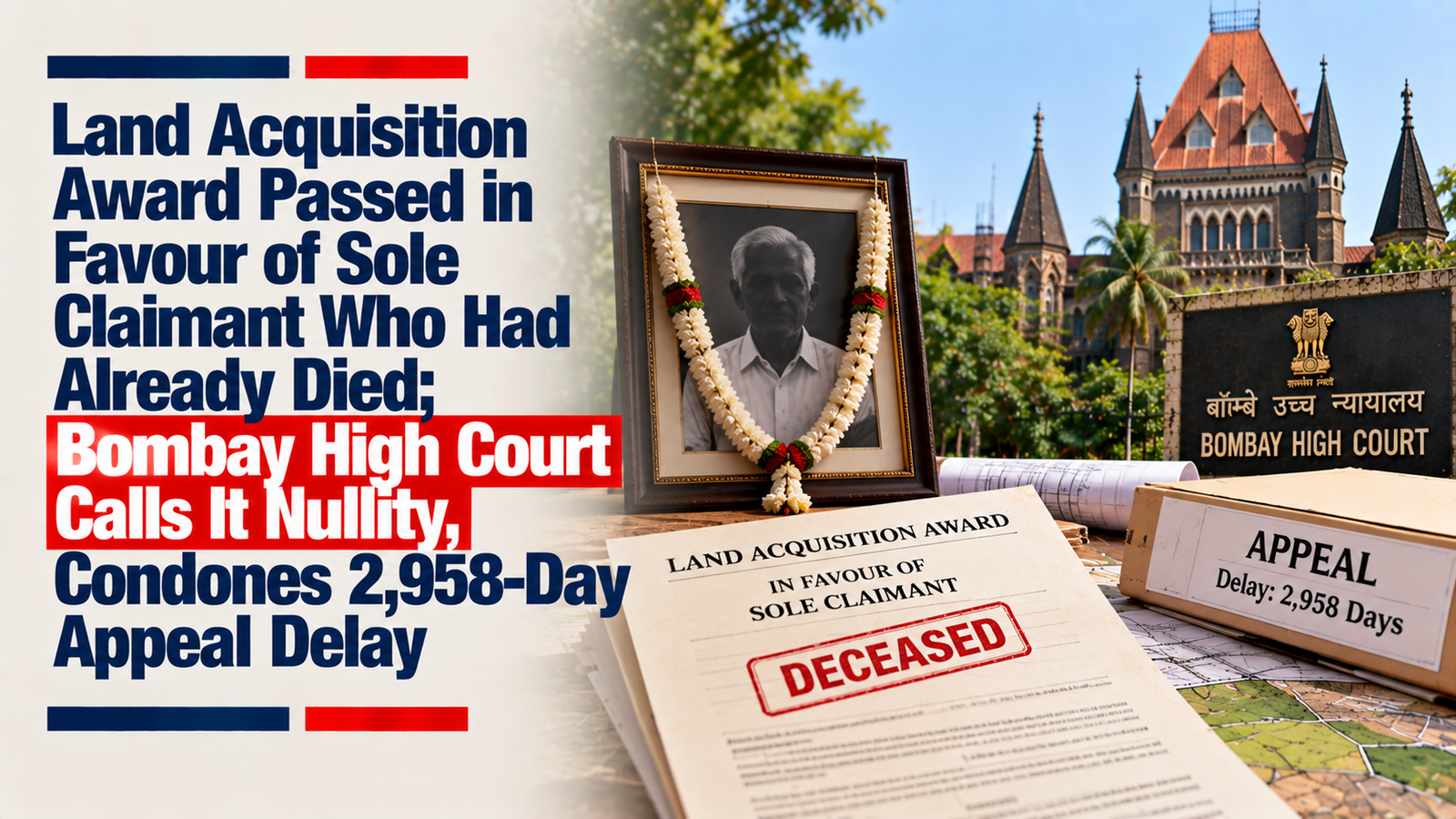
Corporation Challenges Land Acquisition Award After 2,958 Days; Bombay High Court Condones Delay Because Award Was Passed in Favour of Dead Claimant
Facts
The matter arose from an application filed by the Maharashtra Krishna Valley Development Corporation seeking condonation of an extraordinary 2,958-day delay in filing a First Appeal against a land acquisition award. The District Judge, Pune had passed the judgment and award in Land Reference No. 16 of 2002 on 22 March 2017.
The Corporation initially explained the delay on conventional grounds: movement of the file through several administrative authorities, obtaining sanctions and approvals, collection of old records and disruption caused by the COVID-19 pandemic.
However, a far more fundamental issue emerged. The sole claimant had died during the pendency of the land acquisition reference and before arguments were heard. His legal representatives were never brought on record. Nevertheless, on 22 March 2017, the Reference Court proceeded to pronounce the award in the name and in favour of the deceased claimant.
The First Appeal was eventually filed only on 15 April 2025, leading to the application for condonation of the 2,958-day delay.
Issues
The Bombay High Court identified two principal questions:
- Whether the death of the sole claimant, without substitution of his legal representatives, resulted in abatement of the land acquisition reference and consequently rendered the award passed in his favour a nullity.
- If the award was a nullity, whether the enormous 2,958-day delay could nevertheless prevent the Corporation from challenging it.
Applicant’s Arguments
The Maharashtra Krishna Valley Development Corporation argued that Section 53 of the Land Acquisition Act read with Section 141 CPC made the provisions of Order XXII CPC applicable to proceedings before the Reference Court.
According to it, a claimant seeking enhancement of compensation occupies a position analogous to a plaintiff. Therefore, once the sole claimant died, the obligation to bring his legal representatives on record rested upon the claimant’s side.
Since no substitution occurred before the Reference Court heard and decided the matter, the subsequent award in favour of the deceased person could not constitute a valid adjudication.
Respondent’s Arguments
The claimant’s side argued that a reference under Section 18 of the Land Acquisition Act should not be treated as having abated merely because the claimant died.
It was contended that the Special Land Acquisition Officer controlled the reference proceedings and therefore the State/Special Land Acquisition Officer ought to have brought the legal representatives on record.
Reliance was also placed on Khazan Singh v. Union of India, where the Supreme Court held that a Reference Court cannot simply dismiss a land acquisition reference for default because the claimant fails to participate. The respondent further argued that the Corporation had failed to satisfactorily explain the entire period of 2,958 days.
Analysis of the Law
The High Court held that Order XXII CPC applies to land acquisition reference proceedings.
Relying upon Special Land Acquisition Officer (2) v. Harichandra Ramji Patil, the Court noted that when a person approaches the Reference Court seeking enhancement of compensation, the claimant occupies a position comparable to that of a plaintiff. Consequently, the obligation to take steps for substitution following the claimant’s death rests on the claimant’s side.
The Court also relied upon the Full Bench decision in Chander v. Mauji, which recognised the applicability of the CPC, including Order XXII and the rules concerning abatement, to land acquisition proceedings and appeals.
Since there was only one claimant, and no legal representative was brought on record within the prescribed period after his death, the Court concluded that the reference had abated by operation of law.
Precedent Analysis
The Court distinguished Khazan Singh v. Union of India. That case concerned a living claimant who failed to appear. Here, the sole claimant had actually died and nobody representing his estate had been substituted.
The Court explained that there is a material legal distinction between the non-appearance of a living claimant and the death of the sole claimant without substitution. The former does not necessarily prevent the Reference Court from answering the reference; the latter attracts Order XXII and the consequences of abatement.
The Court placed considerable reliance on the Supreme Court’s decision in Vikram Bhalchandra Ghongade, where an appellate judgment pronounced in favour of persons who had died before the appeal was heard was held to be a nullity. Significantly, even the fact that the 90-day substitution period had not expired when the judgment was delivered did not save the adjudication.
The Court also referred to Gurnam Singh and Kiran Singh, reiterating the settled distinction between an erroneous adjudication and one which is a genuine nullity. A nullity affects the very authority of the Court to make the adjudication and can be questioned when it is sought to be relied upon or enforced.
Court’s Reasoning
The decisive fact was straightforward: the sole claimant was dead when the Reference Court heard and decided the matter.
No legal representative represented his estate. The reference had already abated, yet the Reference Court proceeded to pronounce an award in favour of the deceased claimant.
The High Court therefore held that this was not merely a procedural irregularity or an erroneous determination of compensation. The defect went to the foundation of the adjudication itself.
This distinction became decisive on limitation.
Ordinarily, a party filing an appeal after limitation must establish “sufficient cause” under Section 5 of the Limitation Act. If the underlying award were merely wrong—for example, because the compensation was excessive or evidence was incorrectly appreciated—the Corporation would have been required to satisfactorily explain the entire delay.
But the Court held that a nullity does not acquire validity merely because time has passed.
The Court acknowledged that the Corporation’s administrative explanation might not satisfactorily account for every part of the 2,958-day delay. Yet administrative lethargy could not transform an adjudication that was a nullity when pronounced into a legally valid award.
The Court carefully limited this proposition: a litigant cannot defeat limitation simply by describing every erroneous order as “void.” The Court must first examine the nature of the defect. Only where the defect genuinely affects the authority of the Court and renders the adjudication a nullity does the limitation analysis change accordingly.
Here, that threshold was satisfied because the Reference Court adjudicated the claim after the sole claimant had died and without his legal representatives being before it.
Conclusion
The Bombay High Court held that the 22 March 2017 land acquisition award was a nullity because it was passed in favour of the deceased sole claimant after the reference had abated and without substitution of his legal representatives.
Accordingly, the Court held that the 2,958-day delay could not prevent examination of this fundamental defect. It stressed that the delay was being condoned not because every belated challenge to an illegal or erroneous award deserves consideration, but specifically because the underlying adjudication was found to be a nullity.
The Interim Application was therefore allowed and the entire 2,958-day delay in filing the First Appeal was condoned. The First Appeal would consequently be considered on its merits.
Case: Maharashtra Krishna Valley Development Corporation v. Maruti Laxman Khedkar & Ors.
Court: Bombay High Court, Civil Appellate Jurisdiction
Case No.: Interim Application No. 11771 of 2025 in First Appeal (St.) No. 25914 of 2025
Citation: 2026:BHC-AS:38716
Judge: Justice Amit Borkar
Date: 22 September 2026
Result: 2,958-day delay condoned; land acquisition award passed in favour of the deceased sole claimant held to be a nullity; First Appeal to be considered on merits