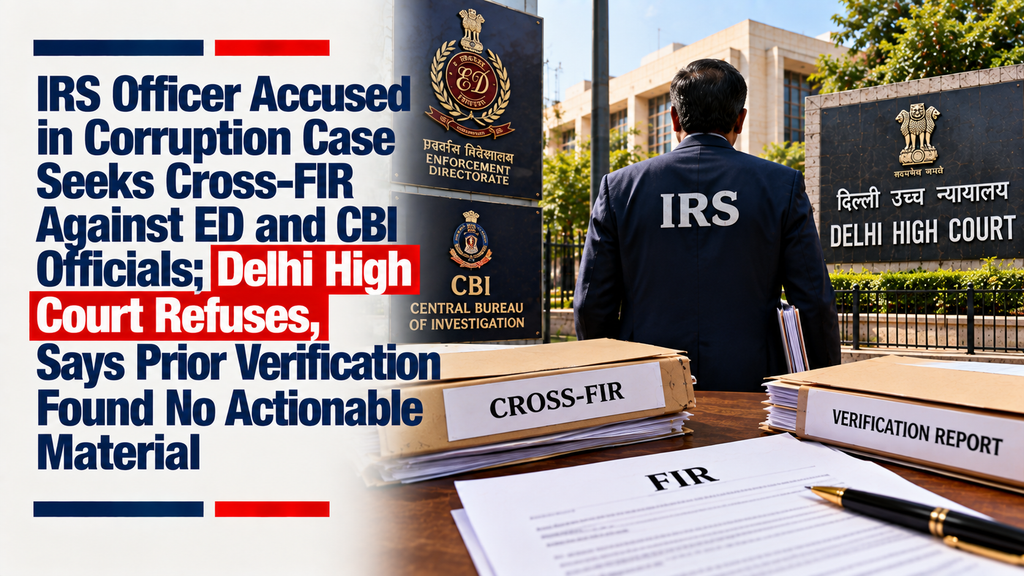
IRS Officer Accused in Corruption Case Seeks Cross-FIR Against ED and CBI Officials; Delhi High Court Refuses, Says Prior Verification Found No Actionable Material

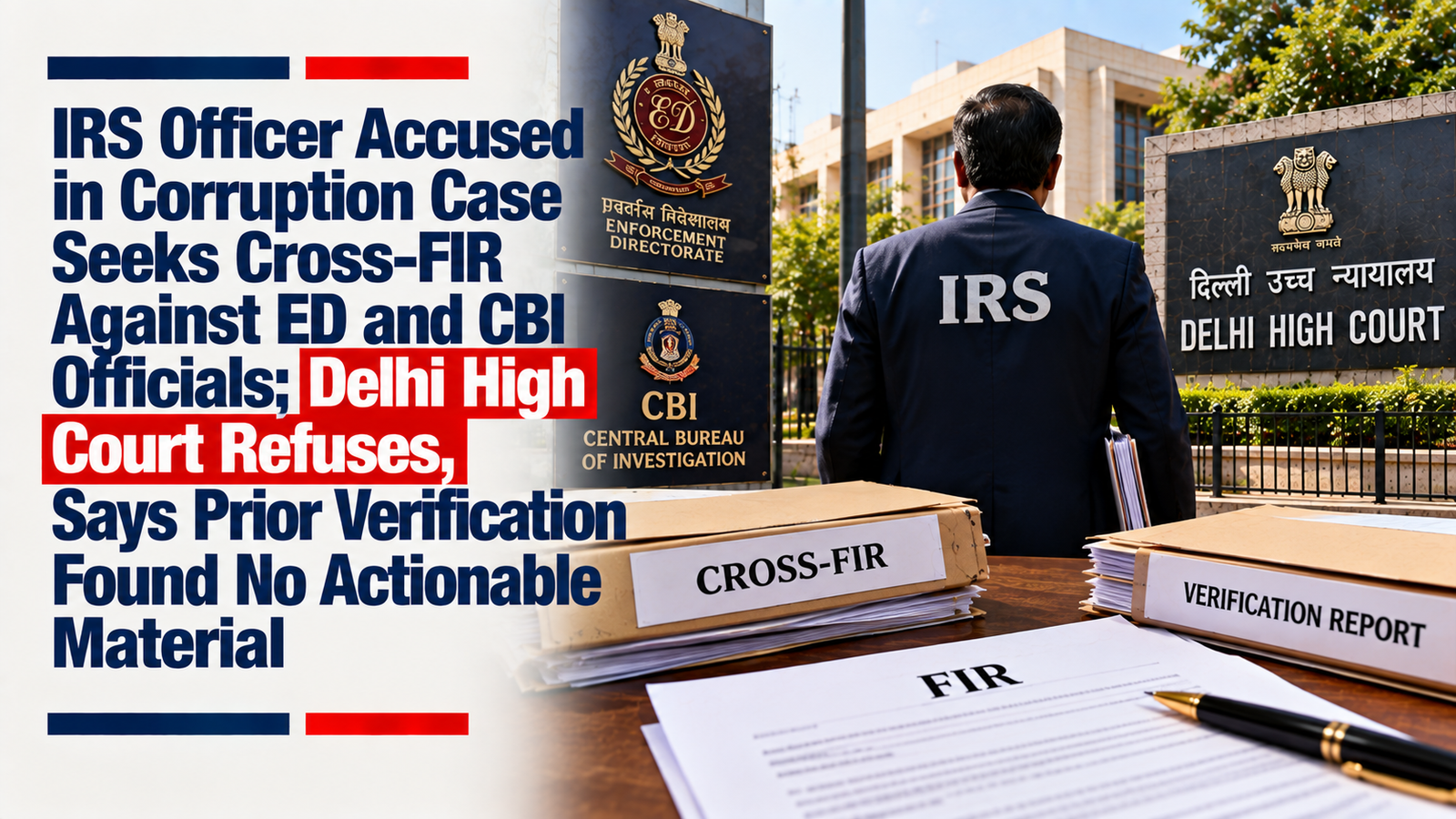
CBI Verifies Allegations Against Former ED Director and Finds No Wrongdoing; Delhi High Court Says Dissatisfaction With Investigation Cannot Compel Fresh FIR
Facts
The petitioner, Jitendra Pratap Singh, an Indian Revenue Service officer formerly posted with the Enforcement Directorate at Ahmedabad, sought a direction to the CBI to register a cross-FIR, or alternatively a fresh criminal case, against officials including former ED Director Karnail Singh and then CBI Deputy Superintendent of Police M.C.R. Mukund.
In 2015, while posted with the ED, the petitioner was associated with an investigation concerning cricket betting and related financial transactions. On 22 September 2015, the CBI registered RC No. 03(A)/2015/CBI/AC-III against him and others. A charge-sheet was subsequently filed before the competent court at Ahmedabad for conspiracy and offences under the Prevention of Corruption Act. Those proceedings remained pending.
The petitioner subsequently lodged three complaints before the Central Vigilance Commission (CVC) in 2018, alleging interference with the ED investigation and questioning the circumstances in which the CBI case came to be registered against him.
On 11 April 2019, the CVC directed the CBI to investigate the allegations and submit a report. When the petitioner complained of delay, the Delhi High Court, in an earlier writ petition, directed the CBI on 10 January 2022 to expedite the enquiry.
The CBI ultimately submitted its report on 28 June 2023, stating that its verification had disclosed no actionable material against Karnail Singh or M.C.R. Mukund. The CVC consequently closed the complaints and informed the CBI on 17 November 2023 that the matter would rest.
The petitioner therefore approached the High Court seeking registration of a cross-FIR or fresh case.
Issues
The central question was whether the High Court should exercise its extraordinary jurisdiction under Articles 226 and 227 of the Constitution read with Section 482 CrPC to compel the CBI to register a cross-FIR/fresh FIR, despite the petitioner’s complaints already having undergone verification by the CBI pursuant to the CVC’s direction.
A related question was whether characterising the allegations as a counter-version of the same transaction itself created an entitlement to registration of a separate FIR.
Petitioner’s Arguments
The petitioner appeared in person and argued that his complaints represented a genuine counter-version of the transaction underlying the CBI prosecution against him.
He relied upon T.T. Antony v. State of Kerala, Kari Choudhary v. Sita Devi and Upkar Singh v. Ved Prakash, contending that where a counter-version of the same occurrence discloses cognizable offences, it can legitimately be separately investigated.
He further relied upon Lalita Kumari v. Government of Uttar Pradesh, arguing that his allegations were serious, specific and capable of verification and therefore required appropriate criminal investigation.
According to him, the CBI merely conducted a “verification”, rather than registering an FIR or preliminary enquiry. Such an exercise, particularly one substantially dependent on corporate and publicly available records, could not adequately investigate allegations concerning off-record transactions, beneficial ownership, electronic evidence and interference with the cricket-betting investigation.
He also highlighted the alleged disparity in treatment: the CBI case against him was registered without a preliminary enquiry, whereas his allegations against the officials were subjected to prolonged verification.
Respondents’ Arguments
The CBI stated that the complaints had not been ignored. They were registered as Complaint CO-26/2019 and subjected to verification pursuant to the CVC’s direction.
During that process, Karnail Singh was examined on 26 February and 9 March 2020. Records concerning allegedly connected companies, disproportionate assets, benami properties and shell companies were examined. The allegations against M.C.R. Mukund were also scrutinised.
According to the CBI, the exercise revealed no actionable material or wrongful conduct. It argued that merely describing allegations as a “cross-FIR” did not create a legal entitlement to registration of another FIR merely because the complainant disagreed with the outcome of verification.
The CVC similarly stated that it closed the complaints after receiving and considering the CBI’s report.
Analysis of the Law
The High Court recognised that counter-cases or counter-versions are legally permissible in appropriate circumstances. However, it held that the authorities relied upon by the petitioner must be applied according to the particular facts.
The important distinction was that the petitioner’s complaints had not been rejected without examination. They were referred by the CVC to the CBI; the CBI conducted verification, examined individuals and records, submitted a report, and the CVC thereafter closed the complaints.
Accordingly, the Court held that:
Merely asserting that a complaint constitutes a counter-version does not automatically entitle its maker to a judicial direction for registration of a second FIR.
The petitioner’s disagreement was essentially with the adequacy and result of the investigative exercise, which by itself did not justify a direction to register another FIR.
Precedent Analysis
The petitioner relied substantially upon T.T. Antony, Kari Choudhary and Upkar Singh to establish that the law does permit investigation of a genuine counter-version arising from the same occurrence. The High Court did not reject that proposition in the abstract; instead, it held that those decisions must be applied in their factual context.
His reliance on Lalita Kumari was similarly based on the proposition that information disclosing a cognizable offence ordinarily requires action in accordance with law.
The Court nevertheless distinguished the present factual situation because the complaints had already been subjected to an investigative verification pursuant to the CVC’s direction.
Court’s Reasoning
The High Court emphasised that the petitioner had earlier approached it complaining that the CVC direction had not been acted upon. In those proceedings, the Court was informed that an enquiry had commenced and consequently disposed of the petition while directing expedition. That enquiry was subsequently completed.
The petitioner was also already facing criminal proceedings arising from the 2015 CBI case, with a charge-sheet pending before the competent court at Ahmedabad. The Court observed that he remained entitled to raise every permissible ground and defence before that court.
Most importantly, the Court held that allegations that the CBI’s verification was inadequate, that certain material was not collected, or that evidence was improperly examined would require the High Court to reassess the investigative process and evidence.
In proceedings under Section 482 CrPC, the Court would not ordinarily substitute its own assessment for that of the investigating agency unless the record demonstrated clear illegality, arbitrariness or failure to exercise jurisdiction.
No such exceptional circumstance was demonstrated.
The High Court also made clear that it was not deciding whether the CBI’s factual conclusions were correct. Its decision was confined to whether the circumstances justified extraordinary judicial intervention compelling another FIR or investigation.
The Court encapsulated the principle by observing that extraordinary jurisdiction cannot be invoked merely to secure a particular investigative outcome after the competent agency has already examined the allegations and reached a decision.
Conclusion
The Delhi High Court refused to direct the CBI to register either a cross-FIR or a fresh case on the petitioner’s complaints.
The petition was disposed of, while expressly preserving the petitioner’s liberty to pursue whatever other remedies may be available before the competent forum. Crucially, the Court clarified that it had expressed no opinion on the merits of the petitioner’s allegations, the pending criminal case against him, or the material collected in those proceedings.
Case: Jitendra Pratap Singh v. Union of India & Ors.
Court: Delhi High Court
Case No.: W.P.(CRL) 2903/2023
CNR: DLHC010396292023
Judge: Justice Madhu Jain
Date: 22 September 2026
Result: Petition disposed of; request for CBI registration of cross-FIR/fresh case declined; liberty to pursue other remedies preserved.