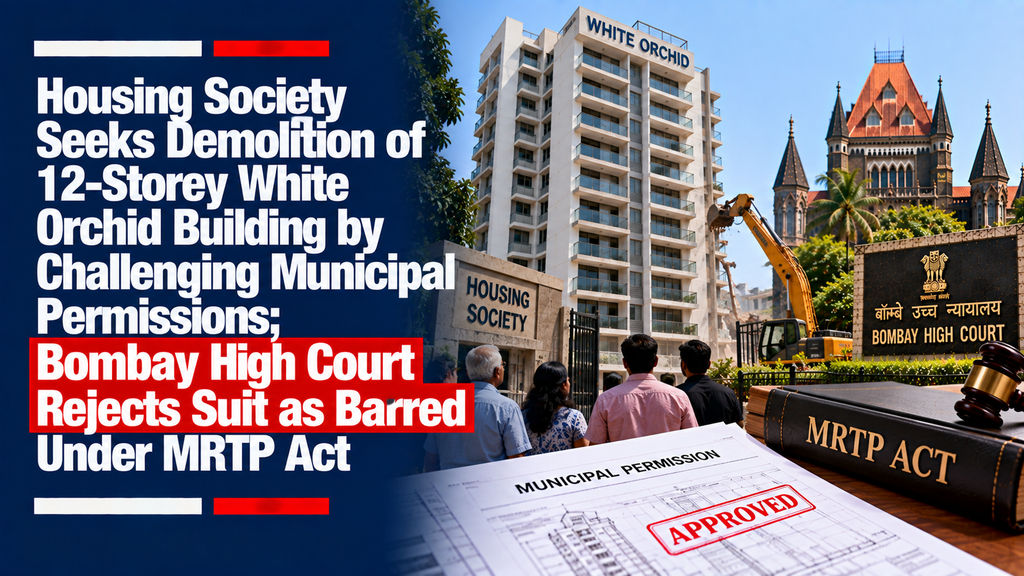
Housing Society Seeks Demolition of 12-Storey White Orchid Building by Challenging Municipal Permissions; Bombay High Court Rejects Suit as Barred Under MRTP Act

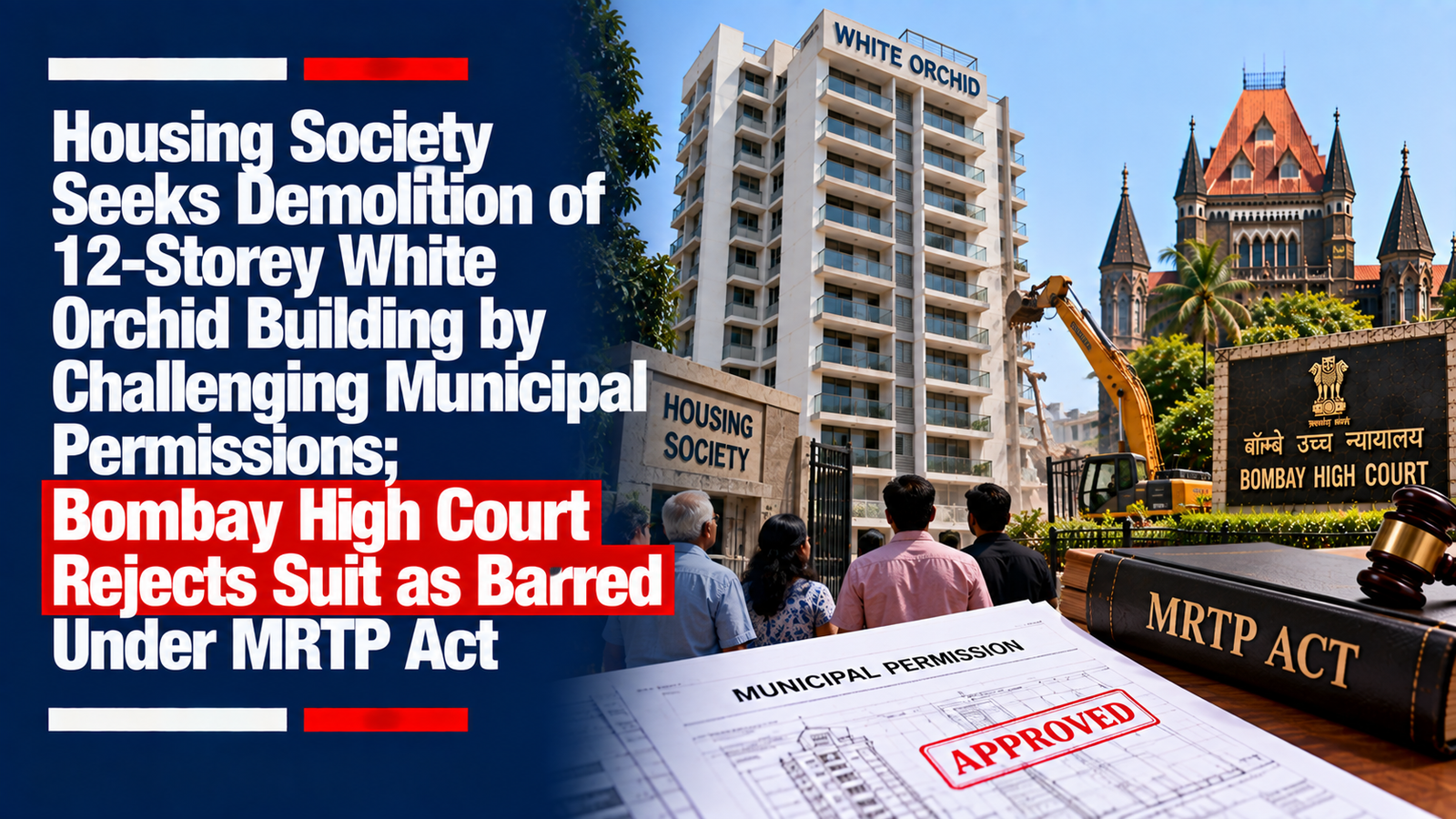
Mentioning Ownership Dispute Without Seeking Declaration of Title Cannot Bypass Section 149 MRTP Act: Bombay High Court
Facts
The dispute concerned a larger parcel of land measuring 2,676.86 sq. metres at Pali Road, Bandra West, Mumbai. Applicants Murzban Nusserwanji Khariwala and Manijeh Burjor Bandrawala had conveyed the property with 18,000 sq. ft. FSI to Kakad Investments under a conveyance dated 27 February 1979, while claiming entitlement to the balance FSI. On the same day, Kakad Investments granted them a 999-year lease over 1,005.03 sq. metres at a nominal rent of ₹1 per year.
Kakad Investments constructed Kakad Apartments, whose flat purchasers subsequently formed Kakad Co-operative Housing Society Ltd.
In 1996, the leasehold rights were assigned to M.R.P. Enterprises. Plans were then submitted for construction of a 12-storey building known as “White Orchid”, using the alleged balance FSI of the larger property. Construction was completed in 1998 and an Occupancy Certificate was issued on 27 August 1999. Flat purchasers thereafter formed White Orchid Co-operative Housing Society Ltd.
Kakad Society instituted L.C. Suit No. 2591 of 2000, challenging the sanctioned building plans and permissions for White Orchid and seeking, among other reliefs, declaration of the construction as illegal and its demolition.
The defendants sought rejection of the plaint under Order VII Rule 11 CPC, arguing that Section 149 of the Maharashtra Regional and Town Planning Act, 1966 expressly barred such a civil suit.
The City Civil Court rejected that application on 14 July 2009, leading to the present Civil Revision Application.
Issues
The principal issue was whether a civil suit substantially seeking to invalidate municipal development permissions and demolish construction carried out pursuant to them is maintainable despite the jurisdictional bar under Section 149 of the MRTP Act.
The Court also considered whether:
- allegations regarding ownership and FSI converted the proceedings into a genuine title suit;
- consequential relief of demolition could survive if the principal challenge to development permissions was barred;
- an Order VII Rule 11 application could be entertained after issues had already been framed; and
- a pending application to amend the plaint could prevent rejection of the existing plaint.
Applicants’ Arguments
The applicants argued that the substance of Kakad Society’s suit was a direct challenge to the sanctions, permissions and building plans granted by the Municipal Corporation for White Orchid.
Section 149 gives finality to orders and directions issued by planning authorities under the MRTP Act and expressly prevents them from being questioned through a civil suit.
They further argued that although the plaint narrated an alleged dispute regarding ownership and FSI, it sought no declaration of title or possession. Mere narration of a title dispute could not transform the true character of the suit.
They also contended that an Order VII Rule 11 application could be filed at any stage and that the Trial Court wrongly treated its filing after framing of issues as belated.
Respondent Society’s Arguments
Kakad Society contended that the applicants had unlawfully consumed FSI belonging to the Society while constructing White Orchid.
According to it, the challenge to development permissions was fundamentally intended to protect the Society’s proprietary rights in the land and FSI. It therefore argued that the dispute involved questions of title appropriately adjudicated by a civil court.
The Society also pointed to a pending amendment application seeking additional pleadings and relief concerning TDR and argued that rejecting the existing plaint would prejudice its proprietary claims.
Analysis of the Law
Section 149 of the MRTP Act gives finality to orders, directions and notices issued by the competent authorities under the Act and provides that they shall not be questioned in any suit or other legal proceedings.
The High Court examined the actual prayers rather than merely the narrative contained in the plaint.
Those prayers sought:
- declaration that the sanctioned building plans were illegal;
- cancellation of the sanctioned plans;
- declaration that White Orchid was illegal;
- demolition of the 12-storey building;
- cancellation of the IOD, commencement certificate and other permissions;
- cancellation of ULC permission;
- demolition of a paved platform; and
- disconnection of the building’s water connection.
The Court therefore found that the essence of the suit was a challenge to development permissions. The demolition, platform and water-connection prayers were merely consequential to that principal challenge.
Precedent Analysis
The Court relied significantly on Arihant Construction v. Subhash Kesharmal Barlota, where a similar suit challenging development permission was held barred because the plaintiff had not actually sought a declaration of title or recovery of possession.
The High Court held that Arihant Construction squarely applied because Kakad Society likewise referred to its alleged title in the plaint but did not seek any declaration of ownership or possession.
It also relied on Sujala Yashwant Nitsure, which held that grant of development permission constitutes an order under the MRTP Act and a civil suit challenging such permission attracts Section 149.
The Court further considered Roha Municipal Council, Juhi Infra Build LLP, and Nashik Municipal Corporation, reiterating that courts must make a meaningful reading of the plaint rather than permit clever drafting to circumvent statutory bars.
Court’s Reasoning
The Court described Kakad Society’s case as a “plain vanilla challenge to the development permissions issued under the MRTP Act.”
Although the plaint contained a history of the Society’s alleged ownership, there was no prayer seeking declaration of ownership or recovery of possession.
The Court held that:
Mere averments about title do not transform a suit into a title suit when no substantive relief concerning title is actually sought.
Accordingly, the principal challenge to the building permissions was barred by Section 149. The consequential prayers seeking demolition of White Orchid, demolition of the platform and disconnection of water supply could not independently survive once the principal relief itself was outside the Civil Court’s jurisdiction.
Order VII Rule 11 Can Be Invoked Even After Issues Are Framed
The High Court also rejected the Trial Court’s reasoning that the application for rejection of plaint was belated.
It held that an application under Order VII Rule 11 CPC can be considered at any stage before conclusion of the trial, and mere framing of issues does not prevent the Court from rejecting a plaint that is barred by law.
It further held that subject-matter jurisdiction cannot be conferred by waiver. Failure of a defendant to raise the jurisdictional objection in its written statement does not confer jurisdiction upon a court where the statute expressly excludes it.
Pending Amendment Cannot Rescue Existing Plaint
Kakad Society had also sought amendment of its plaint to claim rights concerning TDR and challenge subsequent permissions.
The High Court held that a pending amendment application cannot postpone adjudication of an Order VII Rule 11 application. The Court must examine the plaint as it presently exists. A possibility that it might subsequently be amended cannot preserve a plaint that is presently barred by law.
ULC Challenge
The Court separately observed that the challenge to the ULC permission had already abated because the Urban Land (Ceiling and Regulation) Act had been repealed, with the Repeal Act adopted in Maharashtra on 29 November 2007.
Conclusion
The Bombay High Court held that the City Civil Court had erred in refusing to reject the plaint.
The Society’s suit, in its existing form, did not seek adjudication or declaration of its ownership rights. Its substantive object was to invalidate municipal development permissions granted for White Orchid and obtain consequential demolition and related reliefs. That challenge was barred by Section 149 of the MRTP Act.
The High Court therefore:
- set aside the City Civil Court’s order dated 14 July 2009;
- allowed the defendants’ application under Order VII Rule 11;
- rejected the plaint in L.C. Suit No. 2591 of 2000;
- consequently dismissed the suit; and
- allowed the Civil Revision Application with no order as to costs.
Case: Murzban Nusserwanji Khariwala & Ors. v. Kakad Co-operative Housing Society Ltd. & Ors.
Court: Bombay High Court, Civil Appellate Jurisdiction
Case No.: Civil Revision Application No. 472 of 2009
Citation: 2026:BHC-AS:38815
Judge: Justice Sandeep V. Marne
Reserved: 8 September 2026
Pronounced: 22 September 2026
Result: Revision allowed; plaint rejected under Order VII Rule 11; L.C. Suit No. 2591 of 2000 dismissed.