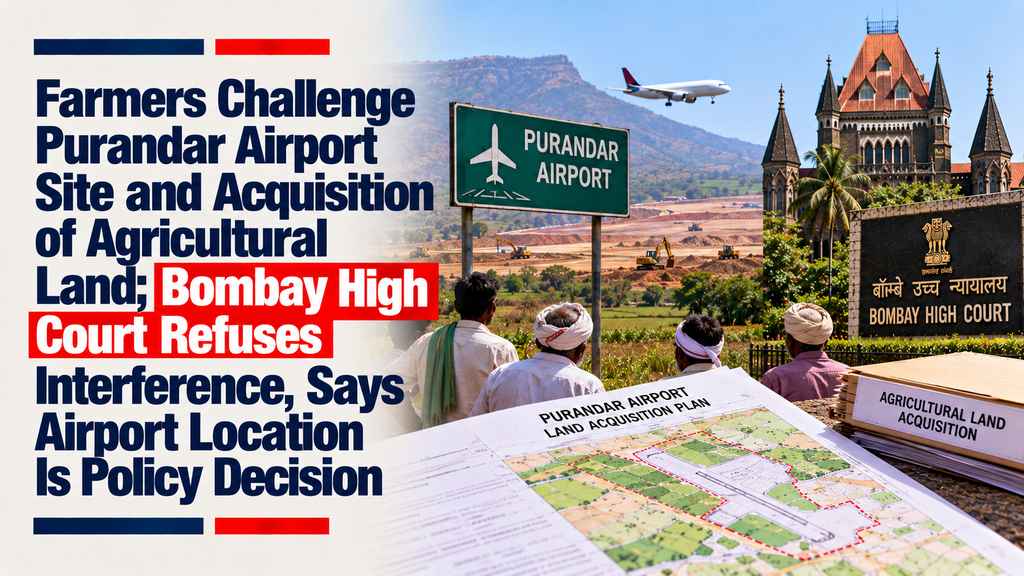
Farmers Challenge Purandar Airport Site and Acquisition of Agricultural Land; Bombay High Court Refuses Interference, Says Airport Location Is Policy Decision

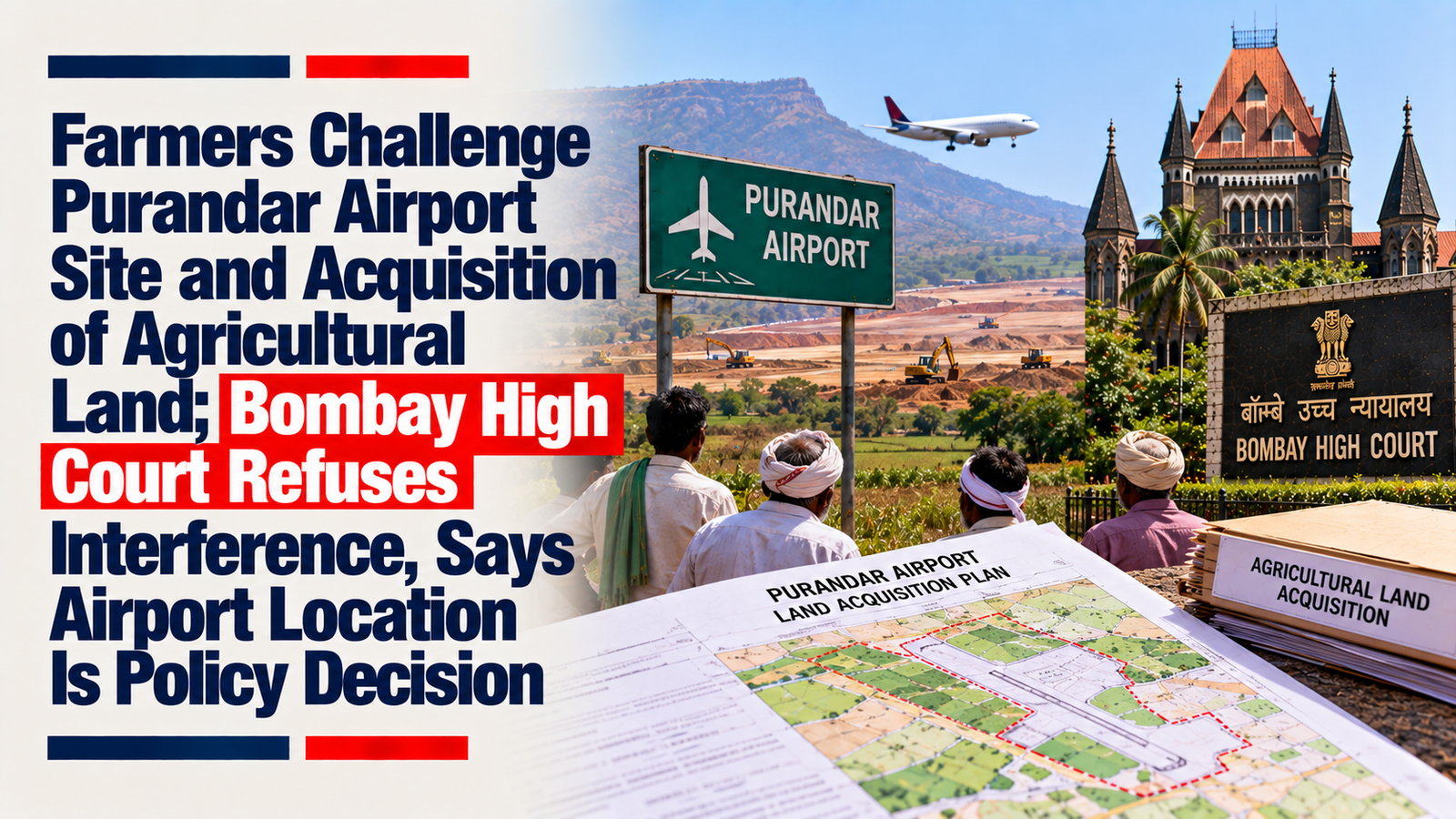
Agricultural Landowners Challenge Purandar Airport on Safety and Technical Grounds; Bombay High Court Says Experts, Not Courts, Must Decide Site Suitability
Facts
Three agriculturists from Purandar Taluka, Pune approached the Bombay High Court challenging the authorities’ decision to locate the proposed Greenfield Airport at “Site 1A” and seeking to halt acquisition of their agricultural lands. The petitioners owned land in villages forming part of the proposed airport area.
The proposal for a Greenfield International Airport at Pune had been under consideration since 2005. In 2016, the Airports Authority of India examined six sites in the Saswad–Jejuri area and recommended Site 1A at Munjewadi/Pargaon Memane, subject to Ministry of Defence clearance. AAI approved Site 1A in September 2016, the Ministry of Defence granted its NOC in January 2018, and the Ministry of Civil Aviation granted site clearance in May 2018. Maharashtra then approved acquisition of approximately 2,367 hectares.
During 2020–21, however, an alternative “Site 5A” was explored. MADC’s February 2021 proposal referred to technical advantages of Site 5A over Site 1A, and the Ministry of Defence initially granted an NOC for Site 5A. That NOC was subsequently cancelled.
Approval for Site 1A was restored on 6 May 2024. Thereafter, acquisition proceeded under the Maharashtra Industrial Development Act, 1961. Ultimately, a final notification under Section 32(1) dated 9 February 2026 covered approximately 1,216.7522 hectares.
Issues
The principal questions were whether:
- the Government’s decision to revert from Site 5A to Site 1A was arbitrary or irrational;
- the High Court could undertake a comparative assessment of the technical suitability of the two airport sites;
- acquisition of the petitioners’ agricultural lands warranted interference under Article 226; and
- the availability of an allegedly less disruptive alternative site could invalidate the Government’s site-selection decision.
Petitioners’ Arguments
The petitioners contended that Site 1A suffered from technical and operational limitations, including height restrictions, flight-operation concerns and safety issues. They argued that Site 5A was technically superior and involved comparatively barren land, whereas Site 1A involved irrigated, multi-crop agricultural land on which farmers depended for their livelihood.
They argued that the 2021 proposal itself demonstrated advantages of Site 5A, including lower acquisition and development costs, absence of conflict with Indian Air Force/National Defence Academy flying operations, greater expansion possibilities and reduced resettlement requirements. According to them, reverting to Site 1A without a cogent explanation was arbitrary.
They also invoked Article 300A, arguing that compulsory deprivation of property must be supported by law and genuine public purpose and remains subject to judicial review.
Respondents’ Arguments
The Union, State authorities, MADC and MIDC maintained that selection of an airport location involves specialised questions of aviation safety, technical feasibility, alignment, operational requirements and public infrastructure planning.
The Union argued that the petitioners could not substitute their assessment for that of expert authorities and that Article 226 was not intended to reopen technical conclusions unless arbitrariness, mala fides or illegality was demonstrated.
MADC emphasised that Site 5A was only explored as an alternative and was never finally selected. Its clearance was withdrawn, whereas Site 1A was subsequently reaffirmed by the Ministry of Civil Aviation.
The State further submitted that acquisition had substantially progressed and that reopening it would disrupt consent arrangements, administrative processes and the implementation of a major public infrastructure project.
Analysis of the Law
The High Court accepted that the petitioners were landowners directly affected by acquisition. However, it found no sufficient pleading establishing a statutory violation in the acquisition proceedings. The essential challenge was instead to the choice of Site 1A because the petitioners considered Site 5A a better alternative.
The Court found that although Site 5A had been explored, there was nothing on record showing that Site 5A had ever been finally selected. Its NOC was subsequently cancelled and Site 1A was restored while the authorities were still evaluating alternative locations.
The Court held that selection of the location of a major public infrastructure project depends upon numerous technical considerations and falls principally within the policy and technical domain of the executive.
Judicial intervention would become appropriate where cogent material demonstrates bad faith, colourable exercise of power, violation of mandatory statutory provisions or non-compliance with environmental norms. None was established here.
Precedent Analysis
The Court relied significantly on the Supreme Court’s 2026 decision in Alok Kotahwala v. Jaipur Metro Rail Corporation Ltd., which held that selection of a particular parcel of land for a public infrastructure project falls within the domain of expert planning authorities.
The Supreme Court had specifically rejected the proposition that a landowner could obtain judicial interference merely by showing that another parcel of land appeared feasible or preferable.
The High Court also relied upon BALCO Employees’ Union v. Union of India and Narmada Bachao Andolan v. Union of India for the principle that courts do not determine whether a public policy is wiser, fairer, more scientific or more logical than an alternative policy. Judicial review examines legality, not the comparative wisdom of competing policy choices.
Court’s Reasoning
The Court held that whether Site 1A or Site 5A was technically superior was a matter for the competent authorities. Article 226 did not permit the High Court to undertake its own comparative technical evaluation of airport locations.
The petitioners’ safety and feasibility concerns had been examined by specialised agencies. The material did not establish that the Ministry of Defence or other authorities had acted in bad faith or ignored safety considerations, nor did it demonstrate manifest arbitrariness, mala fides or statutory violation.
The Court described airport siting as “purely a matter of policy decision” and held that the State was best placed to determine the suitability and extent of land required for the project. Landowners could not dictate another location merely because they sought to protect their own land.
On the acquisition itself, the Court noted that statutory notifications had been issued, objections invited and considered, and the Section 32(1) notification had already been issued. The acquisition was either complete or at a very advanced stage. It therefore found no basis to interfere on the grounds raised in the petition.
Importantly, however, the Court did not foreclose individual landowners’ statutory objections concerning compliance, compensation or disbursement. Those questions were expressly left open for affected owners to pursue through appropriate statutory remedies.
Conclusion
The Bombay High Court dismissed the writ petition, holding that the choice between Site 1A and Site 5A for the Purandar Greenfield Airport was a policy and technical decision that could not be reconsidered by the Court merely because affected landowners believed another site was preferable.
The Court found no established mala fides, manifest arbitrariness or statutory illegality warranting interference. It also declined to disturb land acquisition proceedings that had reached an advanced stage.
However, individual landowners remained free to pursue available statutory remedies regarding statutory compliance, quantum of compensation and disbursement.
Case: Pandit Shivaji Kumbharkar & Ors. v. State of Maharashtra & Ors.
Court: Bombay High Court, Civil Appellate Jurisdiction
Case No.: Writ Petition No. 14127 of 2025
Citation: 2026:BHC-AS:38753-DB
Coram: Justice Suman Shyam and Justice Advait M. Sethna
Reserved: 1 September 2026
Pronounced: 22 September 2026
Result: Writ Petition dismissed; no order as to costs. Landowners’ individual statutory remedies concerning compensation, disbursement and acquisition compliance expressly left open.