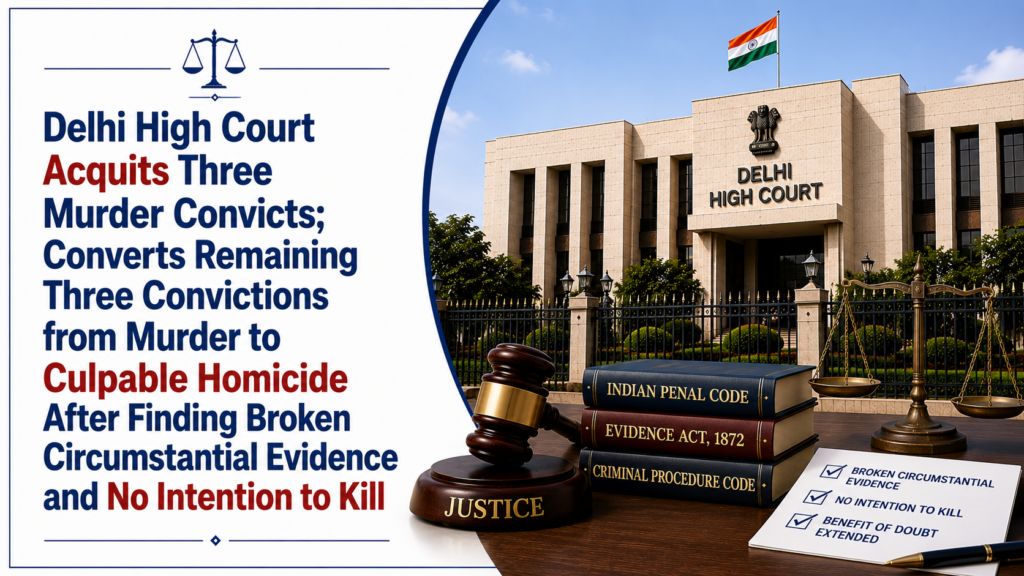
Delhi High Court Acquits Three Murder Convicts; Converts Remaining Three Convictions from Murder to Culpable Homicide After Finding Broken Circumstantial Evidence and No Intention to Kill

Delhi High Court Holds Defective TIP and Unreliable Identification Entitle Three Murder Accused to Acquittal; Alters Conviction of Remaining Three
Facts
The prosecution alleged that on the night of 19–20 September 1997, six accused persons entered the house of Nar Singh at Nangloi, Delhi. Two of them had taken a room on rent in the deceased’s house on the very day of the incident. During the night, the intruders allegedly overpowered the deceased’s wives, tied Nar Singh with ropes, gagged his mouth with a cloth and caused his death by suffocation. After trial, all six accused were convicted under Section 302 read with Section 34 IPC, while two of them were additionally convicted under the Arms Act. The accused challenged their convictions before the Delhi High Court.
Issues
- Whether the prosecution established an unbroken chain of circumstantial evidence against all six accused.
- Whether the identification of three accused through dock identification without a valid Test Identification Parade (TIP) could sustain conviction.
- Whether the prosecution proved the offence of murder under Section 302 IPC or only culpable homicide not amounting to murder.
- Whether the Arms Act convictions were sustainable.
Appellants’ Arguments
The appellants argued that the prosecution case rested entirely on circumstantial evidence, but failed to establish a complete chain pointing exclusively towards their guilt. They contended that:
- the key eyewitnesses made material improvements and contradictions;
- three accused were strangers to the witnesses and were shown to them before the TIP, rendering the identification proceedings meaningless;
- recoveries of the knife and other articles were unreliable and not connected with the offence;
- no motive or common intention had been proved;
- the disclosure statements of co-accused were inadmissible; and
- the prosecution failed to prove their presence and participation beyond reasonable doubt.
Respondent’s Arguments
The State argued that the testimonies of the deceased’s wives and another tenant consistently established that the accused had entered the premises immediately before the murder and fled after the incident. It contended that:
- the FIR was promptly registered;
- medical and forensic evidence corroborated the prosecution case;
- refusal to participate in the TIP justified an adverse inference;
- the recoveries, subsequent conduct and surrounding circumstances completed the chain of evidence; and
- all accused acted with common intention in committing the offence.
Analysis of the Law
The High Court reiterated that in a case based purely on circumstantial evidence, every incriminating circumstance must be proved beyond reasonable doubt and all circumstances must form a complete chain inconsistent with innocence.
The Court further examined the principles governing Test Identification Parade (TIP). It held that where an accused is previously unknown to the witnesses, a properly conducted TIP assumes considerable importance. If the accused has already been shown to the witnesses before the TIP, the evidentiary value of the identification proceedings is substantially destroyed and mere dock identification becomes unsafe.
The Court also considered the distinction between murder under Section 302 IPC and culpable homicide under Section 304 Part II IPC, observing that where the evidence establishes knowledge that death was likely but fails to prove intention to cause death, conviction under Section 304 Part II alone would be justified.
Precedent Analysis
The Court relied upon:
- Nazim & Ors. v. State of Uttarakhand (2025 SCC OnLine SC 2117), holding that dock identification of strangers without a valid TIP must be approached with great caution.
- Raj Kumar @ Bheema v. State (NCT of Delhi) (2025 SCC OnLine SC 2465), holding that where witnesses had seen the accused before the TIP, the identification proceedings lose their evidentiary value.
- Rajesh Govind Jagesha v. State of Maharashtra (1999) 8 SCC 428, regarding circumstances where TIP may not be necessary.
- V.K. Mishra v. State of Uttarakhand and Alauddin v. State of Assam, explaining the limited use of statements recorded under Section 161 CrPC and the manner in which contradictions must be proved.
Court’s Reasoning
The Court separately evaluated the cases of the six appellants.
With respect to Firoz @ Sagar, Shehzad and Sanjay Kumar, the Court found that they were complete strangers to the eyewitnesses. Their names did not appear in the earliest version of the prosecution case, they were shown to the witnesses before the scheduled TIP, and consequently the TIP became meaningless. The recoveries and disclosure statements did not independently connect them with the crime. Accordingly, the prosecution failed to prove their guilt beyond reasonable doubt, entitling them to acquittal.
However, the evidence against Rajesh Kumar, Nasim and Rahish Khan stood on a different footing. Rajesh and Nasim had taken the room on rent on the very day of the incident and were identified by witnesses who had interacted with them earlier. Rahish Khan was already known to the family as a former tenant and was identified by another tenant while fleeing from the scene. Their presence immediately before and after the occurrence was satisfactorily established.
Nevertheless, the Court found that although the accused tied the deceased and gagged his mouth, there was no evidence that they intended to cause his death. The post-mortem revealed death due to suffocation caused by the gagging rather than by intentional fatal injuries. Therefore, while the accused had knowledge that their acts were likely to cause death, the prosecution failed to establish the intention necessary for murder under Section 302 IPC. Consequently, their conviction was altered to one under Section 304 Part II read with Section 34 IPC. The conviction of Rahish Khan under Section 25 of the Arms Act was maintained.
Conclusion
The Delhi High Court partly allowed the connected appeals. It acquitted Firoz @ Sagar, Shehzad and Sanjay Kumar after holding that the prosecution failed to establish their identity and involvement through reliable evidence. As regards Rajesh Kumar, Nasim @ Sagar and Rahish Khan, the Court held that the prosecution proved their participation but failed to establish the intention necessary for murder. Their convictions under Section 302/34 IPC were therefore modified to Section 304 Part II read with Section 34 IPC, while Rahish Khan’s conviction under Section 25 of the Arms Act was affirmed. The matter was directed to be listed separately for hearing on the quantum of sentence.
Case Details
Case: Firoz @ Sagar v. State (NCT of Delhi) & Connected Appeals
Court: High Court of Delhi
Case Numbers: CRL.A. 609/2002, CRL.A. 662/2002, CRL.A. 814/2002, CRL.A. 949/2002, CRL.A. 127/2003 and CRL.A. 451/2004
Judges: Hon’ble Mr. Justice Navin Chawla and Hon’ble Mr. Justice Ravinder Dudeja
Date: 05 August 2026
Result: Appeals partly allowed. Convictions of Firoz @ Sagar, Shehzad and Sanjay Kumar set aside. Convictions of Rajesh Kumar, Nasim @ Sagar and Rahish Khan under Section 302/34 IPC modified to Section 304 Part II read with Section 34 IPC. Conviction of Rahish Khan under Section 25 of the Arms Act maintained. Matter listed separately for hearing on sentence.