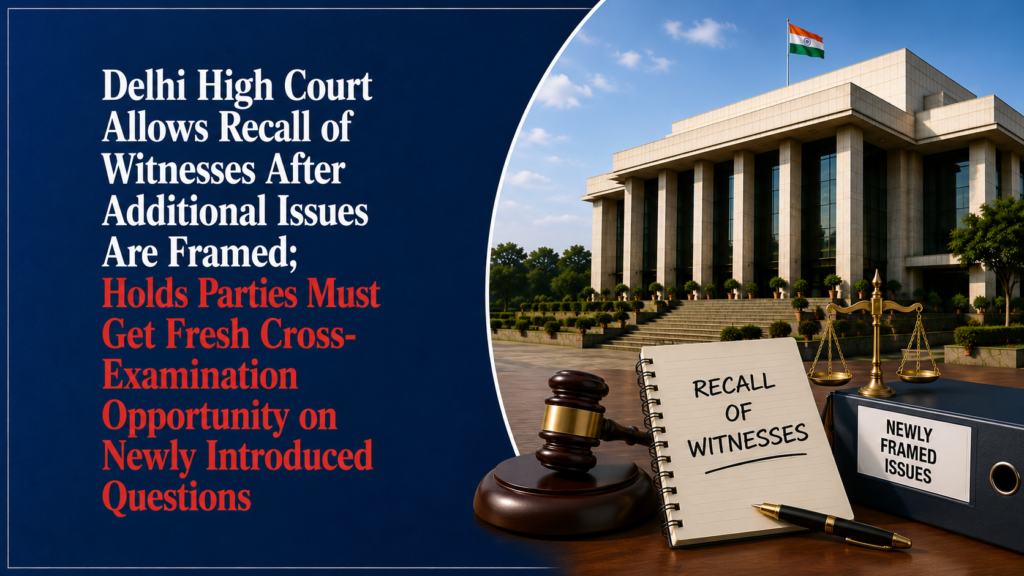
Delhi High Court Allows Recall of Witnesses After Additional Issues Are Framed; Holds Parties Must Get Fresh Cross-Examination Opportunity on Newly Introduced Questions

Additional Issues Mean Fresh Cross-Examination: Delhi High Court Sets Aside Trial Court’s Refusal to Recall Witnesses
Facts
The dispute arose from a civil suit concerning ownership and possession of Shop No. 45-A, Ground Floor, Khan Market, New Delhi. During the pendency of the suit, the plaintiff amended the plaint under Order VI Rule 17 CPC to clarify that damages/mesne profits were claimed at ₹2 lakh per month. Pursuant to the amendment, the Trial Court framed three additional issues relating to mesne profits, limitation, and court fees.
The defendants thereafter sought permission to further cross-examine the plaintiff’s witnesses on the newly framed issues. While the Trial Court had earlier permitted limited cross-examination following the amendment, it later rejected the defendants’ applications seeking recall of witnesses under Order XVIII Rule 17 CPC. Aggrieved, the defendants invoked the supervisory jurisdiction of the Delhi High Court under Article 227 of the Constitution.
Issues
- Whether framing of additional issues after amendment of the plaint entitles the opposite party to further cross-examine witnesses.
- Whether the Trial Court was justified in refusing recall of witnesses under Order XVIII Rule 17 CPC.
- Whether permitting limited cross-examination on additional issues amounts to reopening the entire trial.
Petitioners’ Arguments
The petitioners contended that:
- The amendment introduced fresh questions requiring adjudication.
- The additional issues could not be effectively decided without permitting cross-examination confined to those issues.
- They sought only a limited opportunity and not a fresh trial.
- Denial of such opportunity violated principles of natural justice and rendered the additional issues meaningless.
Respondent’s Arguments
The respondent argued that:
- The petition was merely an attempt to delay disposal of the suit.
- The plaintiff had already been recalled after the amendment and extensively cross-examined.
- The amendment only corrected a clerical omission by adding the words “per month.”
- The additional issues were merely consequential and did not justify another round of cross-examination.
Analysis of the Law
The Court held that once the Trial Court itself frames additional issues, it acknowledges that fresh questions requiring adjudication have arisen.
Cross-examination is a fundamental component of a fair trial. When new issues arise after witnesses have already been examined, the opposite party must ordinarily be given an opportunity to confront those witnesses on matters that were previously not in issue.
However, such recall must remain strictly confined to the newly framed issues and should not become a means to reopen the entire evidence or prolong the trial.
Precedent Analysis
The judgment principally interprets procedural provisions under:
- Order VI Rule 17 CPC (Amendment of Pleadings)
- Order XIV Rule 5 CPC (Framing Additional Issues)
- Order XVIII Rule 17 CPC (Recall of Witnesses)
- Article 227 of the Constitution of India
The Court did not rely upon any reported Supreme Court or High Court precedent, deciding the issue on settled procedural principles governing fair trial and cross-examination.
Court’s Reasoning
The Court observed that:
- The Trial Court itself had framed additional issues after allowing amendment of the plaint.
- Those issues were distinct from the original issues and necessarily required evidence directed towards them.
- Earlier cross-examination could not have addressed questions that did not exist at that stage.
- The Trial Court wrongly assumed that the earlier opportunity granted after amendment automatically covered the subsequently framed additional issues.
- Allowing limited recall would not reopen the entire trial because the defendants sought only a restricted cross-examination confined to the newly framed issues.
Accordingly, while refusing to interfere with the earlier order dated 29 October 2025, the High Court found that the subsequent order dated 20 February 2026 rejecting recall under Order XVIII Rule 17 CPC was legally unsustainable.
Conclusion
The Delhi High Court partly allowed the petition.
The Court set aside the Trial Court’s order dated 20 February 2026, permitted limited recall of the respondent’s witnesses strictly for cross-examination on the additional issues framed on 7 May 2025, and directed the Trial Court to complete the exercise expeditiously within one month. It clarified that the petitioners would not be permitted to reopen matters already covered during earlier cross-examination.
Case Details
Case: Rajinder Lal Arora & Ors. v. Monu Dhingra
Court: Delhi High Court
Case Number: CM(M) 925/2026
Judge: Hon’ble Mr. Justice Ajay Digpaul
Date: 30 July 2026
Result: Petition partly allowed. Order refusing recall of witnesses under Order XVIII Rule 17 CPC set aside. Petitioners granted one effective opportunity to further cross-examine witnesses strictly on the additional issues framed by the Trial Court.