Delhi High Court: Commercial Court must return plaint, not dismiss suit, if dispute is non-commercial

HEADNOTE
Pramod Kumar v. M/s Gannon Dunkerley and Co. Ltd.
Court: High Court of Delhi
Bench: Hon’ble Mr. Justice Anil Kshetarpal and Hon’ble Mr. Justice Amit Mahajan
Date of Judgment: January 20, 2026
Case Number: RFA (COMM) 348/2024
Laws Involved:
Section 13, Commercial Courts Act, 2015; Section 2(1)(c), Commercial Courts Act, 2015; Order VII Rule 10 & 10A, Code of Civil Procedure, 1908
Keywords: Commercial dispute, return of plaint, Order VII Rule 10 CPC, service recovery suit, Commercial Courts Act
Summary
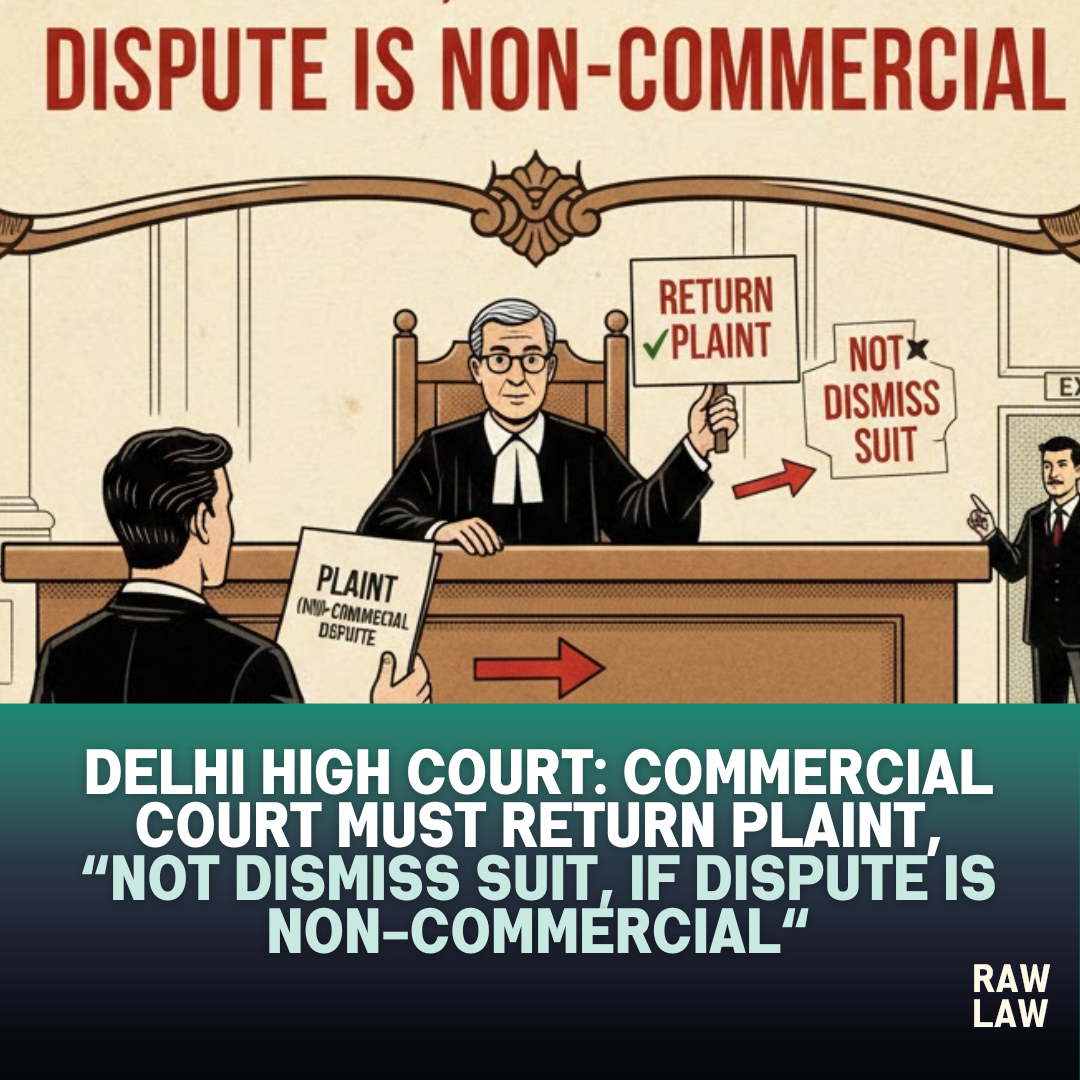
The Delhi High Court held that where a Commercial Court finds that a dispute does not qualify as a “commercial dispute” under Section 2(1)(c) of the Commercial Courts Act, 2015, it cannot dismiss the suit but is mandatorily required to return the plaint under Order VII Rule 10 CPC. Allowing the appeal filed by a former senior employee seeking recovery of terminal benefits, the Court ruled that dismissal of the suit amounted to a jurisdictional error, as lack of subject-matter jurisdiction is a procedural defect and not an adjudication on merits. The Court emphasised that litigants cannot be rendered remediless merely for approaching the wrong forum. Accordingly, the impugned judgment was set aside and directions were issued for return of the plaint for presentation before the competent non-commercial court, with liberty to utilise already recorded evidence.
Court’s decision
The Delhi High Court allowed the appeal and set aside the judgment of the Commercial Court which had dismissed the appellant’s recovery suit. The Division Bench held that once the Commercial Court concluded that the dispute did not fall within the definition of a “commercial dispute” under the Commercial Courts Act, it lacked jurisdiction to adjudicate the matter on merits. In such circumstances, the Court was duty-bound to return the plaint under Order VII Rule 10 CPC for presentation before the appropriate forum, rather than dismissing the suit outright.
Facts
The appellant was employed with the respondent company in 1992 and served for over 27 years, eventually holding the post of Deputy General Manager (Civil). In February 2020, while on sanctioned leave for his son’s wedding, the appellant’s services were terminated by the respondent company. Following termination, the appellant claimed unpaid terminal dues including notice pay, leave encashment, travel expenses, and refund of a laptop security deposit, totalling ₹4,10,184. As the dues were not settled despite legal notices, the appellant filed a recovery suit before the Commercial Court.
Issues
The primary issue before the High Court was whether a Commercial Court, after holding that a dispute is non-commercial in nature, can dismiss the suit or is mandatorily required to return the plaint under Order VII Rule 10 CPC. The Court was not called upon to adjudicate the merits of the termination or the appellant’s monetary claims.
Appellant’s arguments
The appellant contended that the Commercial Court committed a grave jurisdictional error by dismissing the suit instead of returning the plaint. It was argued that dismissal amounts to a final adjudication, whereas approaching a wrong forum is only a procedural defect. The appellant submitted that the Commercial Court’s approach effectively deprived him of his right to seek adjudication of legitimate terminal benefits and resulted in a miscarriage of justice.
Respondent’s arguments
The respondent defended the impugned judgment, arguing that the appellant had deliberately approached a specialised Commercial Court despite the dispute being purely service-related. It was contended that dismissal was a natural consequence of filing a non-maintainable suit before a court lacking jurisdiction. The respondent further asserted that the appellant’s termination was lawful and that no dues remained payable.
Analysis of the law
The Court examined Section 2(1)(c) of the Commercial Courts Act and reaffirmed that a simple service-related recovery dispute between an employee and a private employer does not constitute a “commercial dispute”. However, the Court clarified that the procedural consequence of such a finding is governed by Order VII Rule 10 CPC, which mandates return of the plaint at any stage when the court lacks jurisdiction. Treating a jurisdictional defect as a substantive failure, the Court held, is legally impermissible.
Precedent analysis
The Bench relied on the Bombay High Court’s decision in AJ Organica Pvt. Ltd. v. State of Maharashtra, which held that lack of jurisdiction necessarily entails return of the plaint. Strong reliance was also placed on the Supreme Court’s ruling in Ambalal Sarabhai Enterprises Ltd. v. K.S. Infraspace LLP, which clarified that Commercial Courts must return plaints when disputes do not qualify as commercial disputes. The Court distinguished dismissal from return of plaint, emphasising their fundamentally different legal consequences.
Court’s reasoning
The High Court reasoned that dismissal of a suit is reserved for situations involving adjudication on merits or absolute legal bars such as limitation or res judicata. In contrast, filing before an incorrect forum only triggers a procedural correction. The Commercial Court, by dismissing the suit, wrongly foreclosed the appellant’s substantive claims. The Court further adopted a pragmatic approach by permitting the competent court to utilise evidence already recorded, subject to consent of parties.
Conclusion
The Court concluded that the Commercial Court erred in dismissing the appellant’s suit after holding it to be non-commercial. The impugned judgment was set aside, and directions were issued for return of the plaint under Order VII Rule 10A CPC for presentation before the appropriate court of competent jurisdiction.
Implications
This judgment reinforces a crucial procedural safeguard under civil law: litigants cannot be penalised for approaching the wrong forum. The ruling has significant implications for service-related recovery disputes mistakenly filed before Commercial Courts and serves as a clear reminder that jurisdictional errors must be cured procedurally, not punitively. It strengthens access to justice by ensuring that substantive rights are not defeated by technicalities.
Case law references
- AJ Organica Pvt. Ltd. v. State of Maharashtra – Held that courts lacking jurisdiction must return the plaint under Order VII Rule 10 CPC. Applied.
- Ambalal Sarabhai Enterprises Ltd. v. K.S. Infraspace LLP – Clarified procedure when dispute is non-commercial. Relied upon.
- EXL Careers v. Franklin Aviation Services – Held that return of plaint ordinarily results in de novo trial. Applied pragmatically.
FAQs
1. What should a Commercial Court do if a dispute is non-commercial?
It must return the plaint under Order VII Rule 10 CPC, not dismiss the suit.
2. Does dismissal differ from return of plaint?
Yes. Dismissal is a final adjudication, whereas return of plaint is a procedural correction.
3. Why is this judgment important?
It prevents denial of justice due to filing before an incorrect forum and clarifies procedural law under the Commercial Courts Act.
Also Read: Delhi High Court refuses to quash FIR alleging outraging of woman’s modesty under BNS