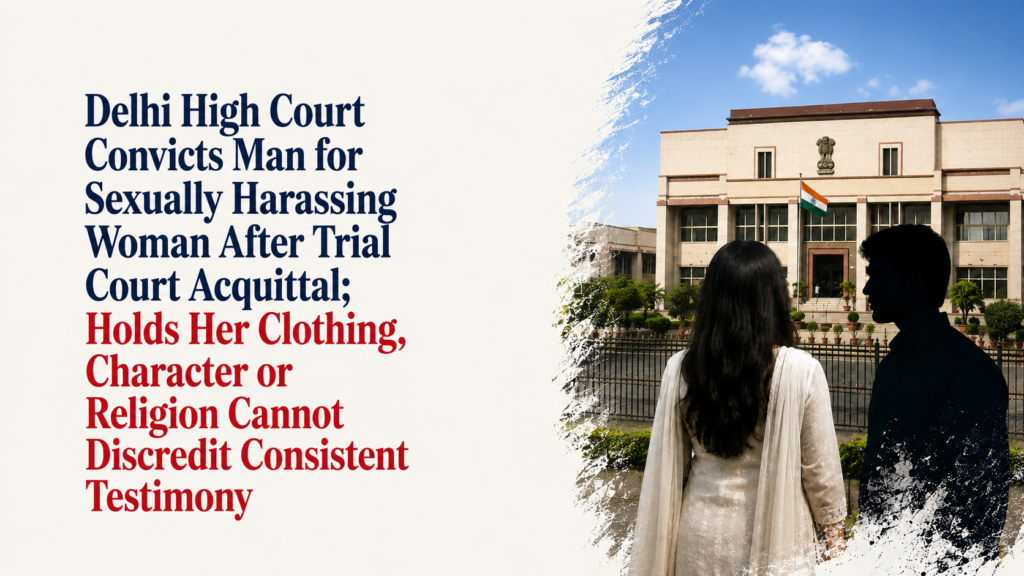
Delhi High Court Convicts Man for Sexually Harassing Woman After Trial Court Acquittal; Holds Her Clothing, Character or Religion Cannot Discredit Consistent Testimony

Delhi High Court Reverses Acquittal in Sexual Harassment Case; Convicts Accused Under Section 354A IPC, Rejects Attempts to Shame Victim Over Clothing
Facts
The case arose from an incident dated 17 July 2013 in Lal Kuan, Delhi. The prosecutrix alleged that Sajid Ali, who lived in her neighbourhood, had been repeatedly stalking her, making remarks towards her and subjecting her to unwanted physical contact. On the date of the incident, she alleged that he touched her cheek and, when she objected, made an intimidating remark. In her statement under Section 164 Cr.P.C., she further alleged that he had previously touched her cheeks and hips while following her.
An FIR was registered at Hauz Qazi Police Station. Although the chargesheet alleged offences under Sections 354A and 354D IPC and Section 12 of the POCSO Act, the Trial Court framed charges under Section 354A IPC and Section 10 of the POCSO Act. After trial, the accused was acquitted on 22 August 2014. The State challenged the acquittal before the Delhi High Court under Section 378(3) Cr.P.C.
The Trial Court had relied upon several perceived deficiencies, including discrepancies regarding the accused’s arrest time, where the complaint was written, the prosecutrix’s illness, failure to investigate complaints made by local residents against her, and non-examination of independent witnesses.
A significant issue also arose concerning the prosecutrix’s age. Her birth had been registered approximately 13 years after her alleged date of birth. The relevant birth register contained no corresponding entry, and the order of the SDM ordinarily required for delayed registration could not be produced. Consequently, the authenticity of the birth certificate could not be satisfactorily established.
Issues
The principal issue before the High Court was whether the Trial Court’s judgment of acquittal suffered from such error as to warrant appellate interference.
Within that broader question, the Court considered whether:
- the prosecution had proved that the prosecutrix was below 18 years so as to attract the POCSO Act;
- the inconsistencies and alleged defects in investigation justified rejecting the prosecution case;
- the prosecutrix’s evidence regarding unwanted physical contact and remarks established sexual harassment under Section 354A(1)(i) IPC;
- complaints by local residents concerning the prosecutrix’s clothes and conduct had any legal relevance;
- questions concerning a woman’s clothing, character and religion could legitimately be used in cross-examination to undermine her credibility; and
- the High Court could reverse the acquittal notwithstanding the reinforced presumption of innocence applicable in an appeal against acquittal.
Petitioner/Appellant State’s Arguments
The State contended that the prosecutrix had remained consistent on the essential allegations throughout her complaint, Section 164 Cr.P.C. statement and deposition before the Trial Court.
It argued that minor discrepancies in the prosecution evidence could not destroy the case where its central and material features remained intact. Accordingly, the State sought reversal of the acquittal and conviction of the accused.
Respondent/Accused’s Arguments
The accused supported the Trial Court’s judgment and argued that there was no infirmity warranting interference by the High Court.
A central defence contention was that the prosecution had failed to prove that the prosecutrix was below 18 years of age. The defence challenged the birth certificate because the concerned Sub-Registrar admitted that the corresponding birth entry could not be found in the relevant register.
The defence also relied upon complaints allegedly made by residents of the locality concerning the prosecutrix’s behaviour and clothing and sought to support the theory of false implication.
Analysis of the Law
Appeal Against Acquittal
The High Court reiterated that an appellate court has full power to review, reconsider and reappreciate the evidence in an appeal against acquittal. However, an acquitted accused enjoys a “double presumption” of innocence: the ordinary presumption of innocence and the additional reinforcement resulting from the Trial Court’s acquittal.
Therefore, where two reasonable views of the evidence are possible, the appellate court ordinarily should not disturb an acquittal. However, interference remains permissible where the Trial Court’s conclusions are erroneous, manifestly illegal or perverse.
Failure to Prove Minority Under POCSO
The Court held that minority is a foundational requirement for application of the POCSO Act.
The birth certificate relied upon by the prosecution was problematic because the birth had been registered about 13 years later, the corresponding entry was absent from the relevant birth register, and no SDM order supporting delayed registration could be produced.
The concerned official himself could not confirm whether the certificate was genuine or false. The Court therefore held that the prosecution had failed to satisfactorily establish the prosecutrix’s age or minority, and consequently the POCSO Act could not be invoked.
Defective Investigation Does Not Automatically Require Acquittal
The Court rejected the proposition that discrepancies concerning the time of arrest, place where the complaint was written and similar investigative lapses necessarily destroyed the prosecution case.
A defective or negligent investigation does not by itself justify acquittal. Courts must independently examine the substantive evidence and determine whether the investigative defects affect the root of the prosecution case or cause prejudice to the accused.
Woman’s Clothing and Character
A substantial part of the judgment concerns the defence’s attempt to rely upon the prosecutrix’s clothing and the objections of residents in the locality.
The High Court strongly rejected this approach. It held that a woman’s choice of attire neither diminishes her dignity nor justifies unlawful conduct towards her. Questions designed merely to embarrass, humiliate or morally judge a prosecutrix based upon her clothing are improper and should be stopped by the presiding judge.
The Court emphasised that cross-examination is not an unrestricted licence to insult or shame a witness.
It further held that neither religion, local custom nor community expectations can justify unlawful conduct or impose restrictions upon a woman’s personal choices. A woman’s choice of what to wear is her own, and neighbours, society, an accused or counsel have no right to dictate it.
Precedent Analysis
The Court relied upon Babu Sahebogouda Rudragoudar v. State of Karnataka, Rajesh Prasad v. State of Bihar and Chandrappa v. State of Karnataka for the governing principles concerning appeals against acquittal, particularly the reinforced presumption of innocence and the principle that an acquittal ordinarily should not be disturbed where two reasonable views are possible.
On defective investigation, the Court referred to C. Muniappan v. State of Tamil Nadu, Hema v. State, Dayal Singh v. State of Uttaranchal, Gajoo v. State of Uttarakhand, Dhanaj Singh v. State of Punjab and Paras Yadav v. State of Bihar. These authorities establish that investigative lapses cannot, standing alone, result in acquittal; the Court must evaluate whether the substantive prosecution evidence remains reliable despite those lapses.
On improper attacks upon the character of witnesses, the Court discussed State of U.P. v. Raghubir Singh, which recognised the court’s authority to prohibit scandalous questions directed merely at impeaching a witness where they are irrelevant to the actual facts in issue.
The Court also relied upon State of Maharashtra v. Madhukar Narayan Mardikar and Ranvir Singh v. State of M.P. for the proposition that even a woman characterised as being of “easy virtue” retains her right to privacy, bodily integrity and protection of law; such a character allegation cannot by itself justify discarding her evidence.
Court’s Reasoning
The High Court found that several grounds relied upon by the Trial Court were either immaterial or legally insufficient to undermine the prosecution’s core case.
The identity of the person who initially called the police was immaterial. The discrepancy concerning the exact time of arrest did not affect the essential allegations. Similarly, whether the prosecutrix had fever or typhoid and precisely where she wrote her complaint had no material bearing on whether sexual harassment occurred.
The absence of independent witnesses was also not automatically fatal, even though the incident allegedly occurred at a crowded location.
Most importantly, the High Court found that the prosecutrix had remained consistent across her FIR, Section 164 statement and testimony on the essential allegation that the accused subjected her to unwanted physical contact by touching her cheek despite her objection. Although her Section 164 statement additionally referred to touching of her hips, that variation did not undermine the central allegation.
The Court concluded that the accused’s act of touching her cheeks, coupled with the remarks made towards her, established physical contact and advances involving an unwelcome sexual overture and therefore satisfied Section 354A(1)(i) IPC.
The High Court consequently found the Trial Court’s conclusions erroneous and held that appellate interference was warranted.
At the same time, because minority had not been satisfactorily proved, the POCSO provisions could not be sustained.
The Court additionally issued a significant caution to Trial Courts: judges have an affirmative duty to protect witnesses from irrelevant, scandalous, insulting or humiliating questioning. Courts cannot remain passive spectators when cross-examination becomes a means of character assassination, particularly in cases involving children, sexual-offence victims and vulnerable witnesses.
Conclusion
The Delhi High Court set aside the acquittal insofar as the offence under Section 354A IPC was concerned and convicted Sajid Ali under Section 354A(1)(i) IPC.
However, the Court held that the prosecution had failed to satisfactorily prove the prosecutrix’s minority, and therefore the POCSO Act could not be invoked.
The judgment also laid down strong observations protecting the dignity of women during cross-examination, holding that clothing, lifestyle, character, religion or personal choices cannot ordinarily become tools for humiliation or victim-blaming. The Court directed that the judgment be circulated among Delhi’s judicial officers and sent to the Delhi Judicial Academy for appropriate training and sensitisation.
The accused was directed to appear before the High Court on 12 August 2026 for hearing on sentence under Section 235(2) Cr.P.C.
Case Details
Case: State (NCT of Delhi) v. Sajid Ali
Court: High Court of Delhi at New Delhi
Case Number: CRL.A. 1065/2016; CNR No. DLHC012885792016
Judge: Hon’ble Ms. Justice Chandrasekharan Sudha
Date: 10 August 2026
Result: State’s appeal allowed to the extent of Section 354A(1)(i) IPC; acquittal reversed and accused convicted for sexual harassment. POCSO charge not sustained because minority was not satisfactorily proved; matter listed for hearing on sentence on 12 August 2026.