Delhi High Court denies anticipatory bail in IMEI tampering racket — ₹4 crore transactions and digital trail justify custodial interrogation; application dismissed

Court’s decision
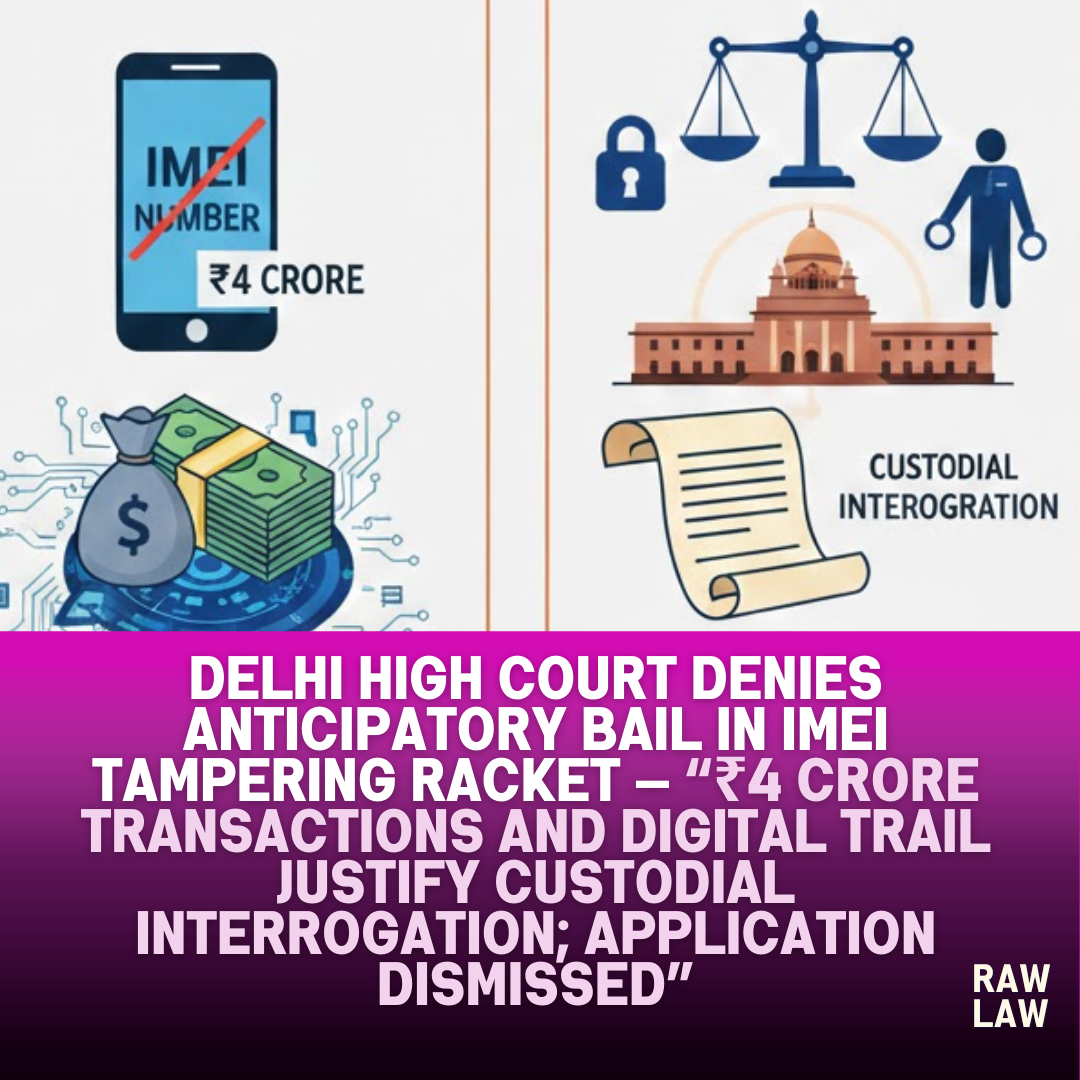
The Delhi High Court dismissed an anticipatory bail application filed by a shop owner accused of running a racket involving stolen mobile phones, holding that the scale of alleged illegal transactions, recovery of phones, and digital evidence indicating IMEI number manipulation warranted custodial interrogation. The Court ruled that at the investigation stage, where the modus operandi and extent of the crime remain to be uncovered, pre-arrest bail would seriously impede the probe — “one wonders why IMEI numbers would be changed if phones were not stolen”; anticipatory bail rejected.
Court’s decision
Justice Girish Kathpalia refused to grant anticipatory bail to the applicant booked under provisions of the Bharatiya Nyaya Sanhita for dealing in stolen property and related offences. The Court accepted the prosecution’s submission that custodial interrogation was necessary to trace the larger network, understand the IMEI alteration mechanism, and recover additional stolen mobile phones allegedly concealed elsewhere. The bail application was accordingly dismissed.
Facts
The case arose out of an e-FIR registered at Police Station South Campus alleging that the applicant, along with his brother and other associates, was involved in illegally dealing with stolen mobile phones by changing their IMEI numbers and reselling them in the market. During investigation, the police conducted a raid at a shop owned by the applicant and claimed to have recovered multiple mobile phones suspected to be stolen.
The prosecution alleged that the shop was a front for organised illegal activity involving tampering with unique device identifiers to disguise stolen phones as legitimate devices. The applicant approached the High Court seeking anticipatory bail, asserting innocence and disassociation from the alleged activities.
Issues
The primary issue before the High Court was whether the applicant was entitled to anticipatory bail at a stage when the investigation was ongoing and custodial interrogation was sought by the investigating agency. The Court also considered whether the applicant’s claim of non-involvement could override documentary and digital material indicating his active role in the alleged illegal business.
Petitioner’s arguments
The applicant contended that he had been falsely implicated solely because he owned the shop from where mobile phones were sold by his brother. He argued that he had no role in the mobile phone business and that his brother independently conducted the transactions. Emphasis was placed on the absence of criminal antecedents and the fact that recoveries had already been effected, thereby negating the need for custodial interrogation.
The applicant also attempted to argue that earlier status reports did not clearly allege that the seized phones were stolen, suggesting that the prosecution was now improving its case.
Respondent’s arguments
The State strongly opposed the anticipatory bail plea and placed before the Court bank records showing business transactions exceeding ₹4 crore through the applicant’s Axis Bank account, suggesting large-scale commercial activity. The prosecution also produced screenshots of WhatsApp chats allegedly exchanged between the applicant and co-accused persons, which reflected discussions regarding alteration of IMEI numbers.
On instructions from the investigating officer, the State submitted that custodial interrogation was essential to uncover the full modus operandi, identify other participants, and recover additional stolen mobile phones. It was argued that granting anticipatory bail at this stage would seriously prejudice the investigation.
Analysis of the law
The Court reiterated that anticipatory bail is a discretionary relief and must be granted sparingly, particularly in cases involving organised economic offences and technical manipulation aimed at defeating law enforcement. It noted that where investigation is at a nascent stage and requires custodial interrogation to unravel the scope of criminal activity, courts should be slow to grant pre-arrest protection.
The Court also emphasised that absence of past criminal antecedents does not automatically entitle an accused to anticipatory bail when prima facie material suggests active involvement in a serious and organised offence.
Precedent analysis
While the order was brief and oral, it reflects settled jurisprudence that anticipatory bail should be declined where custodial interrogation is necessary to trace recoveries, uncover conspiracies, or understand technical aspects of the offence. Courts have consistently held that economic and organised crimes involving digital manipulation require deeper investigation, which cannot be effectively conducted if the accused is insulated from arrest at the threshold.
Court’s reasoning
Rejecting the applicant’s argument that the phones were not proven to be stolen, the Court observed that if the devices were legitimate, there would be no reason to tamper with their IMEI numbers. The Court found the submission regarding absence of allegation of stolen property in earlier reports to be incorrect and contrary to the record.
Given the bank transaction trail showing high-value dealings, the WhatsApp chats indicating technical manipulation, and the need to identify additional recoveries and accomplices, the Court held that custodial interrogation was justified. At this stage, it found no ground to extend the extraordinary protection of anticipatory bail.
Conclusion
The Delhi High Court dismissed the anticipatory bail application, holding that the seriousness of allegations, pendency of investigation, and necessity of custodial interrogation outweighed the applicant’s plea for pre-arrest protection. The Court clarified that its observations were limited to the bail stage and would not prejudice the merits of the case at trial.
Implications
This order underscores judicial reluctance to grant anticipatory bail in cases involving organised economic crime and digital tampering. It signals that ownership of premises and financial trails can prima facie establish involvement sufficient to deny pre-arrest bail. The ruling also highlights the growing judicial focus on IMEI manipulation as a serious offence with wider implications for cyber security and organised theft networks.
Case law references
- Anticipatory bail and custodial interrogation: Pre-arrest bail should be denied where custodial interrogation is necessary to uncover modus operandi and recover property. Applied to reject the plea.
- Economic and organised offences: High-value transactions and digital evidence justify stricter scrutiny at the bail stage. Applied to decline anticipatory bail.
- IMEI tampering inference: Alteration of IMEI numbers prima facie indicates illicit origin of devices. Applied to reject defence contention.
FAQs
1. Can anticipatory bail be denied even if the accused has no prior criminal record?
Yes. Absence of antecedents does not override the need for custodial interrogation in serious or organised offences.
2. Why is IMEI tampering treated seriously by courts?
Changing IMEI numbers is commonly associated with disguising stolen phones and defeating law enforcement tracking, indicating organised criminal activity.
3. Does dismissal of anticipatory bail decide guilt?
No. Bail orders are interlocutory and do not determine guilt, which will be decided at trial.