
Delhi High Court Dismisses NEET-UG Candidate’s Challenge to Biology Answer Key; Refuses Five Additional Marks, Holds Courts Cannot Override Experts Without Manifest Error

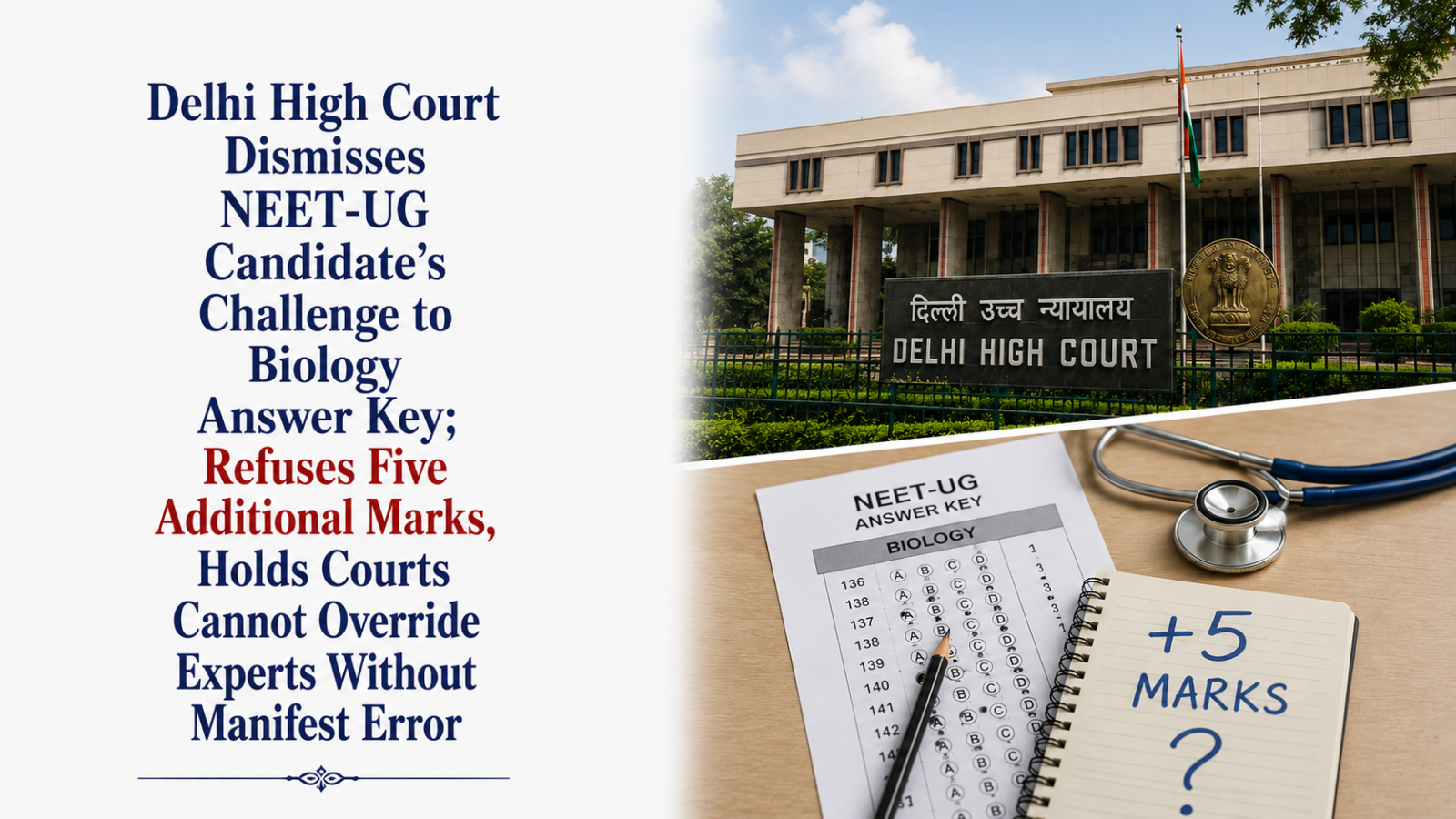
NEET-UG Biology Question Dispute: Delhi High Court Refuses Fresh Expert Committee, Upholds NTA Answer Key and Dismisses Candidate’s Plea for Additional Marks
Facts
The petitioner, a 17-year-old student, appeared for NEET-UG 2026. He had initially appeared for the examination held on 3 May 2026 and, according to the provisional answer key, was likely to obtain a perfect score of 720/720. That examination was subsequently cancelled and a fresh examination was conducted on 21 June 2026.
After the provisional answer key for the re-examination was released, the petitioner challenged Question No. 150 of the Biology Section, Test Booklet Code 80, concerning the reabsorption process in the Loop of Henle. He submitted objections along with supporting material and paid the prescribed objection fee. In the final result declared on 16 July 2026, however, he secured 695/720 marks and All India Rank 65, while NTA retained its answer to Question No. 150.
The petitioner had selected Option No. 2 — statements (a), (b) and (c) only — whereas NTA treated Option No. 3 — statements (a), (b) and (d) only — as the correct answer. Consequently, the petitioner claimed that he lost five marks: four marks that would have been awarded for a correct answer and one mark deducted for the allegedly incorrect response.
He approached the Delhi High Court seeking reconsideration of his objection, correction of his result and rank, issuance of a revised scorecard, and consequential benefits. He also sought protection of a seat commensurate with his revised merit position, preferably at AIIMS New Delhi.
Issues
The principal issues before the Court were:
- Whether the High Court could interfere with the final NEET-UG answer key after the disputed answer had already been considered and approved by a panel of subject experts.
- Whether the petitioner had demonstrated that NTA’s answer to Question No. 150 was manifestly, patently or demonstrably incorrect.
- Whether the Court should constitute an independent expert committee to reconsider the disputed Biology question.
- Whether the petitioner was consequently entitled to five additional marks, revision of his NEET score and rank, and consequential admission benefits.
Petitioner’s Arguments
The petitioner contended that the answer adopted by NTA was scientifically incorrect. According to him, the use of the word “only” in the options created a fundamental defect because the scientific material demonstrated that all four statements concerning the Loop of Henle were correct, meaning none of the options could properly constitute the sole correct answer.
He clarified that he was not asking the Court itself to decide a technical question of Biology. Instead, he sought constitution of an independent expert body to determine the correctness of Question No. 150 and NTA’s answer.
The petitioner relied upon NCERT material, Guyton and Hall Textbook of Medical Physiology, and an opinion of a Professor of Physiology from AIIMS Rishikesh to support his scientific challenge. His case was that these materials demonstrated that there could not be only one correct answer to the disputed question.
He further argued that prior examination of his objection by NTA’s experts did not completely bar judicial review where the answer was demonstrably or palpably erroneous. He relied upon decisions including Vanshika Yadav v. Union of India, Shaureen Shamik Ambatkar v. Union of India, Aditya Singh v. Consortium of National Law Universities and Shivraj Sharma v. Consortium of NLUs.
Respondent’s Arguments
NTA argued that its examination process already contained a structured mechanism for challenging provisional answer keys. Candidates were permitted to inspect the provisional key, OMR responses and recorded answers and raise objections on payment of the prescribed fee.
The objections to Question No. 150, including the petitioner’s objection, were placed before a panel of experts drawn from premier national institutions. The experts found the petitioner’s objection unsustainable and consequently retained the original answer in the final answer key.
NTA submitted that courts ordinarily cannot interfere with an answer approved by subject experts unless the answer is shown to suffer from a patent, manifest or demonstrable error. The NEET-UG Information Bulletin also required candidates to select the “correct answer or the most appropriate answer”, making determination of the most appropriate answer essentially an academic exercise for experts.
NTA additionally relied upon Clauses 15.2 and 15.4 of the Information Bulletin to argue that decisions on challenges to the answer key attain finality and that there is no provision for rechecking or re-evaluation after completion of the prescribed process.
Analysis of the Law
The Court emphasised the settled limits governing judicial review of examination answer keys. Courts must exercise restraint in matters involving specialised academic expertise and cannot substitute their own assessment for that of qualified subject experts merely because another interpretation is possible.
Judicial intervention is permissible only in rare or exceptional circumstances where the error is manifest, palpable or demonstrably incorrect on the face of the record. If determining whether an answer is incorrect requires detailed reasoning, competing interpretations, scientific analysis or evaluation of rival expert opinions, the Court ordinarily must defer to the examining authority.
The Court observed that a manifest error must be so evident that no reasonable body of persons well versed in the particular subject could regard the disputed answer as correct. The burden of establishing such an error rests upon the candidate. In the present case, the Court found that the petitioner had failed to discharge that burden. His contentions required inferences, logical deductions and application of specialised scientific knowledge.
Precedent Analysis
The Court relied substantially upon Ran Vijay Singh v. State of U.P., which establishes that courts should ordinarily presume the correctness of key answers and should not themselves undertake re-evaluation. Judicial intervention is justified only where a material error can be clearly demonstrated without an inferential process of reasoning.
The Court also considered Freya Kothari v. Union of India and the line of authorities emphasising judicial restraint where examination questions and answers have been assessed by subject experts.
The petitioner relied heavily upon Vanshika Yadav v. Union of India to seek constitution of an independent expert committee. The Court distinguished that decision because there NTA itself had altered its position and treated two different options as correct after receiving numerous representations. It was in those peculiar circumstances that an independent three-member committee was constituted.
The Court similarly distinguished Shaureen Shamik Ambatkar v. Union of India, noting that the challenge there involved questions allegedly outside the prescribed syllabus and a question alleged to be inherently incorrect—circumstances materially different from the present dispute.
The Court clarified that judicial review is not completely excluded in answer-key disputes. However, interference is warranted only in exceptional circumstances where the incorrectness of the answer is apparent on its face.
Court’s Reasoning
The Court noted that Question No. 150 had been prepared by subject experts and that objections to the provisional answer key had thereafter been examined by another expert process. NTA specifically stated that objections received from candidates, including the petitioner, had been placed before eminent experts from premier institutions before the final answer key was approved.
Justice Jasmeet Singh held that the Court lacked the specialised expertise necessary to sit in appeal over the conclusions of Biology experts. The scientific materials relied upon by the petitioner did not establish an error so obvious that judicial intervention could occur without the Court itself undertaking technical analysis.
The Court found that determining whether the petitioner’s scientific interpretation was preferable would necessarily require inferential reasoning and evaluation of competing scientific propositions. Such an exercise would effectively place the Court in the position of an examiner or subject expert, which the settled law prohibited.
The Court also observed that precedents concerning examinations for judicial appointments or entry into law institutes stood on a different footing because courts may themselves possess sufficient expertise to examine questions of law. The same approach could not appropriately be adopted for a specialised scientific subject such as Biology.
Conclusion
The Delhi High Court held that the petitioner had not established any manifest, patent or demonstrable error in NTA’s answer to Question No. 150 sufficient to justify judicial intervention.
It therefore refused to constitute another expert committee, declined to interfere with NTA’s expert-approved final answer key, and consequently refused the petitioner’s claim for additional marks, revision of his score/rank and consequential admission benefits.
While acknowledging that the petitioner was an exceptionally bright and hardworking student, the Court held that sympathy could not justify interference within the limited scope of judicial review available in examination matters.
Accordingly, the writ petition and all pending applications were dismissed.
Case Details
Case: Kushagra Mittal Minor & Anr. v. National Testing Agency & Ors.
Court: High Court of Delhi at New Delhi
Case Number: W.P.(C) No. 10274/2026 with CM Appl. 47576/2026 & CM Appl. 47577/2026
Judge: Hon’ble Mr. Justice Jasmeet Singh
Date: 11 August 2026
Result: Petition dismissed; Court refused to interfere with the NEET-UG 2026 Biology answer key or grant additional marks/revised rank.

1 comment
SEEKING REVIEW/RECALL OF THE JUDGMENT PASSED BY HON’BLE COURT
Below observations attract the central issue for requiring review by the Hon’ble Court:
Hon’ble Court with the utmost respect and with full faith in the wisdom and independence the petitioner approached. The review petition is not intended to seek a rehearing merely because another view is possible. The limited grievance of the Petitioner is that certain material aspects going to the very foundation of the decision appear to have escaped effective consideration, resulting in serious prejudice to the petitioner and similarly situated candidates. Hon’ble Court was pleased to observe, in substance, that the Court did not possess the specialised expertise necessary to sit in appeal over the conclusions of Biology experts. The limited issue was whether the Respondent/NTA had demonstrated, through a properly constituted and scientifically reasoned expert process, that the challenged answer was correct and that the Petitioner’s contrary scientific material was untenable. Further there was no independent third-party expert opinion placed before this Hon’ble Court apart from petitioner and respondent (NTA and its own constituted scientific experts) which conclusively examined the competing scientific propositions. The Petitioner therefore humbly seeks appropriate independent expert scrutiny in the interest of fairness, scientific accuracy and justice to the Petitioner and all similarly situated candidates.