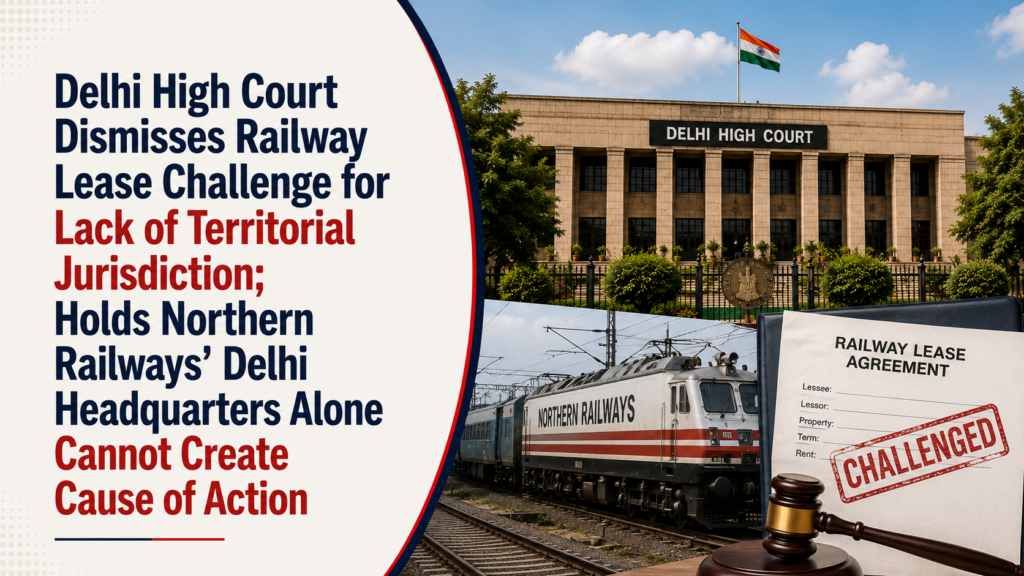
Delhi High Court Dismisses Railway Lease Challenge for Lack of Territorial Jurisdiction; Holds Northern Railways’ Delhi Headquarters Alone Cannot Create Cause of Action

Delhi High Court Rejects Railway Lessee’s Challenge to Lease Termination; Holds Delhi Headquarters of Northern Railways Cannot Alone Confer Territorial Jurisdiction
Facts
The petitioner, M/s Rail Transport Corporation of India, a sole proprietorship engaged in transporting goods through leased railway luggage rakes, approached the Delhi High Court challenging several actions taken by the Railways. It sought quashing of the show-cause notice dated 24 June 2024, lease termination dated 28 June 2024, rejection of appeal dated 12 July 2024, forfeiture of security deposit dated 28 August 2024, refund of ₹5,49,873, restoration of the remaining lease period, and compensation of ₹45.70 lakh.
The petitioner had been granted lease of one Front Second Class Luggage Rake (FSLR-1) on Train No. 12904 running between Mumbai Central and Amritsar for the period from 14 November 2023 to 13 November 2025. A security deposit of ₹5,49,873 had been furnished.
On 17 June 2024, the Railway Protection Force conducted a random inspection at Mumbai Central Railway Station. Four packages containing “old laptops” were found, while the consignment note described the goods as “Exports.” The packages were seized for “No Proper Declaration.”
Proceedings under Section 163 of the Railways Act, 1989 were initiated. The petitioner pleaded guilty and was fined ₹500. It nevertheless contended before the Railways that the laptops were rejected material intended for export replacement and that the discrepancy amounted only to partial declaration rather than misdeclaration.
The Railways terminated the lease on 28 June 2024. The petitioner’s appeal before the DRM’s Office, Firozpur, was rejected on 12 July 2024. The Railways thereafter auctioned the leased FSLR-1 and later informed the petitioner that its security deposit had been forfeited.
During the writ proceedings, the respondents raised a preliminary objection that the Delhi High Court lacked territorial jurisdiction. The Court therefore heard the matter confined to that issue.
Issues
The principal issue before the High Court was:
Whether the Delhi High Court had territorial jurisdiction under Article 226(2) of the Constitution when the Railways’ headquarters were located in Delhi but the inspection, show-cause proceedings, termination, appeal and forfeiture occurred outside Delhi.
The related questions were:
- whether the presence of the Union of India and Northern Railways headquarters in Delhi was enough to confer jurisdiction;
- whether policy control exercised from Delhi formed a material part of the cause of action; and
- whether any material, essential or integral fact giving rise to the dispute arose within Delhi.
Petitioner’s Arguments
The petitioner contended that the Delhi High Court had territorial jurisdiction because the Union of India through the Ministry of Railways operates the Railways throughout the country and Northern Railways is under the Ministry’s administrative control.
It stressed that Northern Railways has its headquarters at Baroda House, New Delhi and argued that this gave rise to at least a material part of the cause of action within Delhi.
The petitioner further argued that Indian Railways is a single unified statutory organisation and that its various zones and divisions, including Firozpur Division, do not have separate legal personalities.
Reliance was placed upon Union of India v. Sri Ladulal Jain to support the proposition that the Railways carry on business as one entity and therefore proceedings could be maintained where the Railways’ central administrative presence existed.
Respondent’s Arguments
The respondents argued that no part of the cause of action arose in Delhi.
They pointed out that:
- the lease was executed with the Firozpur Division;
- the show-cause notice dated 24 June 2024 was issued by the Senior Divisional Commercial Manager, Firozpur;
- the lease termination order dated 28 June 2024 was issued from Firozpur;
- the petitioner filed its appeal before the DRM’s Office at Firozpur;
- the appeal was rejected from Firozpur;
- the security deposit forfeiture order was also issued from Firozpur; and
- the inspection which triggered the entire proceedings took place at Mumbai Central.
The respondents submitted that the mere location of Northern Railways’ headquarters in New Delhi could not confer territorial jurisdiction where none of the essential facts giving rise to the dispute occurred there.
They relied upon ONGC v. Utpal Kumar Basu, Kusum Ingots & Alloys Ltd. v. Union of India, Alchemist Ltd. v. State Bank of Sikkim, and Dr. Neha Chandra v. Union of India.
Analysis of the Law
1. Article 226(2) requires cause of action to arise wholly or partly within the High Court’s territory
The Court examined Article 226(2), which permits a High Court to exercise writ jurisdiction where the cause of action, wholly or in part, arises within its territorial limits, regardless of where the Government or authority is seated.
The Court emphasised that territorial jurisdiction must be determined on the basis of the facts pleaded in the writ petition.
The relevant inquiry is whether those facts, assumed to be true, constitute a part of the cause of action within the territorial jurisdiction of the Court.
2. The fact relied upon must be material, essential or integral to the cause of action
Relying on ONGC v. Utpal Kumar Basu and Alchemist Ltd., the Court held that even a small fraction of the cause of action can confer jurisdiction, but that fraction must consist of a fact that is material, essential or integral to the dispute.
A merely incidental fact is insufficient.
3. Mere location of a government or statutory office does not create jurisdiction
The Court relied upon its earlier decision in Manjira Devi Ayurveda Medical College & Hospital v. Uttarakhand University of Ayurveda, where it was held that merely because the offices of some respondent authorities are situated in Delhi does not automatically confer jurisdiction when no part of the cause of action arose there.
The Court summarised the legal position by holding that a small fraction of the cause of action must arise in Delhi and must itself constitute a material or integral part of the dispute.
The mere presence of the headquarters of a government or statutory authority within Delhi is insufficient.
4. Every impugned action occurred outside Delhi
The Court then examined the actual sequence of events.
It found that:
- the show-cause notice was issued by the Senior Divisional Commercial Manager, Firozpur;
- the lease cancellation order was issued from Firozpur;
- the security deposit forfeiture order was issued from Firozpur;
- the petitioner’s appeal was filed and rejected at Firozpur;
- no representation or communication was addressed by the petitioner to Northern Railways’ Delhi headquarters; and
- the triggering inspection took place at Mumbai Central.
The Court therefore concluded that not even an iota of the cause of action pleaded in the writ petition arose in Delhi.
5. Policy control from Delhi was insufficient
The petitioner’s only basis for invoking Delhi jurisdiction was that the Union of India and Northern Railways, situated in Delhi, frame policies binding upon the Firozpur Division.
The Court rejected this contention by relying on Kusum Ingots.
It held that the mere framing of a statute, rule, executive instruction or policy from a particular place does not create territorial jurisdiction merely because the office of the policy-making authority is situated there.
Accordingly, Northern Railways’ headquarters being located in Delhi could not by itself confer jurisdiction on the Delhi High Court.
Precedent Analysis
ONGC v. Utpal Kumar Basu
The Supreme Court decision in ONGC v. Utpal Kumar Basu was central to the Court’s approach.
It established that territorial jurisdiction under Article 226 must be tested by examining the facts pleaded as constituting the cause of action. The Court need not test the truth of those facts at that stage, but must determine whether they legally amount to a part of the cause of action within the territorial jurisdiction invoked.
Alchemist Ltd. v. State Bank of Sikkim
The Court relied upon Alchemist Ltd. for the proposition that even a small fraction of the cause of action is enough, but only if the fact relied upon is a material, essential or integral component of the dispute.
Merely incidental or peripheral connections are insufficient.
Kusum Ingots & Alloys Ltd. v. Union of India
This precedent directly answered the petitioner’s reliance on Northern Railways’ Delhi headquarters.
The Supreme Court had held that the situs of the authority framing a statute, rule, executive order or instruction does not by itself constitute a cause of action.
The Delhi High Court therefore held that policy formulation by railway authorities situated in Delhi could not create jurisdiction where the actual dispute arose entirely elsewhere.
Manjira Devi Ayurveda Medical College & Hospital v. Uttarakhand University of Ayurveda
The Delhi High Court relied upon this decision to reaffirm that the mere location of government offices in Delhi cannot confer writ jurisdiction where the underlying dispute and all material events occurred outside Delhi.
Union of India v. Sri Ladulal Jain
The petitioner relied on Ladulal Jain, but the Court distinguished it.
That judgment concerned territorial jurisdiction in a civil suit under Section 20(a) and (b) of the Code of Civil Procedure, where jurisdiction may depend on where the defendant resides or carries on business.
Article 226(2), however, operates differently: writ jurisdiction depends upon where the cause of action arises.
Accordingly, Ladulal Jain did not assist the petitioner.
Court’s Reasoning
The Court treated territorial jurisdiction as a threshold issue and therefore did not enter into the merits of whether the lease termination, security forfeiture or penalty were legally justified.
Its reasoning was straightforward:
The inspection that triggered the proceedings took place in Mumbai.
Every material administrative action thereafter—show-cause notice, lease cancellation, appellate rejection and security forfeiture—was undertaken by railway authorities in Firozpur.
There was no representation, decision or communication involving Northern Railways’ Delhi headquarters which formed part of the dispute.
Thus, Delhi’s only connection with the case was the location of Northern Railways’ headquarters and the Union Government’s policy-making authority.
That connection was legally insufficient under Article 226(2).
The Court therefore held that no material, essential or integral part of the cause of action arose within Delhi.
Conclusion
The Delhi High Court dismissed the writ petition solely on the ground of lack of territorial jurisdiction.
It held that:
- jurisdiction under Article 226 depends upon the place where the cause of action wholly or partly arises;
- even a small part of the cause of action can confer jurisdiction, but it must be material, essential or integral;
- the mere location of Northern Railways’ headquarters or the Union Government in Delhi is insufficient;
- all impugned notices and orders were issued from Firozpur;
- the inspection that triggered the dispute occurred in Mumbai; and
- no part of the pleaded cause of action arose within Delhi.
The Court therefore dismissed the writ petition without examining the merits of the lease termination or forfeiture dispute.
Case Details
Case: M/s Rail Transport Corporation of India v. Union of India & Ors.
Court: High Court of Delhi at New Delhi
Case Number: W.P.(C) 3308/2025 and CM APPL. 15621/2025; CNR No. DLHC010136032025
Judge: Justice Amit Bansal
Date: 21 August 2026
Result: Writ petition dismissed for lack of territorial jurisdiction; merits of railway lease termination and security forfeiture not examined.