Delhi High Court — “Employee who accepted 90-day notice pay cannot later challenge termination”, ICICI Bank termination upheld

Court’s decision
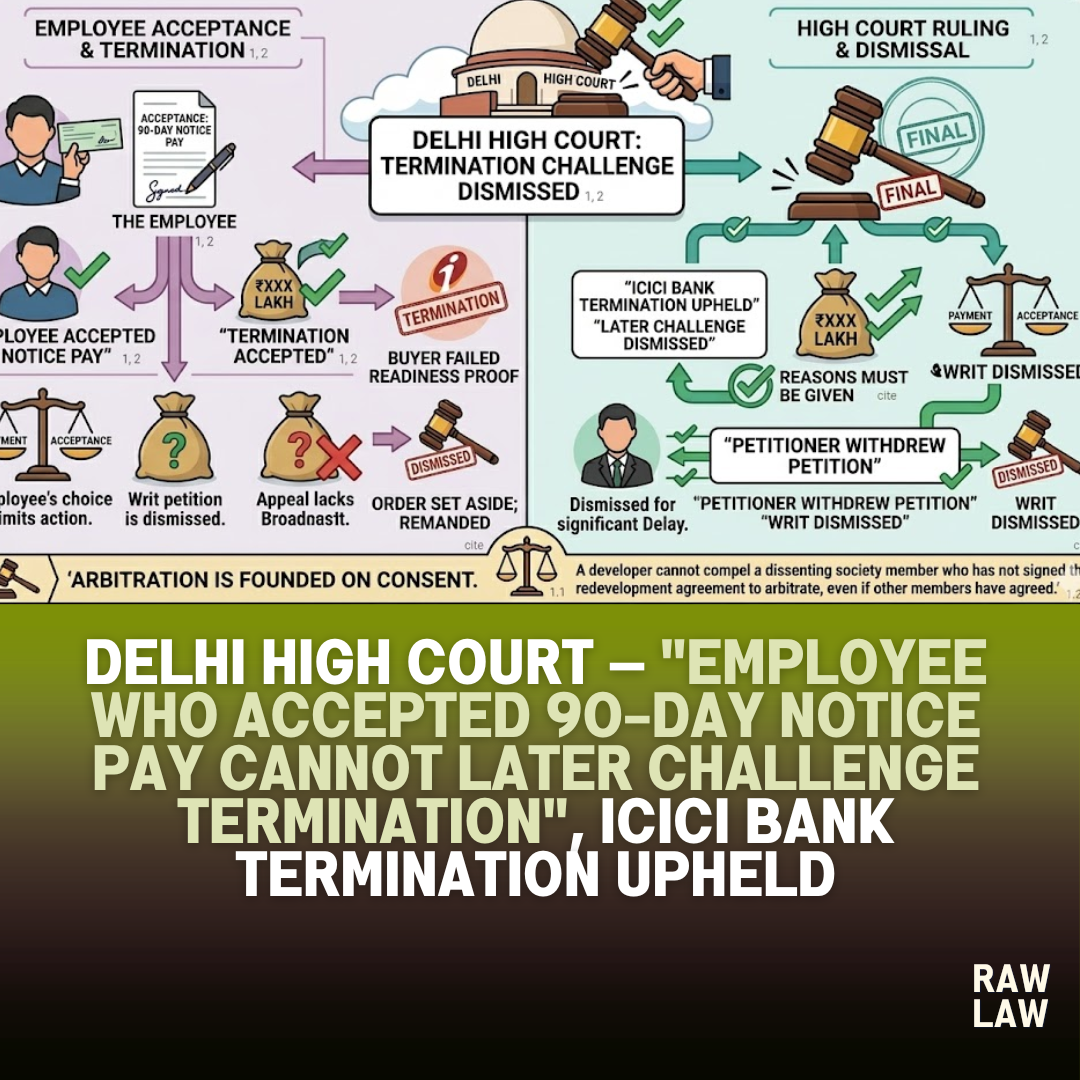
The Delhi High Court dismissed the Regular First Appeal filed by the employee against the trial court judgment. The Court confirmed that the bank had exercised its contractual right to terminate the employee by paying salary equivalent to the 90-day notice period.
The Bench noted that the employee had received and encashed a cheque of ₹99,634 representing three months’ salary in lieu of notice. By accepting the payment, the employee effectively acknowledged termination under the contract and could not later challenge it as arbitrary.
Consequently, the Court upheld the dismissal of claims for reinstatement and damages but maintained the trial court’s order granting salary of ₹35,000 for June 2009 along with 6% annual interest.
Facts
The appellant, a qualified electronics engineer, joined ICICI Bank in October 2007 as Manager in the Credit Card Collection Division. His role involved supervising collection agencies responsible for recovering outstanding credit card dues.
In June 2008, he was transferred to a different team handling accounts with longer delinquency periods. Later, in May 2009, he was promoted to the post of Area Manager in recognition of his work performance.
However, the dispute arose when the employee noticed that his salary for June 2009 had not been credited. After making enquiries with senior officials, he eventually received a termination letter on 7 July 2009 stating that his services had been terminated with effect from 5 June 2009.
The employee contended that the termination was arbitrary because no reasons were provided and because he had continued working during June 2009 despite the termination being backdated.
He subsequently served a legal notice demanding reinstatement or compensation and later filed a civil suit claiming ₹50 lakh for loss of future employment and ₹20 lakh for mental agony.
Issues
The Delhi High Court considered the following issues:
- Whether the bank was required to provide reasons before terminating the employee’s services.
- Whether the termination was arbitrary and unfair.
- Whether the employee was entitled to reinstatement or damages for alleged wrongful termination.
- Whether acceptance of notice pay prevented the employee from challenging the termination.
Petitioner’s arguments
The employee argued that his termination was arbitrary and violated the terms of his appointment letter. According to him, the appointment contract permitted termination only in specific circumstances such as breach of conditions or suppression of material facts.
He contended that the termination letter did not provide any reasons for ending his employment and therefore the action was illegal and unfair.
The employee also emphasized that he had worked throughout June 2009 despite the termination order being dated earlier. This, he argued, demonstrated that the bank acted in a high-handed manner.
Further, he claimed that the termination caused serious reputational damage and affected his future employment prospects. On this basis, he sought reinstatement or substantial monetary compensation for loss of career opportunities and mental suffering.
Respondent’s arguments
ICICI Bank argued that the termination was carried out strictly in accordance with the employment contract.
The bank pointed out that the appointment letter clearly allowed termination after confirmation by giving 90 days’ notice or paying salary equivalent to the notice period.
In this case, the employee was given a cheque for ₹99,634 representing three months’ gross salary in lieu of the notice period.
The bank emphasized that the employee had accepted and encashed this cheque. Therefore, he could not later dispute the validity of the termination.
The bank further argued that the employee’s claims for reinstatement and large damages were baseless and motivated by financial gain.
Analysis of the law
The Court analysed the contractual terms governing the employment relationship. It observed that private employment contracts often contain provisions allowing termination by giving notice or payment in lieu of notice.
Such clauses provide flexibility to employers and employees while ensuring that the terminating party compensates the other for the notice period.
The Court emphasized that when an employee voluntarily accepts payment in lieu of notice and encashes the cheque, it amounts to acceptance of the termination mechanism provided in the contract.
Once such acceptance occurs, it becomes difficult for the employee to subsequently claim that the termination was illegal.
Precedent analysis
The Court relied on established principles governing contractual employment relationships.
Courts have consistently held that where termination occurs in accordance with contractual terms and notice pay is provided, reinstatement is generally not granted in private employment disputes.
Reinstatement is typically reserved for cases involving statutory protections or public employment, where constitutional safeguards apply.
In purely contractual employment relationships, the remedy usually lies in damages rather than reinstatement unless the contract itself has been breached.
Court’s reasoning
The Court noted that the appointment letter expressly permitted termination after confirmation either by giving 90 days’ notice or by paying equivalent salary.
In the present case, the bank had exercised the latter option by issuing a cheque covering three months’ salary.
The Court found it significant that the employee had encashed the cheque without protest. By doing so, he effectively accepted the termination arrangement provided in the employment contract.
However, the Court also acknowledged that the termination letter was communicated to the employee only on 7 July 2009 even though it was dated 5 June 2009.
Since the employee had worked during June 2009, the trial court rightly awarded him salary for that month.
The High Court concluded that the trial court had correctly balanced the equities by granting one month’s salary while rejecting claims for reinstatement and large damages.
Conclusion
The Delhi High Court concluded that the termination of the employee’s services by ICICI Bank was valid and in accordance with the terms of the appointment letter.
Because the employee had accepted and encashed the notice pay, he could not subsequently challenge the termination or claim reinstatement.
Accordingly, the appeal was dismissed and the trial court’s award of one month’s salary with interest was upheld.
Implications
This judgment reinforces an important principle in employment law relating to termination clauses in private employment contracts.
The ruling clarifies that when an employee accepts notice pay provided under a termination clause, it may operate as acceptance of the termination itself.
The decision also highlights the limited scope of judicial intervention in private employment disputes where termination occurs strictly in accordance with contractual terms.
For employers, the ruling underscores the importance of clearly drafted termination clauses. For employees, it serves as a caution that accepting notice pay may weaken future legal challenges to termination.
Case Law References
Private employment termination jurisprudence
Indian courts generally hold that reinstatement is rarely granted in private employment disputes unless statutory protections are involved.
Contractual termination principles
Termination clauses allowing notice or payment in lieu of notice are legally enforceable if exercised in accordance with the employment contract.
FAQs
1. Can an employee challenge termination after accepting notice pay?
Generally no. If an employee accepts and encashes payment in lieu of notice provided under the employment contract, courts may treat it as acceptance of termination.
2. Is reinstatement available in private employment disputes in India?
Reinstatement is rarely granted in private employment matters. Courts usually award damages instead if the termination violates the contract.
3. What happens if an employee works after a termination letter is issued?
If an employee continues working due to delayed communication of termination, courts may award salary for that period, as happened in this case.