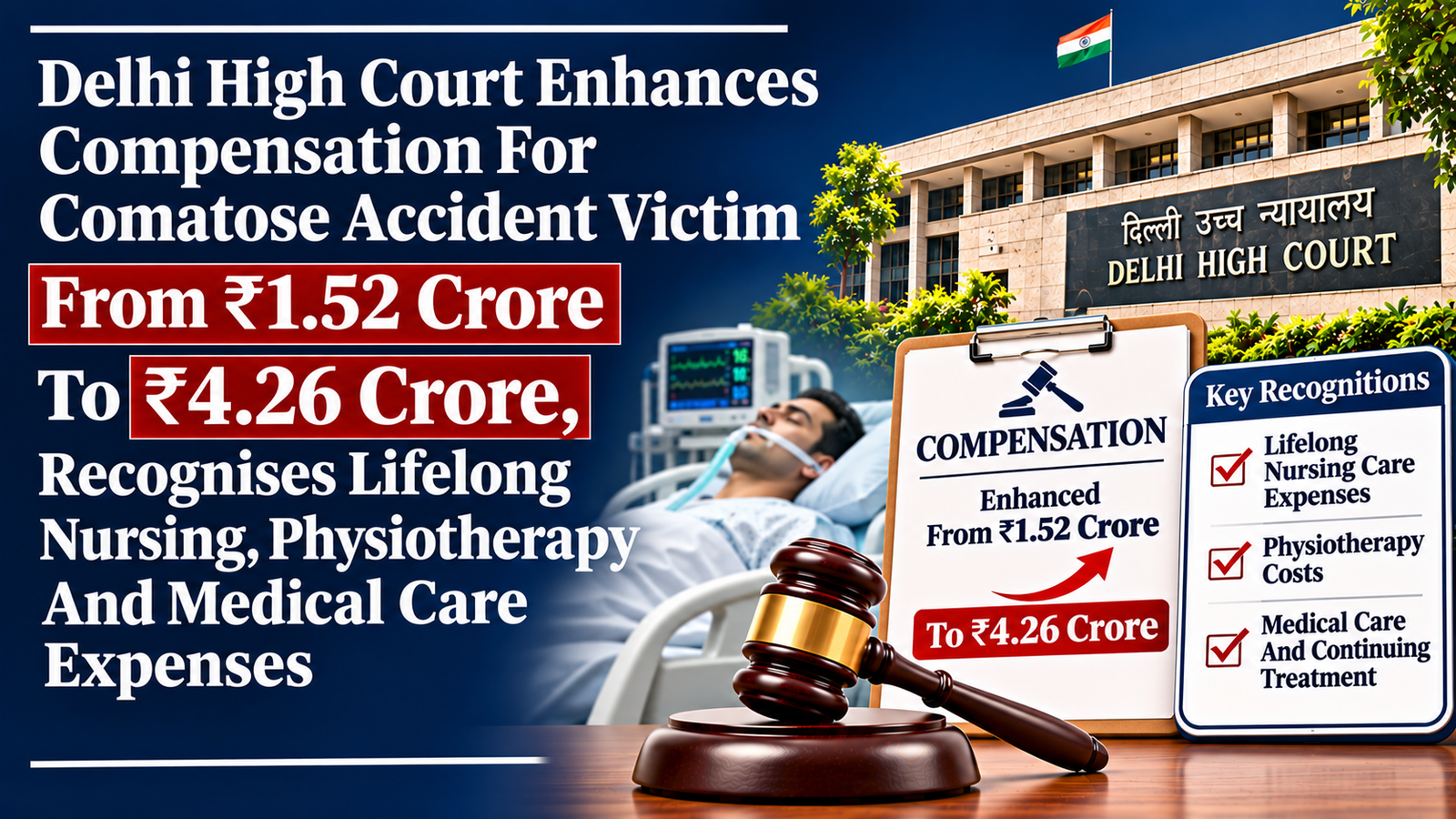
Delhi High Court Enhances Compensation For Comatose Accident Victim From ₹1.52 Crore To ₹4.26 Crore, Recognises Lifelong Nursing, Physiotherapy And Medical Care Expenses

Delhi High Court Rules Mediclaim Payout Cannot Be Deducted From Motor Accident Award, Applies Three-Year Average Income And Multiplier Method To Assess 100% Disability
Facts
Bharat Ghai, aged 39, was struck by a Maruti Swift on 11 February 2022 outside BSF Camp, Chhawala, while helping his children alight from his parked car. His head struck the windshield and he was dragged 20-30 feet. He suffered severe hypoxic brain injury and remains in a comatose, bed-bound condition, with 100% permanent physical impairment and 100% functional disability. Through his wife and next friend, Harpreet Kaur, he sought compensation for lost earnings, treatment and lifelong assistance. By award dated 16 March 2026 in MACT No. 620/2022, the Dwarka Motor Accident Claims Tribunal granted ₹1,52,76,996 with 7.5% annual interest. He appealed for enhancement, asserting that the award severely underestimated expenses for his continuing care and assessed his earnings using a pandemic-affected financial year.
Issues
Whether the Tribunal correctly determined a self-employed claimant’s income by relying solely on his last income-tax return; whether Mediclaim receipts could be deducted from statutory accident compensation; how proven medical bills and lifelong physiotherapy, attendant, nursing and treatment expenses should be quantified for a claimant in a coma; whether loss of consortium was available despite the claimant being alive; and what further compensation and disbursement directions were warranted.
Appellant’s Arguments
The claimant submitted that his event-management earnings were depressed during COVID-19 and that previous income-tax returns better reflected his earning capacity. He challenged the ₹9,95,015 Mediclaim deduction; the reduction of claimed pharmacy bills of ₹19,76,382 to ₹3 lakh; and the rejection of bills for medical consumables, Ayurvedic treatment and other expenses. He sought realistic provision for continuous care: enhanced medical, physiotherapy and skilled attendant charges, a trained nurse and appropriate future expenses. He also urged compensation for loss of consortium because his coma deprived his wife and children of his companionship. Claims concerning loss of amenities, pain and suffering, homeopathic consultation and contingent future medical expenses were ultimately not pressed.
Respondents’ Arguments
Bajaj Allianz General Insurance Company Ltd. opposed enhancement, submitting that the Tribunal had considered the evidence and documentary record, assigned reasons under individual heads and assessed a justified quantum. Its position was that the impugned award did not call for appellate interference.
Analysis of the Law
The Motor Vehicles Act, 1988 requires just and reasonable compensation tailored to the injured person’s actual loss and foreseeable needs. For a self-employed claimant with variable earnings, the average of three preceding income-tax returns is an appropriate benchmark rather than a single distorted year. Mediclaim benefits arise from a private insurance contract and premiums paid, and cannot be set off against the separate statutory right to accident compensation, including medical expenses. In cases of catastrophic disability, lifelong recurring costs may be estimated using a suitable monthly amount and multiplier; the court need not confine relief to bills already incurred. Nonetheless, expenses must be sufficiently supported, and consortium under the controlling Supreme Court authorities concerns death claims rather than a living claimant’s incapacitation.
Precedent Analysis
Rashmirekha Tripathy v. Sriram General Insurance Co. Ltd. (2026 SCC OnLine SC 1256) supported averaging three years’ returns for a self-employed person. New India Assurance Co. Ltd. v. Dolly Satish Gandhi (2026 SCC OnLine SC 861) barred deduction of Mediclaim payouts from Motor Vehicles Act compensation. Kajal v. Jagdish Chand ((2020) 4 SCC 413), Jithendran v. New India Assurance ((2022) 15 SCC 620), Sunil Kumar v. IFFCO Tokio (2026 INSC 1145) and Abhimanyu Pratap Singh v. Nanita Sekhon ((2022) 8 SCC 489) informed the multiplier-based assessment of attendant, physiotherapy and future care costs for profoundly disabled claimants. Bishan Singh v. Chinki (2025:DHC:5099) supported skilled-worker wages for attendants. Pranay Sethi, Magma General Insurance and Sameem Begum v. K. Venkat Swamy (2026 SCC OnLine SC 1577) confined spousal, parental and filial consortium to cases of death.
Court’s Reasoning
Justice Anish Dayal found it unfair to draw an adverse inference from the absence of an income-tax return for AY 2022-23 after the claimant had entered a coma. The Court averaged his returns for AY 2019-20, 2020-21 and 2021-22 (₹7,36,053, ₹5,03,623 and ₹2,48,153), fixing annual income at ₹4,95,943. With 40% future prospects, multiplier 15 and 100% functional disability, lost future earnings became ₹1,04,14,800. It reversed the ₹9,95,015 Mediclaim deduction and accepted substantiated pharmacy expenditure by correlating invoices with medical advice. Dr. Rana Patir’s medical assessment supported ₹90 lakh towards future treatment (₹50,000 monthly), ₹54 lakh for physiotherapy (₹30,000 monthly), ₹35,05,140 for a regular attendant at skilled-worker minimum wages (₹19,473 monthly), and ₹54 lakh for a trained nurse (₹30,000 monthly), all using multiplier 15. Separate Amazon expenditure was subsumed within future medical expenses; unsupported Ayurvedic bills and photocopy-only claims remained disallowed. Loss of consortium was refused because the claimant, though comatose, had not died.
Conclusion
The High Court enhanced the award from ₹1,52,76,996 to ₹4,26,09,147, an increase of ₹2,73,32,151, with interest at 7.5% per annum from the date of filing the claim petition. The enhanced sum must be deposited before the MACT within six weeks; ₹25 lakh plus accrued interest is to be released within two weeks thereafter, and the remainder placed in staggered ₹2 lakh fixed deposits, with periodic interest credited to the claimant’s savings account. Any unreleased balance of the original award is also to be paid in a lump sum to assist the family with borrowings incurred for care. The ruling underscores evidence-based yet realistic assessment of lifelong support where an accident leaves the claimant entirely dependent upon others. Note: the judgment mentions pharmacy bills of ₹19,76,382 in its discussion but uses ₹19,76,322 in the final computation table; the published overall award follows that table.
Case: Bharat Ghai (through wife Harpreet Kaur) v. Raju Grover (since deceased) through LRs & Anr. (Bajaj Allianz General Insurance Co. Ltd.)
Court: High Court of Delhi at New Delhi
Case Number: MAC.APP. 374/2026; CM APPL. 37334/2026 and 37335/2026; CNR DLHC010247582026
Judge: Justice Anish Dayal
Date: 6 November 2026 (reserved on 28 September 2026)
Result: Compensation enhanced to ₹4,26,09,147 (+₹2,73,32,151); interest 7.5% p.a.; deposit within six weeks.