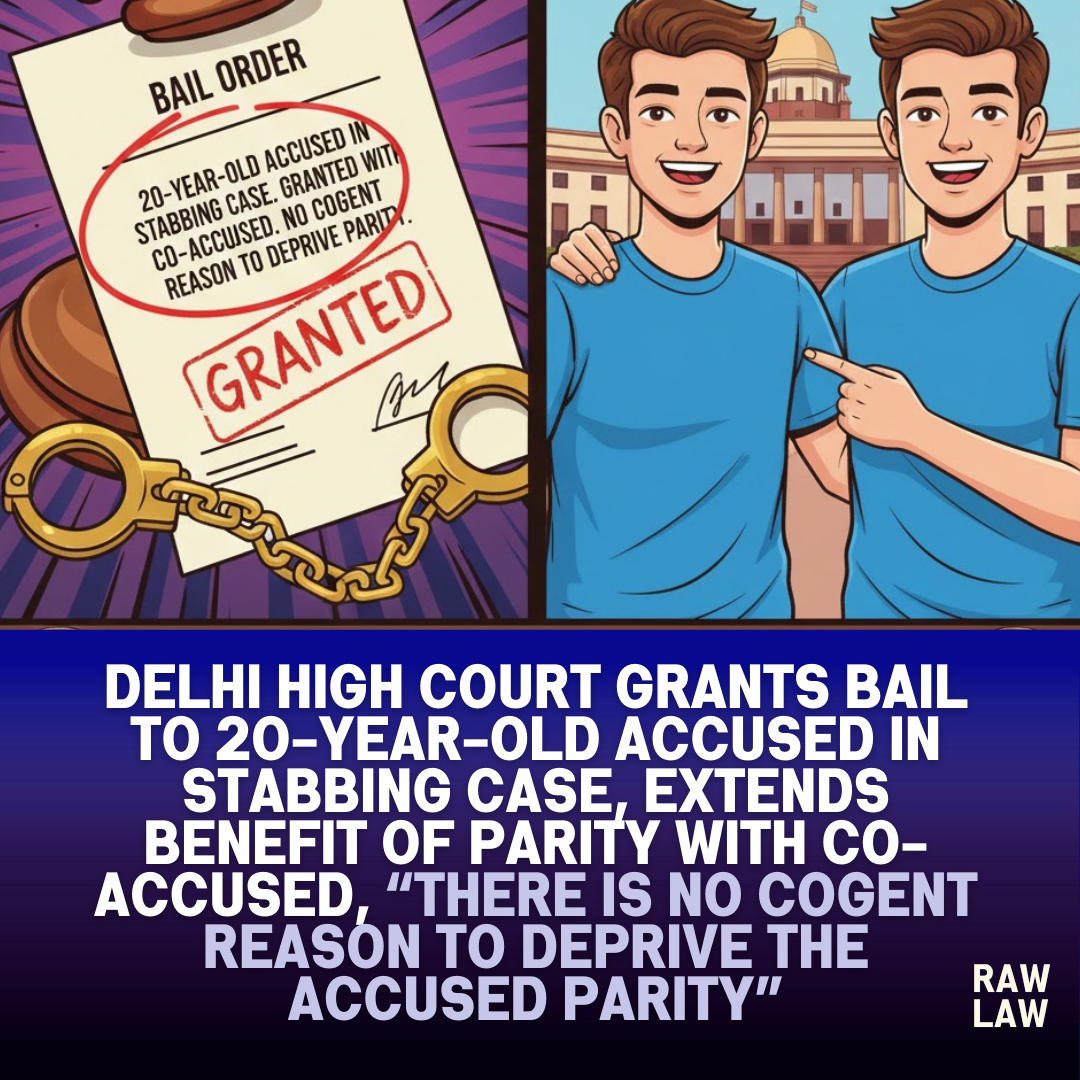
Delhi High Court grants bail to 20-year-old accused in stabbing case, extends benefit of parity with co-accused, “There is no cogent reason to deprive the accused parity”

HEADNOTE
Case Title: Himanshu Nayak v. State (NCT of Delhi)
Court: Delhi High Court
Bench: Hon’ble Mr. Justice Girish Kathpalia
Date of Judgment: 20 January 2026
Case Number: Bail Application No. 4919/2025
Laws/Sections Involved:
Section 109(1) read with Section 3(5), Bharatiya Nyaya Sanhita, 2023
Keywords: bail jurisprudence, parity principle, aiding offence, criminal conspiracy, youth accused, prolonged incarceration, Delhi High Court
Summary
The Delhi High Court granted regular bail to Himanshu Nayak, a 20-year-old accused alleged to have aided the main assailant in a stabbing incident, holding that he was entitled to parity with a co-accused already released on bail. Justice Girish Kathpalia observed that the role attributed to the applicant—of holding the victim while the main accused inflicted a dagger injury—was identical to that of the co-accused who had secured bail earlier. While noting the prosecution’s contention that the applicant had absconded for several months, the Court held that this factor alone could not justify denial of bail when no distinguishing circumstances existed. Emphasising that bail decisions must adhere to consistency and fairness, the Court ruled that continued incarceration would serve no useful purpose and ordered release on bail subject to conditions.
Court’s decision
In a brief but significant oral order, the Delhi High Court allowed the bail application filed by Himanshu Nayak, accused in a case involving an alleged dagger attack on the complainant. The Court held that since the role attributed to the applicant was identical to that of a co-accused who had already been granted bail, there was no cogent reason to deny him the same relief. Justice Girish Kathpalia emphasised the importance of parity in bail jurisprudence and directed the applicant’s release on bail, subject to furnishing a personal bond of ₹10,000 with one surety of the like amount.
Factual background
The bail application arose from FIR No. 561/2024 registered at Police Station Anand Parbat. According to the prosecution, the incident involved a coordinated assault in which the main accused, Deepak, allegedly inflicted a dagger injury on the back of the complainant. The present applicant, Himanshu Nayak, along with another co-accused, Himanshu @ Rawan, was accused of aiding the offence by catching hold of the victim, thereby facilitating the attack.
Fortunately, the victim survived the assault. The applicant was charged under Section 109(1) read with Section 3(5) of the Bharatiya Nyaya Sanhita, provisions dealing with abetment and common intention in the commission of offences.
Procedural posture
Himanshu Nayak was arrested on 10 September 2025 and had remained in judicial custody since then. He approached the Delhi High Court seeking regular bail, contending that prolonged incarceration was unwarranted, particularly when a co-accused with an identical role had already been released on bail by the court.
The bail plea was opposed by the State, primarily on the ground that the applicant had absconded after the incident and was arrested only after a considerable delay of about nine months.
Issues before the High Court
The central issue before the Court was whether the applicant was entitled to bail on the ground of parity with a co-accused who had already been granted bail, despite the prosecution’s contention that the applicant had absconded for a longer duration.
The Court was required to balance considerations of parity, individual conduct, and the object of pre-trial detention in criminal cases.
Applicant’s arguments
Counsel for the applicant submitted that Himanshu Nayak was a young man of only 20 years of age and had already spent several months in custody. It was argued that no useful purpose would be served by keeping him incarcerated any further, particularly when the investigation had progressed and the applicant was not alleged to have directly inflicted the injury.
A key plank of the applicant’s argument was the principle of parity. The defence highlighted that co-accused Himanshu @ Rawan, who was attributed the same role of holding the victim during the assault, had already been granted bail. Denial of bail to the present applicant, it was contended, would amount to unequal treatment and arbitrariness.
State’s opposition
Opposing the bail application, the State contended that the applicant was not entitled to parity as he had absconded after the incident and was arrested only after nine months, whereas the co-accused had been arrested on the same day as the incident.
The prosecution argued that this conduct reflected adversely on the applicant and justified continued custody. It was submitted that the seriousness of the offence and the applicant’s alleged attempt to evade the law warranted rejection of the bail plea.
Analysis of bail jurisprudence
Justice Girish Kathpalia examined the rival submissions through the settled principles governing grant of bail. While acknowledging the prosecution’s contention regarding abscondence, the Court focused on the determinative factor of parity.
The Court noted that it was an admitted position that the role attributed to the present applicant was the same as that attributed to co-accused Himanshu @ Rawan. In such circumstances, consistency in judicial approach demanded that similarly placed accused persons be treated alike, unless there were compelling distinguishing factors.
The Court implicitly reaffirmed the principle that bail is not to be withheld as a form of punishment, and that pre-trial detention must be justified by necessity rather than retribution.
Parity as a cornerstone of bail decisions
The judgment underscores parity as a cornerstone of bail jurisprudence. Courts have repeatedly held that when a co-accused with a similar role has been granted bail, denial of bail to another accused similarly situated would offend principles of equality and fairness, unless specific aggravating circumstances exist.
In the present case, the Court found no “cogent reason” to deprive the applicant of parity. The mere fact of delayed arrest, in the absence of other distinguishing circumstances, was not considered sufficient to override the principle of parity.
Order granting bail
Accordingly, the High Court allowed the bail application and directed that Himanshu Nayak be released on bail upon furnishing a personal bond of ₹10,000 with one surety of the like amount to the satisfaction of the Trial Court. The Court also disposed of the accompanying applications and directed that a copy of the order be transmitted to the concerned Jail Superintendent for immediate compliance.
Conclusion
The Delhi High Court’s order reaffirms the principle that bail decisions must be guided by consistency, fairness, and proportionality. By extending the benefit of parity to the applicant, the Court underscored that similarly placed accused persons cannot be treated differently without compelling justification.
Implications
This ruling serves as a reminder that parity remains a powerful ground for seeking bail, particularly in cases involving allegations of aiding or common intention rather than direct commission of the offence. The decision will likely be cited in future bail applications where accused persons seek equal treatment with co-accused already enlarged on bail, reinforcing the constitutional mandate of equality before law.
Also Read: Delhi High Court refuses to quash FIR alleging outraging of woman’s modesty under BNS