Delhi High Court: “Illegal Custody Without Production Before Magistrate” — Grants Bail in 986 gm Cocaine Ingestion Case; Holds Article 21 Prevails Over Section 37 NDPS Embargo Even in Commercial Quantity Matter

Court’s decision
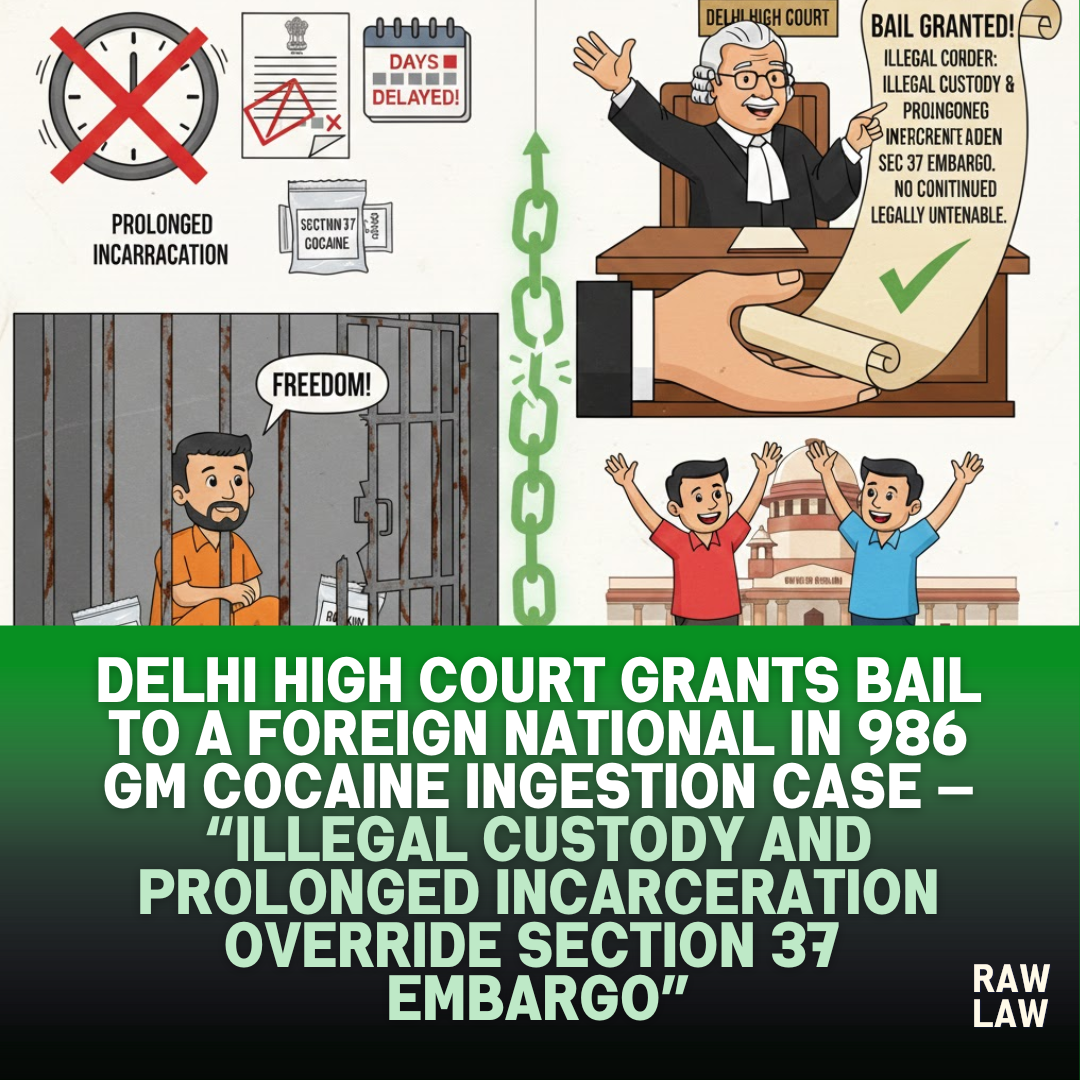
The Delhi High Court granted bail to a Congolese national accused under Sections 8/21/23/28 of the NDPS Act in a case involving ingestion of 73 capsules allegedly containing 986 grams of cocaine. The Court held that the applicant was kept in illegal custody after interception at IGI Airport without being produced before a Magistrate, despite partial recovery having already taken place. It further held that prolonged incarceration of nearly four years and slow trial progress warranted bail, even in a commercial quantity case, as Article 21 must prevail over the statutory bar under Section 37 of the NDPS Act.
Facts
The applicant, a foreign national holding a Congolese passport, arrived at IGI Airport on 20 February 2022 from Addis Ababa. After walking through the Green Channel, he was intercepted by Customs officials. Initial screening yielded nothing suspicious.
Upon further inquiry, officials suspected internal concealment. The applicant was taken to a toilet at the airport, where he extracted 19 capsules allegedly containing narcotic substance. Subsequently, he was taken to RML Hospital, where he passed 54 additional capsules. In total, 73 capsules containing 986 grams of powdery substance, suspected to be cocaine, were recovered.
The applicant was formally arrested on 25 February 2022. A complaint was filed on 24 August 2022, and trial commenced. By the time of the present bail application, only 8 out of 29 witnesses had been examined.
Issues
The Court considered three principal issues:
- Whether the applicant was kept in illegal custody in violation of mandatory safeguards under Section 103 of the Customs Act and provisions of the NDPS Act.
- Whether non-compliance with constitutional safeguards under Articles 21 and 22 justified grant of bail despite the rigours of Section 37 of the NDPS Act.
- Whether prolonged incarceration and delay in trial constituted grounds for bail in a commercial quantity NDPS case.
Petitioner’s arguments
The applicant contended that once he was intercepted and 19 capsules were recovered at the airport itself, he ought to have been immediately arrested and produced before a Magistrate.
It was argued that under Section 103 of the Customs Act, a person suspected of concealing goods inside the body must be produced before the nearest Magistrate unless he voluntarily admits and submits to medical extraction. The defence asserted that there was no clear or recorded voluntary admission.
Relying on Habiob Bedru Omer v. Customs and Directorate of Enforcement v. Subhash Sharma, the applicant argued that detention without judicial authorization violated Articles 21 and 22 of the Constitution, and such illegality vitiated custody.
It was further contended that the applicant had been incarcerated since 25 February 2022 and trial was progressing at a snail’s pace.
Respondent’s arguments
The Customs Department submitted that all statutory procedures were complied with. Notices under Section 50 of the NDPS Act and Sections 102 and 103 of the Customs Act were allegedly served.
It was contended that the applicant voluntarily agreed to medical procedures and that independent panch witnesses were associated at every stage.
The respondent emphasized that the recovered quantity constituted commercial quantity and that the applicant, being a foreign national with no permanent roots in India, posed a flight risk.
Analysis of the law
The Court examined Section 103 of the Customs Act, which mandates production before a Magistrate when goods liable to confiscation are suspected to be secreted inside the body, unless there is voluntary admission and submission.
The Court found no clear recorded admission or explicit voluntary consent from the applicant. The one-line statement that contents were explained in French did not reflect any specific willingness.
The Court further observed that once 19 capsules were recovered at the airport itself, the offence stood revealed. At that stage, the applicant should have been arrested and produced before the Magistrate, even if further medical extraction was necessary.
The Court relied upon its earlier decision in Habiob Bedru Omer v. Customs, where similar custody without judicial authorization was held illegal.
On constitutional grounds, the Court invoked Subhash Sharma and reiterated that when fundamental rights under Articles 21 and 22 are violated, courts must grant bail notwithstanding Section 37 restrictions.
Precedent analysis
The Court referred to Habiob Bedru Omer v. Customs (2025), where continued custody without producing the accused before a Magistrate was declared illegal.
It also cited Directorate of Enforcement v. Subhash Sharma (2025 INSC 141), which held that bail must follow where arrest or post-arrest procedure violates constitutional safeguards.
Further reliance was placed on Supreme Court decisions such as Rabi Prakash v. State of Odisha, Mohd. Muslim v. State (NCT of Delhi), and other precedents holding that prolonged incarceration and delay in trial can justify bail in NDPS cases.
The Court reiterated that Article 21 may override statutory embargo under Section 37 when liberty is unjustly curtailed.
Court’s reasoning
The Court held that after recovery of 19 capsules at the airport, the offence was evident. Yet, the applicant was not produced before a Magistrate and remained in custody until 25 February 2022 without judicial authorization.
This amounted to illegal custody. Formal arrest at a later stage did not cure the illegality.
The applicant had been in custody for nearly four years. Despite earlier directions to expedite trial, only four additional witnesses were examined in 13 months.
The Court observed that prolonged incarceration, coupled with procedural infirmities, warranted bail.
Considering the applicant’s passport and visa had expired during custody, the Court imposed strict conditions, including weekly reporting, restriction on movement within NCR, and verification of local surety.
Conclusion
The Delhi High Court granted bail to the applicant, holding that illegal custody and prolonged incarceration justified relief despite the commercial quantity involved.
The Court clarified that its observations were limited to bail and would not affect trial on merits.
Implications
This judgment significantly reinforces judicial scrutiny of procedural safeguards in NDPS ingestion cases at airports.
It underscores that production before a Magistrate is mandatory when contraband is suspected to be concealed internally, unless clear voluntary admission is recorded.
The ruling also strengthens the jurisprudence that constitutional rights under Articles 21 and 22 can override Section 37 embargo in cases of illegal custody and excessive pre-trial detention.
For enforcement agencies, the decision signals strict compliance with arrest and remand procedures.
Case law references
- Habiob Bedru Omer v. Customs (2025 SCC OnLine Del 4263) — Custody without production before Magistrate held illegal.
- Directorate of Enforcement v. Subhash Sharma (2025 INSC 141) — Bail must follow when arrest violates Articles 21 and 22.
- Rabi Prakash v. State of Odisha (2023 SCC OnLine SC 1009) — Prolonged incarceration justifies bail in NDPS cases.
- Mohd. Muslim v. State (NCT of Delhi) (2023 SCC OnLine SC 352) — Article 21 may override Section 37 embargo.
FAQs
1. Can bail be granted in commercial quantity NDPS cases?
Yes, though Section 37 imposes strict conditions, bail can be granted where constitutional safeguards are violated or incarceration becomes excessively prolonged.
2. Is production before a Magistrate mandatory in body concealment cases?
Yes. Under Section 103 of the Customs Act, production before a Magistrate is required unless there is clear voluntary admission and submission.
3. Does illegal custody affect NDPS prosecution?
Illegal detention without judicial authorization can violate Articles 21 and 22, and courts may grant bail despite statutory restrictions.